
Managed Aquifer Recharge in Practice: California Examples
Shows how four California managed aquifer recharge examples address different water-management problems.
Managed aquifer recharge (MAR) is used in different ways depending on local geology, water needs, governance, infrastructure, and available water sources. The same general idea—moving water into a suitable aquifer—can support different policy goals in different places.
These California examples show that MAR is a flexible tool, not a one-size-fits-all solution. Some projects focus on land subsidence, some on saltwater intrusion, some on stormwater capture and recycled water, and some on agricultural water reliability.
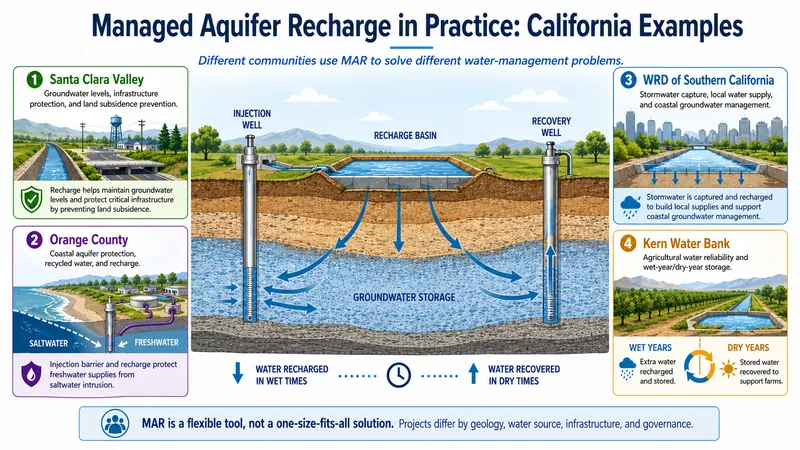
Comparison table
| Location/project | Main problem addressed | Recharge approach | Main water sources | Policy lesson |
|---|---|---|---|---|
| Santa Clara Valley Water District | Groundwater depletion and land subsidence | Recharge to restore and maintain groundwater levels | Local water and imported state and federal water | Recharge can protect infrastructure when paired with sustained groundwater management. |
| Orange County Water District | Saltwater intrusion, water supply reliability, and water quality | Coastal injection wells and inland spreading grounds | Santa Ana River water and highly treated wastewater | Coastal groundwater protection requires recharge, pumping management, water treatment, and monitoring. |
| Water Replenishment District of Southern California | Stormwater management, local water supply, and saltwater-intrusion protection | Spreading grounds and coastal injection wells | Recycled water, stormwater, local water, and historically imported water | MAR can connect stormwater management, recycled water, and groundwater sustainability. |
| Kern Water Bank | Agricultural water reliability and wet-year/dry-year storage | Spreading grounds over thick sandy aquifers | Kern River water and imported state and federal water | Aquifer storage can support agricultural reliability, but governance, water rights, and accounting are central. |
Santa Clara Valley Water District
Santa Clara Valley, now widely known as Silicon Valley, experienced land sinking in the early 1900s after excessive groundwater removal caused aquifer sediments to compact. This kind of land subsidence can damage infrastructure and reduce long-term aquifer storage.
The Santa Clara Valley Water District was founded in the 1920s to recharge groundwater and prevent further subsidence. Later, imported state and federal water helped restore groundwater levels, and subsidence largely stopped.
Policy lesson: Recharge can protect infrastructure when it is paired with sustained groundwater management, long-term monitoring, and reliable water supplies.
Orange County Water District
Orange County provides an example of coastal aquifer protection, water recycling, and recharge. Saltwater intrusion threatened groundwater in the 1930s, creating a need to protect freshwater aquifers from salty ocean water moving inland.
The district uses injection wells near the coast to help maintain a freshwater barrier and inland spreading grounds to recharge aquifers. It has used Santa Ana River water and highly treated wastewater cleaned to drinking-quality standards.
Policy lesson: Coastal groundwater protection requires more than adding water underground. It depends on recharge, pumping management, water treatment, groundwater monitoring, and careful operations.
Water Replenishment District of Southern California
The Water Replenishment District of Southern California manages groundwater basins that serve millions of residents. Its work connects stormwater management, recycled water, local water supply, and coastal aquifer protection.
The district uses spreading grounds and coastal injection wells to recharge aquifers and help prevent saltwater intrusion. It has invested in water recycling and expanded stormwater capture to reduce reliance on imported water.
Policy lesson: MAR can link multiple policy goals at once: capturing stormwater, using recycled water, improving local supply reliability, and protecting coastal groundwater.
Kern Water Bank
The Kern Water Bank is an example of agricultural water reliability and wet-year/dry-year storage. The southern San Joaquin Valley has high agricultural water needs, but river water supplies can vary greatly from year to year.
The area is geologically suited for underground storage because it is underlain by thick, sandy aquifers. Water can be stored in wet years using spreading grounds and recovered later when needed.
Policy lesson: Aquifer storage can support agricultural reliability, but water rights, ownership, accounting, governance, and recovery rules are central to how the system works.
Cross-cutting lessons for policy staff
- MAR projects should begin with the problem they are trying to solve: drought supply, subsidence, saltwater intrusion, stormwater management, water quality, or a combination of goals.
- Suitable geology is essential, but geology alone is not enough. Projects also need water sources, infrastructure, governance, monitoring, and long-term management.
- Source water matters. River water, stormwater, recycled water, and imported water each have different reliability, quality, legal, and public-communication considerations.
- Recharge method matters. Spreading grounds, recharge basins, stream-channel recharge, and injection wells each fit different aquifers and land-use settings.
- Coastal projects often require coordinated recharge and pumping management to reduce saltwater-intrusion risk.
- Subsidence prevention depends on maintaining groundwater levels before damaging compaction becomes severe.
- Water accounting, monitoring, and public reporting are central to trust and long-term project performance.
Questions for evaluating a MAR proposal
- What problem is the project designed to solve?
- Is the goal water supply, drought resilience, subsidence prevention, saltwater-intrusion protection, stormwater management, water-quality improvement, or another purpose?
- What aquifer will receive the recharge water?
- Is the aquifer suitable for storing and later recovering water?
- What source water will be used?
- How reliable is that source water during wet years, dry years, and drought?
- Are there competing uses or downstream impacts associated with the source water?
- What recharge method will be used: spreading basin, stream-channel recharge, injection well, or a combination?
- What treatment or pretreatment will be required?
- How will water quality be monitored?
- How will groundwater levels be monitored?
- How will the project account for water stored underground and water recovered later?
- Who owns or controls the stored water?
- What rules govern pumping, recovery, and long-term operation?
- What infrastructure will be needed?
- What are the expected maintenance costs and responsibilities?
- How will the project evaluate success?
- How will information be shared with the public and decision-makers?
Concluding idea
The core policy question is not simply “Can we recharge the aquifer?” but “What problem are we trying to solve, what water will be used, where will it go, who will manage it, and how will success be measured?”
Source document
This companion page is based on AGI’s Critical Issues case study:
Managed Aquifer Recharge in California
AGI Critical Issues Program case study describing four managed aquifer recharge examples in California.