
Why Governance Matters as Much as Geology
Discusses why managed aquifer recharge success depends on suitable geology as well as regulation, management, funding, monitoring, water rights, and public trust.
Managed aquifer recharge needs suitable geology, but geology alone is not enough. A project also needs rules, funding, water rights, monitoring, operations, accountability, and public trust.
This matters for water policy because a recharge site may look promising because the aquifer can accept and store water. But the project will only work over time if people and institutions can manage where the water comes from, who can store it, who can recover it, how water quality is protected, and how results are reported.
Download or reuse this guide in briefings and meeting materials.
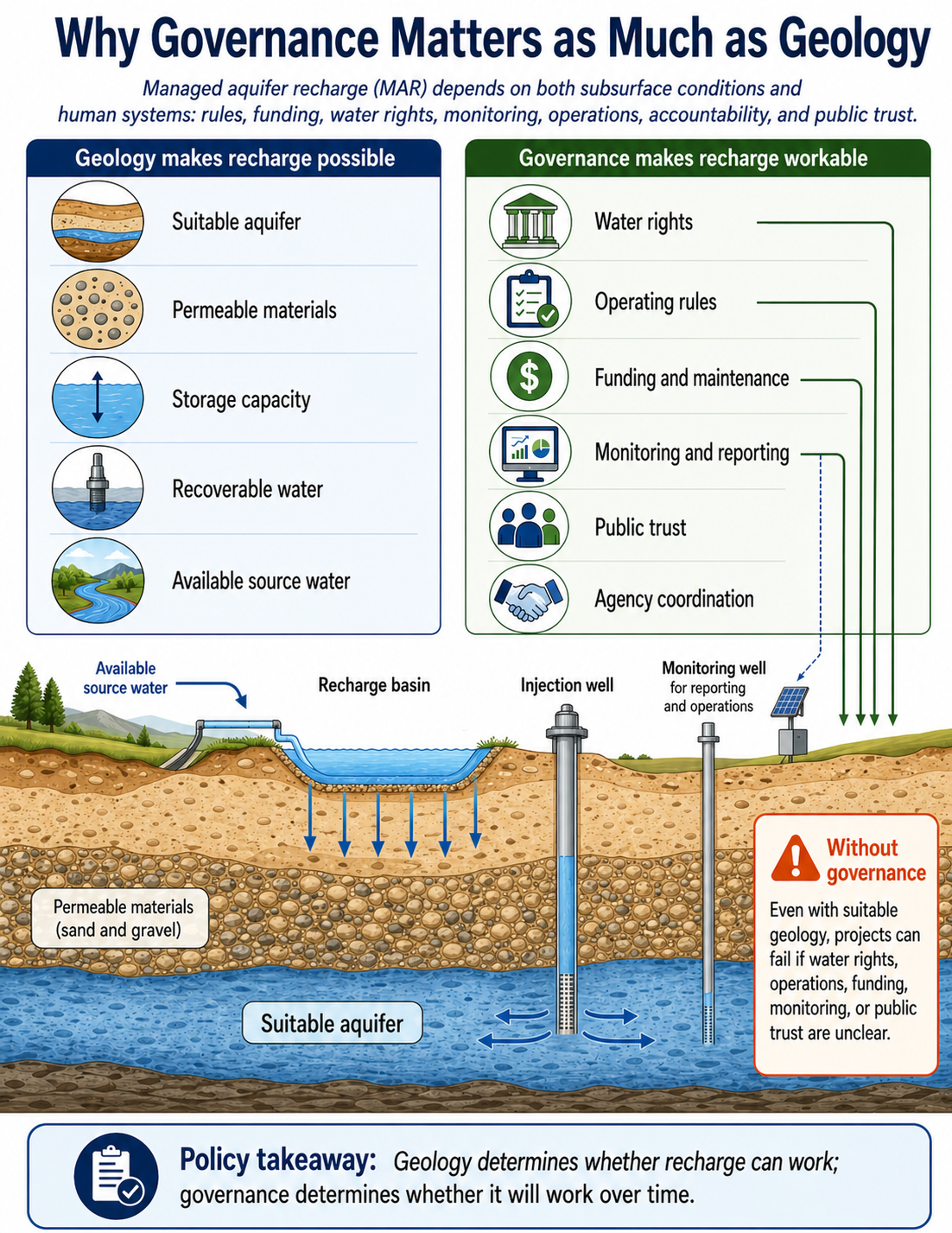
What the visual shows
The visual divides MAR into two connected parts.
The first part is geology makes recharge possible. It includes a suitable aquifer, permeable materials, storage capacity, recoverable water, and available source water. These are the physical conditions that determine whether recharge can happen.
The second part is governance makes recharge workable. It includes water rights, operating rules, funding and maintenance, monitoring and reporting, public trust, and agency coordination. These are the human systems that determine whether recharge can be operated, tracked, maintained, and trusted over time.
The cross-section below shows source water entering a recharge basin, water moving through permeable sand and gravel, an injection well, a monitoring well, and a suitable aquifer. Arrows connect governance decisions to recharge operations and monitoring.
The warning callout emphasizes that even with suitable geology, projects can fail if water rights, operations, funding, monitoring, or public trust are unclear.
What geology can and cannot decide
Geology determines whether recharge is physically possible.
A suitable aquifer must be able to accept water, store it, and allow it to remain recoverable or useful for the project’s goals. Permeable sand, gravel, fractured rock, storage capacity, aquifer depth, confining layers, groundwater-flow direction, and water quality all affect whether MAR can work at a site.
Geology can help answer questions such as:
- Can water enter the ground at this location?
- Can the aquifer store the water?
- Will the water remain recoverable?
- Could recharge affect nearby wells, streams, wetlands, or groundwater users?
- What monitoring is needed to understand groundwater movement?
But geology cannot decide who has the right to use the water, who pays for infrastructure, who maintains the project, who can recover stored water, or how conflicts will be resolved. Those are governance questions.
What governance must decide
Governance determines how a recharge project is authorized, operated, funded, monitored, and explained to the public.
A MAR project needs an available water source and legal authority to use that water. Water rights and ownership rules determine who can store water underground and who can recover it later. Water accounting determines how deposits, storage, losses, and withdrawals are tracked.
Operating rules define when recharge can occur, when pumping can occur, what groundwater levels should be maintained, and what actions are required if monitoring shows a problem.
Funding and maintenance are also governance issues. Recharge basins, injection wells, monitoring wells, pipelines, pumps, treatment systems, sediment removal, data systems, and staff all require long-term support.
Public communication is especially important when projects use treated wastewater, affect nearby land uses, or involve tradeoffs among water users. Monitoring and reporting help demonstrate whether the project is operating as promised.
Why long-term management matters
MAR projects are not one-time construction projects. They are long-term water-management systems.
Recharge conditions can change from year to year. Wet years may provide water for storage. Dry years may increase pressure to recover stored water. Stormwater quality can vary by event. Groundwater levels can rise or fall. Wells, basins, and monitoring systems require maintenance.
Long-term management is also needed because MAR projects can create conflicts or tradeoffs. One user’s stored water may affect another user’s well. Recharge may benefit regional groundwater levels but require land that could be used for other purposes. Pumping stored water may need limits to avoid overdraft, subsidence, saltwater intrusion, or water-quality problems.
Governance affects how projects handle drought, wet years, water quality, recovery, and conflicts among users. Clear rules and transparent reporting help maintain accountability and public trust.
Lessons from California examples
California examples show that MAR success depends not only on suitable aquifers, but also on regulation, institutions, and management.
Santa Clara Valley shows how recharge can help address groundwater depletion and land subsidence when paired with sustained groundwater management and imported water. The policy lesson is that recharge can protect infrastructure, but only if groundwater levels are monitored and managed over time.
Orange County shows how coastal aquifer protection can combine injection barriers, inland spreading grounds, highly treated recycled water, river water, pumping management, and water-quality monitoring. The policy lesson is that saltwater-intrusion protection requires both physical recharge and careful operations.
The Water Replenishment District of Southern California shows how MAR can connect recycled water, stormwater capture, coastal injection wells, spreading grounds, and regional groundwater management. The policy lesson is that recharge can serve multiple goals when agencies coordinate across water supply, stormwater, and groundwater systems.
Kern Water Bank shows how aquifer storage can support agricultural water reliability, but also how central governance, water rights, accounting, ownership, and recovery rules are to water banking. The policy lesson is that underground storage is also an institutional arrangement.
Together, these examples show that MAR is both a geologic and governance challenge. A suitable aquifer creates the opportunity; effective institutions determine whether that opportunity can be used responsibly.
Questions policy staff can ask
- What problem is the MAR project intended to solve?
- Is the aquifer physically suitable for recharge, storage, and recovery?
- What water source will be used?
- Who has the legal authority to use that source water?
- Who owns or controls the water once it is stored underground?
- How will stored water be accounted for?
- Who can recover water, how much, and when?
- What operating rules will guide recharge and pumping?
- What groundwater-level thresholds or water-quality thresholds will trigger action?
- How will the project be funded over the long term?
- Who is responsible for maintenance?
- What monitoring wells and data systems are needed?
- How will monitoring results be reported?
- How will the project communicate with the public?
- Which agencies, districts, landowners, water users, and communities need to coordinate?
- How will conflicts among users be handled?
- What happens if the project does not perform as expected?
Policy takeaway
A good recharge site needs both the right geology and the right institutions.
Main concept: Managed aquifer recharge, or MAR, depends on both subsurface conditions and human systems.
Core message: The visual explains that geology determines whether recharge can work, while governance determines whether it will work over time.
Geology makes recharge possible: The guide identifies the physical conditions needed for recharge.
Suitable aquifer: A suitable aquifer is needed to receive and store recharge water.
Permeable materials: Permeable materials, such as sand and gravel, allow water to move through the subsurface.
Storage capacity: The aquifer needs enough space to store water.
Recoverable water: Stored water must be able to be recovered or used for the project’s intended goals.
Available source water: A recharge project also needs water available for recharge.
Governance makes recharge workable: The guide identifies the human systems needed to operate MAR over time.
Water rights: Water rights help determine who can use, store, and recover water.
Operating rules: Operating rules define how recharge, storage, pumping, and recovery are managed.
Funding and maintenance: Projects need long-term funding and maintenance for infrastructure, monitoring, and operations.
Monitoring and reporting: Monitoring and reporting support accountability and help track project performance.
Public trust: Public trust is important for long-term support, especially where water quality, recycled water, or shared resources are involved.
Agency coordination: Agencies must coordinate across water supply, groundwater, land use, infrastructure, and regulatory responsibilities.
Main diagram: The visual shows available source water entering a recharge system through a recharge basin and an injection well.
Monitoring well: A monitoring well is included for reporting and operations.
Aquifer materials: Permeable sand and gravel are shown above or within a suitable aquifer.
Warning callout: Even with suitable geology, projects can fail if water rights, operations, funding, monitoring, or public trust are unclear.
Policy takeaway: Geology determines whether recharge can work; governance determines whether it will work over time.