
What an Aquifer Actually Is
Explains what aquifers are, how they store groundwater, and why geology determines whether underground water storage is possible.
An aquifer is not an underground lake. It is a layer of rock, sand, gravel, or sediment that has enough connected pores, cracks, or spaces to store and transmit groundwater.
This matters for water policy because not every underground layer can store usable water. Whether an aquifer can support wells, recharge, or underground storage depends on its geology.
Download or reuse this guide in briefings and meeting materials.
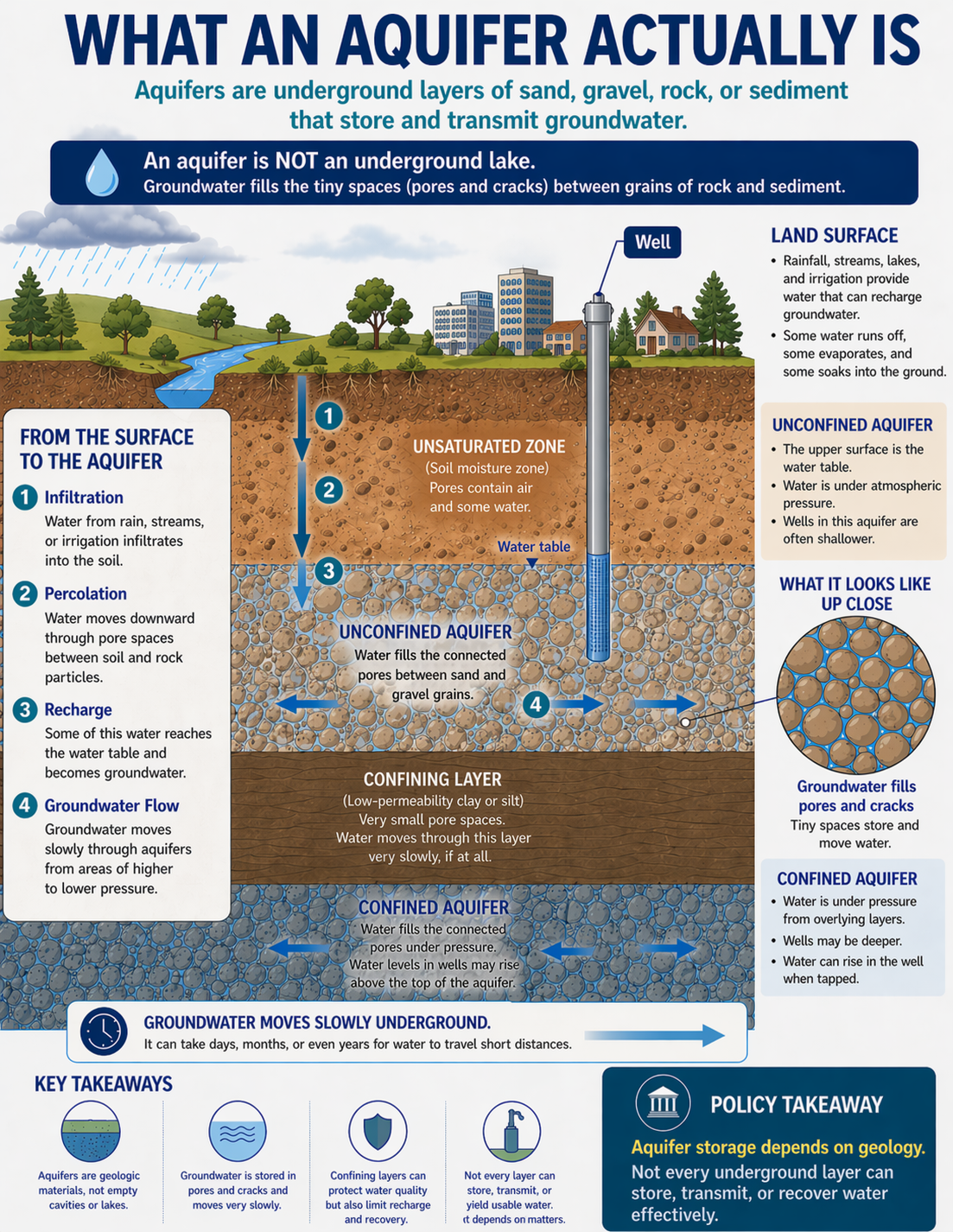
What the visual shows
The visual shows a simplified cross-section from the land surface down into the subsurface.
Rainfall and surface water can soak into the ground. Near the surface, some pore spaces contain air and some contain water. This is called the unsaturated zone.
Below that is the water table, where the connected pore spaces are filled with groundwater. The aquifer just below the water table is an unconfined aquifer. It is open to recharge from the surface where soils and geologic materials allow water to move downward.
The visual also shows a confining layer, such as clay or silt. This layer has very small pore spaces and slows the movement of water. Beneath it is a confined aquifer, where groundwater is held under pressure below the confining layer.
A magnified inset shows that groundwater is stored in small spaces between sediment grains, not in a large underground cave or open lake.
Why this matters for policy
Aquifers are part of the natural water-storage system, but their usefulness depends on local geology. Some aquifers can store and transmit large amounts of water. Others may hold water but release it slowly, or may not be suitable for water supply or managed recharge.
For managed aquifer recharge, the question is not simply whether water can be put underground. Policy staff also need to know whether the aquifer can accept the water, store it safely, keep it recoverable, and avoid unintended consequences.
Aquifer type also affects project design. A shallow unconfined aquifer may be suitable for surface recharge, such as a recharge basin. A deeper confined aquifer may require injection wells and more intensive water-quality controls.
Understanding the basic structure of aquifers helps connect land-use planning, water supply, drought resilience, groundwater protection, and infrastructure decisions.
Key terms
Aquifer
An underground layer of rock, sand, gravel, or sediment that can store and transmit groundwater.
Groundwater
Water stored below the land surface in connected pores, cracks, and spaces in geologic materials.
Pores and cracks
Small openings between grains of sediment or within rock where groundwater can be stored and move.
Unsaturated zone
The area above the water table where pore spaces contain both air and water.
Water table
The upper surface of groundwater in an unconfined aquifer.
Unconfined aquifer
A shallow aquifer where the upper surface is the water table. It can receive recharge from the surface where conditions allow infiltration.
Confining layer
A low-permeability layer, such as clay or silt, that slows the movement of water.
Confined aquifer
An aquifer located beneath a confining layer. Groundwater in a confined aquifer may be under pressure.
Managed aquifer recharge
A water-management approach that intentionally moves water into a suitable aquifer so it can be stored underground and potentially recovered later.
Questions policy staff can ask
- What type of aquifer is present: unconfined, confined, or both?
- Can the aquifer store water and transmit it to wells?
- Can stored water be recovered when needed?
- What geologic layers might limit recharge or movement of groundwater?
- Is the aquifer vulnerable to contamination from the surface?
- Would surface recharge, injection wells, or another method be more appropriate?
- How will groundwater levels, water quality, and recovery be monitored?
- What are the limits of the aquifer as a water-storage system?
Policy takeaway
Aquifer storage is a geologic opportunity, not just an engineering choice.
Main definition: An aquifer is an underground layer of sand, gravel, rock, or sediment that can store and transmit groundwater.
Core concept: The visual explains that an aquifer is not an underground lake. Groundwater fills tiny pores and cracks between grains of rock, sediment, sand, and gravel.
Land surface: The guide shows rainfall, streams, lakes, and irrigation as sources of water that can recharge groundwater. It also notes that some water runs off, some evaporates, and some soaks into the ground.
From the surface to the aquifer: The guide shows four steps in how water moves from the land surface into an aquifer.
First, infiltration: Water from rain, streams, or irrigation soaks into the soil.
Second, percolation: Water moves downward through pore spaces between soil and rock particles.
Third, recharge: Some of the water reaches the water table and becomes groundwater.
Fourth, groundwater flow: Groundwater moves slowly through aquifers from areas of higher pressure to areas of lower pressure.
Subsurface layers: The visual shows several underground layers.
The unsaturated zone: This is the soil moisture zone near the surface. Its pores contain air and some water.
The water table: The water table is the upper surface of the unconfined aquifer.
The unconfined aquifer: Water fills connected pores between sand and gravel grains. The upper surface is the water table, the water is under atmospheric pressure, and wells in this aquifer are often shallower.
The confining layer: This is a low-permeability layer, such as clay or silt. It has very small pore spaces, so water moves through it very slowly, if at all.
The confined aquifer: Water fills connected pores under pressure beneath the confining layer. Wells may be deeper, and water can rise in the well when the aquifer is tapped.
Close-up view: A magnified view shows that groundwater is stored in tiny spaces between grains. These pores and cracks both store and move water.
Groundwater movement: The guide emphasizes that groundwater moves slowly underground. It can take days, months, or even years for water to travel short distances.
Key takeaways: Aquifers are geologic materials, not empty cavities or lakes. Groundwater is stored in pores and cracks and moves very slowly. Confining layers can protect water quality but can also limit recharge and recovery. Not every underground layer can store, transmit, or yield usable water.
Policy takeaway: Aquifer storage depends on geology. Not every underground layer can store, transmit, or recover water effectively.