
What a 100-Year Flood Actually Means
Explains the concept of a 100-year flood and how it refers to annual probability, not a once-per-century schedule.
A 100-year flood is not a flood that happens once every hundred years. It is a flood with a 1 percent chance of occurring in any given year.
This matters because the phrase is often misunderstood in planning, infrastructure, and public communication. A clearer understanding helps policy staff interpret flood information more accurately and explain risk more effectively.
Download or reuse this guide in briefings and meeting materials.
What the visual shows
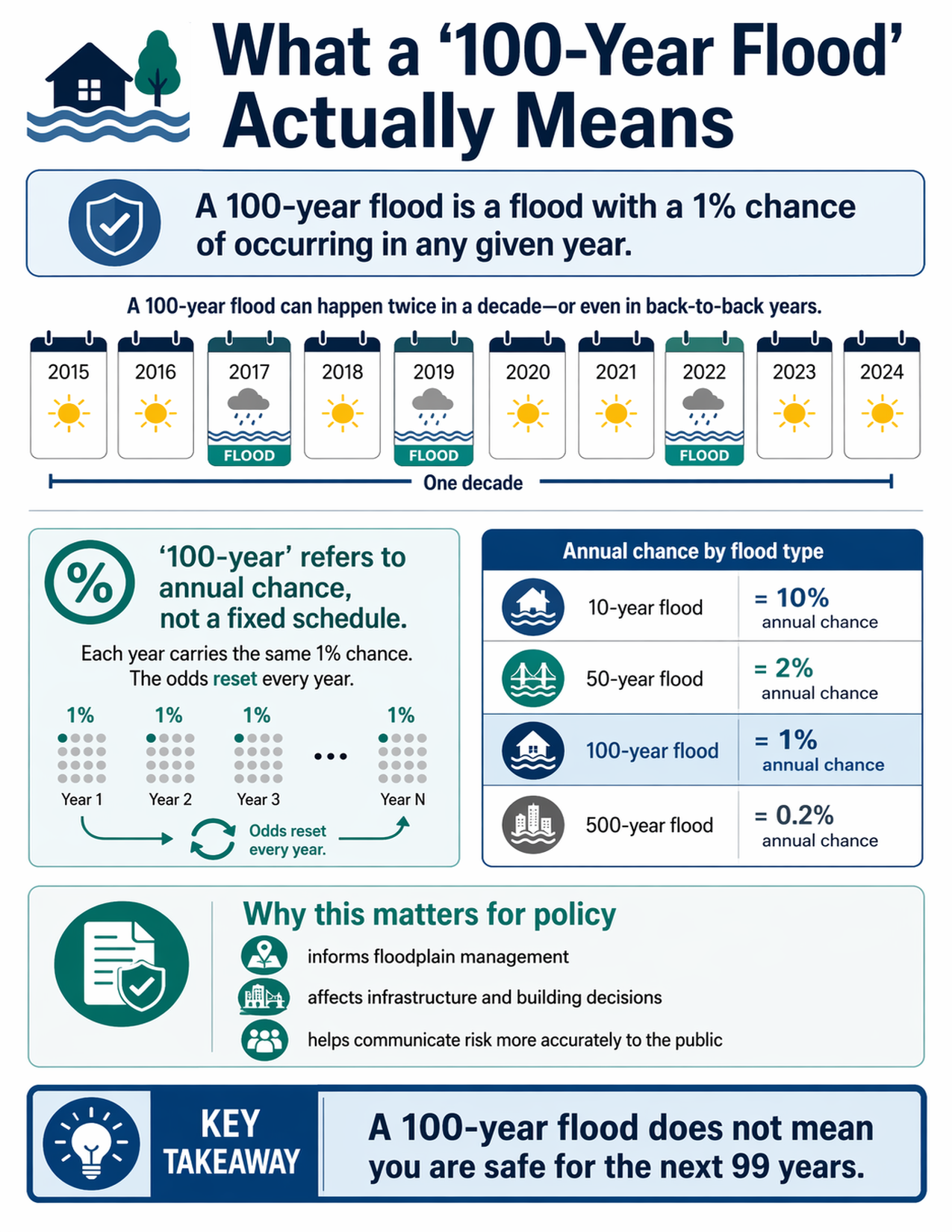
The visual defines a 100-year flood as a flood with a 1 percent annual chance of occurring.
It also shows a decade-long timeline from 2015 through 2024, with flood years marked in 2017, 2019, and 2022. The point is that a 100-year flood can happen more than once in a short period. It is not tied to a fixed schedule.
Another section explains that the term “100-year” refers to annual chance, not waiting time. Each year carries the same 1 percent chance, and the odds reset every year.
The guide also compares common flood terms:
- 10-year flood = 10 percent annual chance
- 50-year flood = 2 percent annual chance
- 100-year flood = 1 percent annual chance
- 500-year flood = 0.2 percent annual chance
Why this matters for policy
Flood terminology affects how people interpret maps, warnings, and planning decisions. If policy staff or the public assume a 100-year flood cannot happen again soon after one occurs, they may underestimate ongoing risk.
This concept matters for floodplain management, infrastructure planning, building decisions, emergency communication, and long-term resilience discussions. It also affects how agencies explain risk to communities, especially when flood maps or development standards use recurrence-based language.
Using the term correctly helps avoid a false sense of safety and supports clearer communication about what flood probability actually means.
Key terms
100-year flood
A flood with a 1 percent chance of occurring in any given year.
Annual chance
The probability that an event of a given size will occur in a single year.
Flood recurrence term
A shorthand way of describing flood probability, such as 10-year, 50-year, 100-year, or 500-year flood.
Floodplain
Land that can be inundated when rivers, streams, or other water systems overflow.
Risk communication
The process of explaining hazards, probabilities, and consequences in ways people can understand and use.
Questions policy staff can ask
- What does this flood term mean in annual probability, not just as a label?
- How is flood risk being explained to the public?
- Could people misunderstand this term as a fixed schedule?
- How is this terminology used in floodplain maps, zoning, or building standards?
- What assumptions are decision-makers making about future flood timing?
- Are infrastructure and land-use decisions based on probability or on a mistaken sense of spacing between events?
- Does public communication explain that the odds reset every year?
Policy takeaway
A 100-year flood does not mean you are safe for the next 99 years.
Main definition: A 100-year flood is a flood with a 1 percent chance of occurring in any given year.
The visual explains that a 100-year flood can happen twice in a decade, or even in back-to-back years.
Example timeline: The guide shows a sequence of years from 2015 through 2024. Flood years are marked in 2017, 2019, and 2022. The sequence is labeled as one decade.
Annual chance explanation: The guide states that “100-year” refers to annual chance, not a fixed schedule. Each year carries the same 1 percent chance. The odds reset every year.
The visual illustrates this with repeated yearly examples: Year 1 — 1 percent Year 2 — 1 percent Year 3 — 1 percent Year N — 1 percent
Flood type comparison: 10-year flood = 10 percent annual chance 50-year flood = 2 percent annual chance 100-year flood = 1 percent annual chance 500-year flood = 0.2 percent annual chance
Policy relevance: The visual notes that this concept informs floodplain management, affects infrastructure and building decisions, and helps communicate risk more accurately to the public.
Key takeaway: A 100-year flood does not mean you are safe for the next 99 years.