
What Bankfull Flow Is and Why Rivers Spill Over
Describes what bankfull flow and overbank flooding are, and why rivers naturally spill onto floodplains.
Bankfull flow is the point at which water fills a river channel up to the top of its banks. When flow rises above that level, water moves out onto the floodplain. This is called overbank flooding.
This matters because rivers are not meant to stay fixed inside their channels at all times. Understanding the difference between low flow, bankfull flow, and overbank flooding helps policy staff interpret river behavior more accurately and make better land-use and infrastructure decisions.
Download or reuse this guide in briefings and meeting materials.
What the visual shows
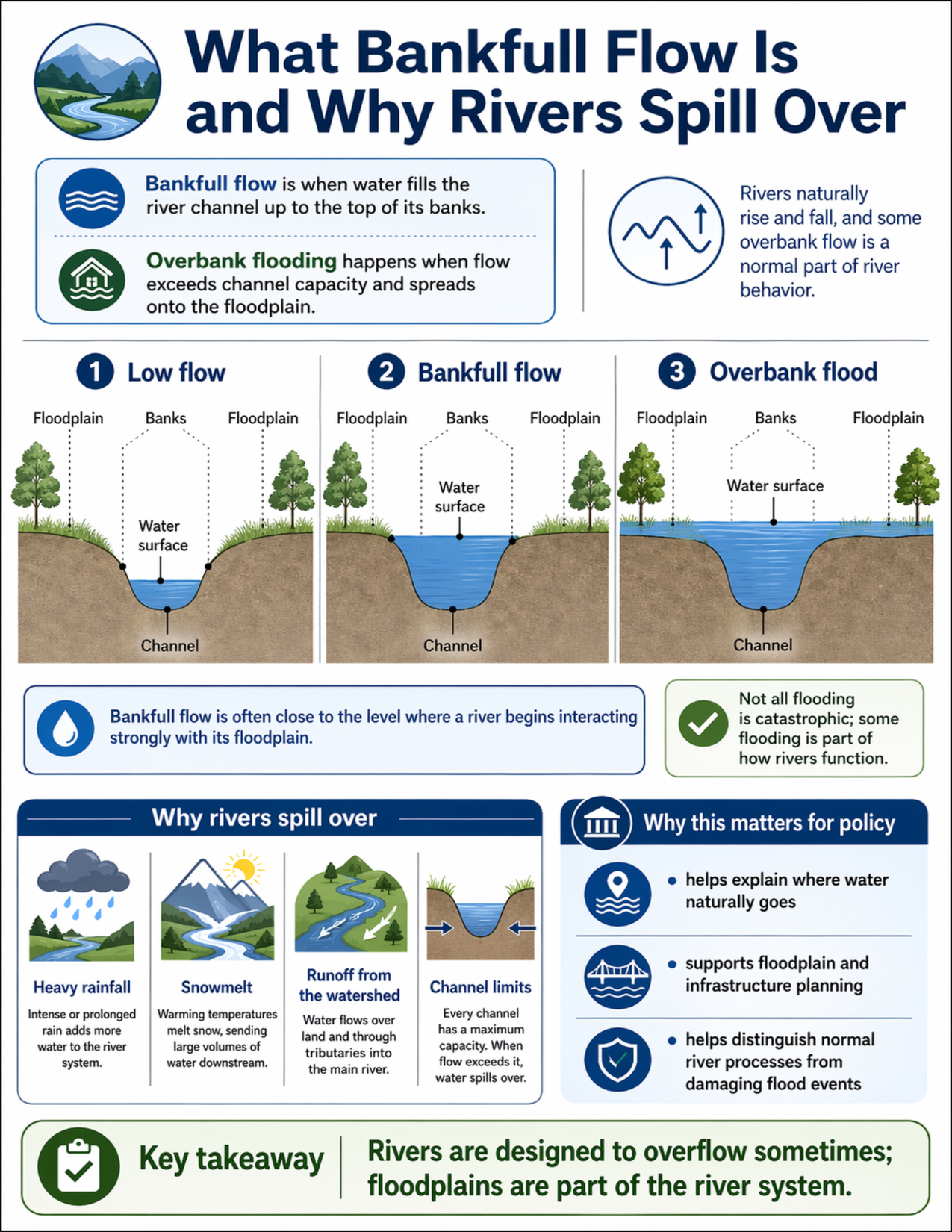
The visual compares three simple river cross-sections: low flow, bankfull flow, and overbank flood.
In the low-flow example, water stays well below the tops of the banks and remains fully inside the channel.
In the bankfull example, water fills the river channel up to the tops of the banks. This is often close to the point where the river begins interacting more strongly with its floodplain.
In the overbank example, water exceeds the channel’s capacity and spreads onto the floodplain. The guide labels the channel, banks, floodplain, and water surface to show how these parts of the river system relate to one another.
The visual also emphasizes that rivers naturally rise and fall. Some flooding is part of normal river function and is not necessarily catastrophic.
A second section explains why rivers spill over. It identifies four common causes:
- heavy rainfall
- snowmelt
- runoff from the watershed
- channel limits
Why this matters for policy
Policy discussions often treat flooding as if it begins only when something has gone badly wrong. But some overbank flow is a normal part of how rivers work. Floodplains exist in part because rivers periodically spread out beyond their channels.
This concept matters for floodplain planning, infrastructure siting, drainage decisions, and public communication. It helps explain where water naturally goes and why development in flood-prone areas can conflict with normal river processes.
It also helps distinguish between ordinary river behavior and more damaging flood events. That distinction is useful in planning, resilience, and risk communication.
Key terms
Bankfull flow
The level at which water fills the river channel up to the tops of its banks.
Overbank flooding
Flow that exceeds the river channel and spreads onto the floodplain.
River channel
The lower part of the river system where water normally flows.
Banks
The sides of the river channel that confine flow at lower stages.
Floodplain
The relatively flat land beside a river that can be inundated when water rises above the channel.
Watershed runoff
Water that moves over land and through tributaries into the main river.
Questions policy staff can ask
- Where does bankfull flow occur in this river system?
- How often does the river interact with its floodplain?
- Which areas are part of the river’s natural overflow space?
- Are roads, buildings, or utilities located where overbank flow is likely?
- Are channel modifications increasing problems elsewhere?
- How do rainfall, snowmelt, and watershed runoff affect river stages here?
- Are planning decisions treating normal river processes as if they were unexpected events?
- How should floodplain and infrastructure planning account for the river’s natural range of behavior?
Policy takeaway
Rivers are designed to overflow sometimes; floodplains are part of the river system.
Main definition: Bankfull flow is when water fills the river channel up to the top of its banks.
Overbank flooding happens when flow exceeds channel capacity and spreads onto the floodplain.
Core concept: The visual explains that rivers naturally rise and fall, and that some overbank flow is a normal part of river behavior.
Cross-section comparison: The guide shows three side-by-side cross-sections.
First, low flow: Water remains well within the river channel. The channel, banks, floodplain, and water surface are labeled.
Second, bankfull flow: Water fills the river channel up to the top of its banks. The channel, banks, floodplain, and water surface are labeled.
Third, overbank flood: Water exceeds the channel and spreads across the floodplain. The channel, banks, floodplain, and water surface are labeled.
Floodplain interaction: The guide states that bankfull flow is often close to the level where a river begins interacting strongly with its floodplain.
Normal river function: The guide notes that not all flooding is catastrophic; some flooding is part of how rivers function.
Causes section: A section titled “Why rivers spill over” identifies heavy rainfall, snowmelt, runoff from the watershed, and channel limits.
Policy relevance: The guide notes that this concept helps explain where water naturally goes, supports floodplain and infrastructure planning, and helps distinguish normal river processes from damaging flood events.
Key takeaway: Rivers are designed to overflow sometimes; floodplains are part of the river system.