
Why Flood Risk Is Not the Same as Flood Hazard
Walks through the differences between flood hazard, exposure, vulnerability, and risk.
Flood hazard and flood risk are related, but they are not the same thing. A flood hazard is the physical event or condition itself, while flood risk depends on what is exposed and how vulnerable those people and assets are to damage.
This matters because flood decisions are often framed too narrowly around the hazard alone. A clearer distinction helps policy staff think more effectively about land use, infrastructure, resilience, and the choices that can reduce harmful consequences.
Download or reuse this guide in briefings and meeting materials.
What the visual shows
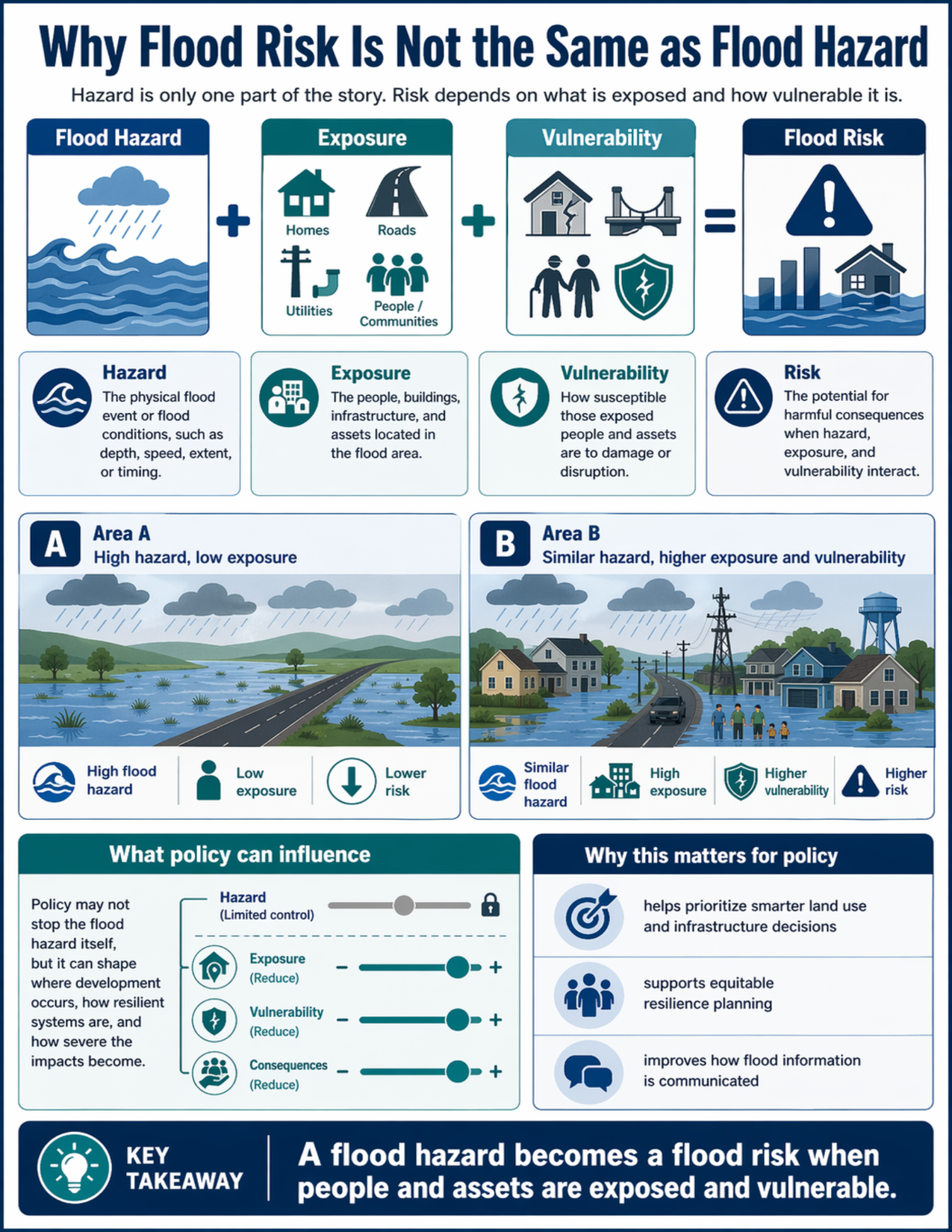
The visual presents a simple framework: flood hazard plus exposure plus vulnerability equals flood risk.
It defines hazard as the physical flood event or flood conditions, such as depth, speed, extent, or timing. It defines exposure as the people, buildings, roads, utilities, and other assets located in the flood area. It defines vulnerability as how susceptible those exposed people and assets are to damage or disruption. It then defines risk as the harmful consequences that can result when hazard, exposure, and vulnerability interact.
The guide also compares two places. In Area A, the flood hazard is high, but exposure is low. Because fewer people and assets are in harm’s way, the resulting risk is lower. In Area B, the flood hazard is similar, but exposure and vulnerability are both higher. Because more homes, infrastructure, and people are exposed—and because they may be more susceptible to damage—the resulting risk is higher.
A final section shows what policy can influence. The guide explains that policy may have limited control over the flood hazard itself, but it can shape where development occurs, how resilient systems are, and how severe the consequences become.
Why this matters for policy
This concept shifts the focus from asking only “How big is the flood?” to also asking “Who and what is exposed?” and “How vulnerable are they?” That broader frame is important for risk reduction.
It matters for land-use planning, building and infrastructure decisions, resilience planning, emergency management, and public communication. In many cases, policy cannot stop the flood hazard itself. But it can reduce exposure, reduce vulnerability, and lower the consequences of flooding.
This is also important for equity. Risk is often higher where exposure is concentrated and where people, infrastructure, or communities are less able to absorb or recover from flood impacts.
Key terms
Flood hazard
The physical flood event or flood conditions, such as depth, speed, extent, or timing.
Exposure
The people, buildings, infrastructure, and assets located in the flood area.
Vulnerability
How susceptible exposed people and assets are to damage or disruption.
Flood risk
The potential for harmful consequences when hazard, exposure, and vulnerability interact.
Consequences
The impacts that result when flooding affects people, property, systems, or communities.
Resilience planning
Planning that aims to reduce disruption, improve preparedness, and support recovery from hazards.
Questions policy staff can ask
- Are we focusing only on the hazard, or also on exposure and vulnerability?
- What people, homes, roads, and utilities are located in the flood area?
- Which communities or assets are most vulnerable to disruption or damage?
- What choices can reduce exposure through land use or siting?
- What choices can reduce vulnerability through design, maintenance, or preparedness?
- How are consequences distributed across different communities?
- Are flood maps and public messaging clearly distinguishing hazard from risk?
- Where can policy reduce harm even if it cannot reduce the hazard itself?
Policy takeaway
A flood hazard becomes a flood risk when people and assets are exposed and vulnerable.
Main concept: Flood hazard is not the same as flood risk.
Core framework: The visual presents a simple framework showing that flood hazard plus exposure plus vulnerability equals flood risk.
Definitions: Flood hazard is defined as the physical flood event or flood conditions, such as depth, speed, extent, or timing. Exposure is defined as the people, buildings, infrastructure, and assets located in the flood area. Vulnerability is defined as how susceptible those exposed people and assets are to damage or disruption. Risk is defined as the potential for harmful consequences when hazard, exposure, and vulnerability interact.
Comparison: A side-by-side comparison contrasts Area A and Area B. Area A has high flood hazard but low exposure, resulting in lower risk. Area B has similar flood hazard but higher exposure and vulnerability, resulting in higher risk.
Policy influence: A section titled “What policy can influence” explains that policy may have limited control over the hazard itself, but can reduce exposure, vulnerability, and consequences.
Policy relevance: The guide notes that this concept helps prioritize smarter land use and infrastructure decisions, supports equitable resilience planning, and improves how flood information is communicated.
Key takeaway: A flood hazard becomes a flood risk when people and assets are exposed and vulnerable.