
What Levees Do and Do Not Do
Clarifies how levees can reduce some flood impacts but do not eliminate flood risk.
Levees can reduce the likelihood of some flooding, but they do not make flood risk disappear. They are structures that help keep river water within a more confined corridor during many flood events, but they do not prevent all types of flooding and they do not guarantee safety.
This matters because levee-protected areas are often treated as if they are fully protected. A clearer understanding helps policy staff think more carefully about land use, infrastructure, emergency planning, and residual risk behind levees.
Download or reuse this guide in briefings and meeting materials.
What the visual shows
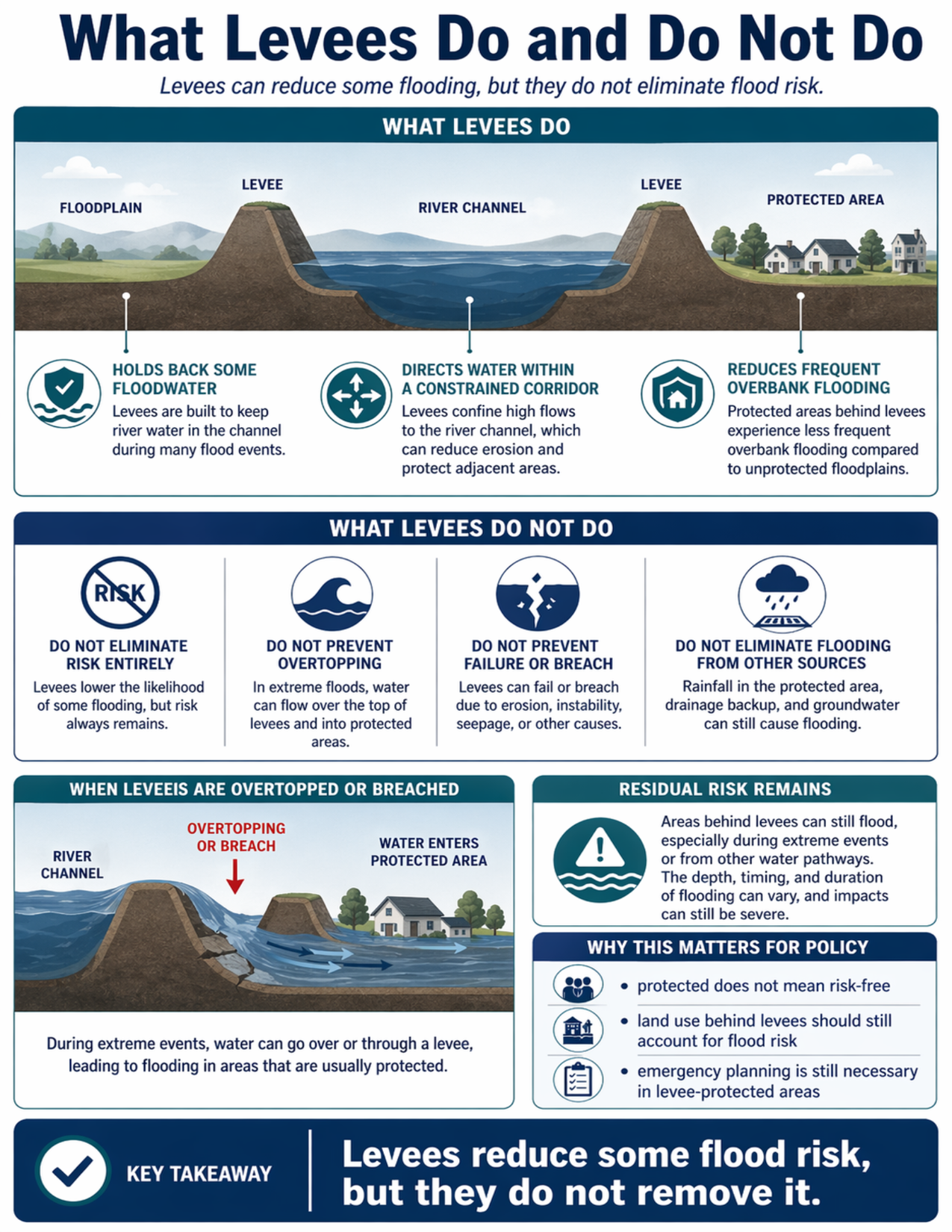
The visual first shows what levees do. A river channel is confined between levees, with a floodplain on one side and a protected area with homes on the other. The guide explains that levees can hold back some floodwater, direct water within a constrained corridor, and reduce frequent overbank flooding in protected areas.
The next section explains what levees do not do. It states that levees do not eliminate risk entirely, do not prevent overtopping in extreme floods, do not prevent failure or breach, and do not eliminate flooding from other sources such as local rainfall, drainage backup, or groundwater.
A lower diagram shows what happens when a levee is overtopped or breached. Water enters the area behind the levee and floods places that are usually treated as protected. Another section labeled “Residual risk remains” explains that flooding behind levees can still occur and can still be severe.
The guide closes by emphasizing that flood protection is not the same as zero risk.
Why this matters for policy
Levees can be important parts of flood management, but they can also create misunderstandings if people assume that “protected” means “safe from flooding.” That can influence where homes, roads, utilities, and other assets are built.
This concept matters for land-use decisions behind levees, infrastructure planning, emergency management, and risk communication. Even where levees reduce frequent overbank flooding, communities still need to plan for extreme events, overtopping, structural problems, and other water pathways.
A better understanding of residual risk helps policy staff avoid false certainty and make more realistic decisions about development, preparedness, and resilience.
Key terms
Levee
A raised embankment or structure built to help keep river water within a channel during flood events.
Overbank flooding
Flooding that occurs when water rises above the banks of a river and spreads onto the floodplain.
Protected area
Land behind a levee where flooding may be reduced during some events, but not eliminated.
Overtopping
Water flowing over the top of a levee during a flood.
Breach
A break or failure in a levee that allows water to pass through.
Residual risk
The remaining flood risk that still exists even after protective measures such as levees are in place.
Questions policy staff can ask
- What level of flood reduction does this levee provide, and under what conditions?
- What flooding sources remain even with the levee in place?
- What happens if the levee is overtopped or breached?
- How is land use behind the levee being managed?
- Are homes, roads, and utilities being placed in ways that assume too much protection?
- Is emergency planning in place for levee-protected areas?
- How is residual risk being communicated to the public?
- Are drainage, groundwater, and local rainfall flooding also being considered?
Policy takeaway
Levees reduce some flood risk, but they do not remove it.
Main concept: Levees can reduce some flooding, but they do not eliminate flood risk.
What levees do: The visual shows a river channel confined between levees, with a floodplain on one side and a protected area on the other. It explains that levees hold back some floodwater, direct water within a constrained corridor, and reduce frequent overbank flooding in protected areas.
What levees do not do: A second section explains that levees do not eliminate risk entirely, do not prevent overtopping, do not prevent failure or breach, and do not eliminate flooding from other sources such as rainfall, drainage backup, or groundwater.
Overtopping and breach: A lower diagram shows water going over or through a levee and entering a protected area. The diagram labels overtopping or breach and shows flooding in the area behind the levee.
Residual risk: A section titled “Residual risk remains” explains that areas behind levees can still flood, especially during extreme events or from other water pathways, and that impacts can still be severe.
Policy relevance: The guide notes that protected does not mean risk-free, that land use behind levees should still account for flood risk, and that emergency planning is still necessary in levee-protected areas.
Key takeaway: Levees reduce some flood risk, but they do not remove it.