
Why Aquifer Storage Can Help with Drought
Explores how managed aquifer recharge can support drought resilience by storing water underground when it is available and recovering it during dry periods.
Water supplies vary by season and from year to year. Managed aquifer recharge can help communities store water underground when it is available and recover it later when surface water supplies are limited.
This matters for water policy because aquifer storage is not a stand-alone drought solution. It works best as part of long-term planning that includes conservation, water rights, infrastructure, monitoring, and careful groundwater management.
Download or reuse this guide in briefings and meeting materials.
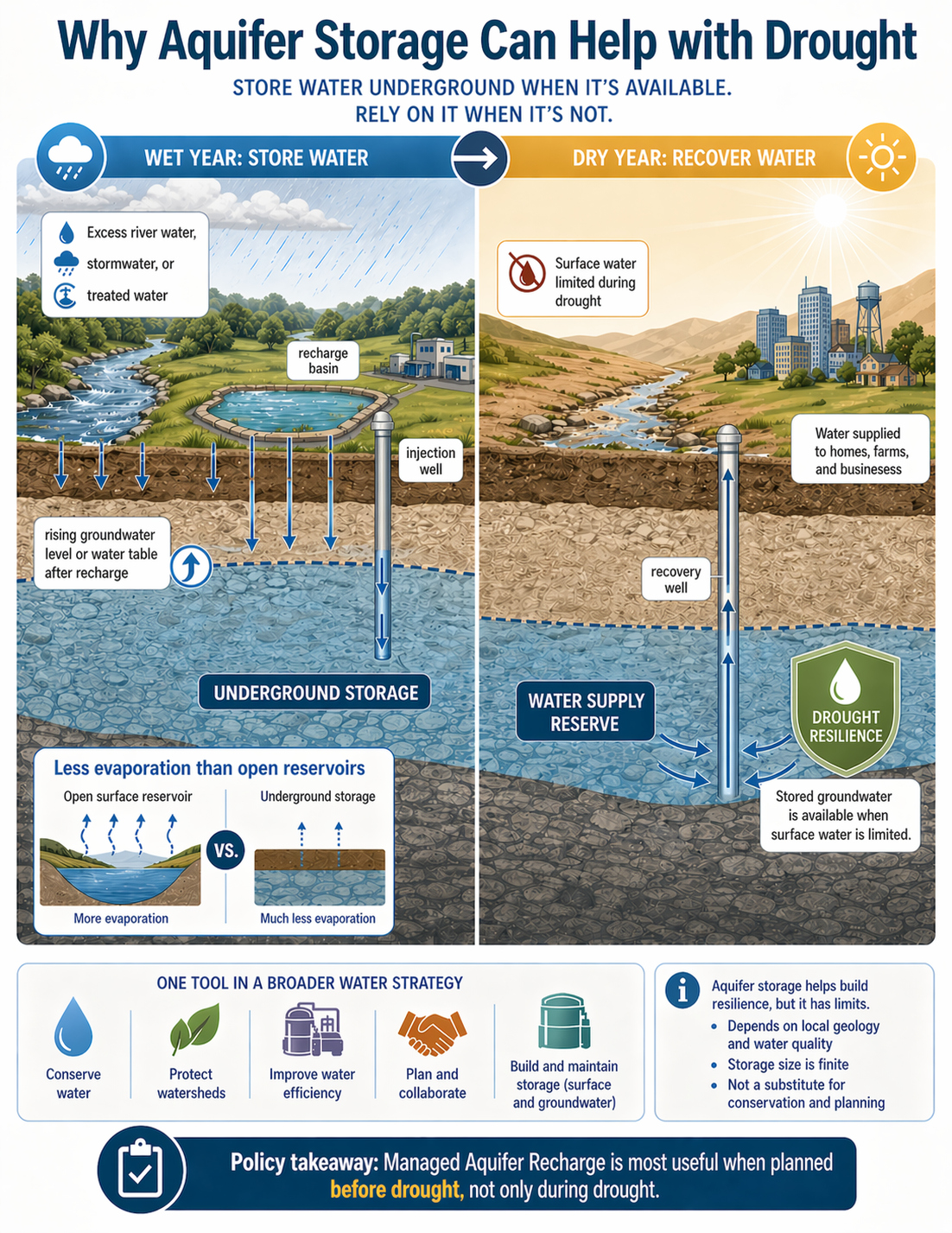
What the visual shows
The visual uses a wet-year and dry-year timeline.
The wet-year panel shows water being stored underground. Excess river water, stormwater, or treated water can be directed to recharge basins, stream channels, or injection wells when water is available and when legal, operational, and water-quality requirements are met.
The visual shows the groundwater level or water table rising after recharge. It also shows underground storage as a water supply reserve.
The dry-year panel shows stored groundwater being recovered through a well when surface water is limited. The water can support homes, farms, businesses, or other approved uses, depending on the project design and local rules.
The visual also compares underground storage with surface reservoirs. Underground storage can reduce evaporation losses because the water is stored below the surface instead of in an open reservoir.
Wet years and dry years
Natural water supplies are not constant. Some years are wetter, with more rain, snowmelt, streamflow, or stormwater. Other years are drier, with lower surface water availability and higher stress on water systems.
Managed aquifer recharge uses this variation by storing water during times of relative abundance. In wet years, water may be available for recharge if it is legally accessible, physically capturable, and suitable for the aquifer.
During dry years, some of the stored water may be recovered. This can help reduce pressure on surface water supplies and provide an additional reserve during drought.
The key point is timing. Water must be stored before it can be recovered. MAR is most useful when it is planned, permitted, monitored, and operated before drought conditions become severe.
Why underground storage can be useful
Aquifer storage can be useful because it takes advantage of natural underground storage space where the geology is suitable.
Compared with surface reservoirs, underground storage can require less visible surface land for the storage itself. Recharge basins, wells, conveyance systems, and monitoring infrastructure still require land and maintenance, but the stored water is held underground.
Underground storage can also reduce evaporation losses. This can be especially important in hot or dry regions where open surface reservoirs lose water to the atmosphere.
In some settings, water that infiltrates from the surface can also pass through soil and rock that help filter the water. This natural filtration can improve water quality, although it does not remove every contaminant and should not replace appropriate treatment and monitoring.
Aquifer storage can also help maintain groundwater levels, reduce risks from overpumping, and provide flexibility when surface water supplies are variable.
What MAR cannot solve by itself
Managed aquifer recharge has limits.
MAR cannot create water. It depends on water being available for recharge before it can be recovered later. If there is no surplus water, no legal access to water, or no infrastructure to capture and move water, recharge may not be possible.
MAR is also limited by geology. Some aquifers cannot accept water quickly, store it effectively, or release it when needed. Some areas may have confining layers, contamination concerns, or groundwater-flow conditions that make recharge difficult.
Water quality must also be managed. Stormwater, river water, and treated water each have different risks and treatment needs. Recharge projects need monitoring to protect groundwater quality.
Finally, aquifer storage does not replace conservation, demand management, watershed protection, surface storage, or emergency planning. It is one tool in a broader drought-resilience strategy.
Questions policy staff can ask
- What water will be available for recharge during wet periods?
- Is there legal access to that water?
- How often is the source water available?
- Is the aquifer suitable for storing and recovering water?
- How much water can realistically be stored?
- How much can be recovered during dry periods?
- What infrastructure is needed to capture, convey, recharge, store, and recover the water?
- What water-quality standards and monitoring will apply?
- How will recharge affect nearby wells, streams, wetlands, or groundwater users?
- Who will manage the water accounting?
- How will the project define success during drought?
- How does MAR fit with conservation, demand management, surface storage, and other drought strategies?
Policy takeaway
Aquifer storage is a long-term drought-planning tool, not a last-minute emergency fix.
Main concept: Aquifer storage can help with drought by storing water underground when it is available and relying on it later when surface water is limited.
Core message: The visual explains that managed aquifer recharge is most useful when planned before drought, not only during drought.
Wet-year panel: The left side of the visual shows a wet year when water can be stored underground.
Water sources in wet years: The guide identifies excess river water, stormwater, or treated water as possible sources for recharge when water is available.
Recharge methods: The wet-year panel shows a recharge basin and an injection well as ways to move water into the aquifer.
Underground storage: The visual shows the groundwater level or water table rising after recharge, with water stored underground in the aquifer.
Evaporation comparison: The guide compares open surface reservoirs with underground storage. Open surface reservoirs have more evaporation, while underground storage has much less evaporation.
Dry-year panel: The right side of the visual shows a dry year when stored groundwater can be recovered.
Recovery during drought: The dry-year panel shows a recovery well pumping stored groundwater when surface water is limited during drought.
Water supply reserve: The guide shows stored groundwater as a water supply reserve that can provide water to homes, farms, and businesses.
Drought resilience: The visual identifies stored groundwater as one way to support drought resilience.
Broader water strategy: The guide emphasizes that aquifer storage is one tool in a broader water strategy. Other actions include conserving water, protecting watersheds, improving water efficiency, planning and collaborating, and building and maintaining both surface and groundwater storage.
Important limits: The visual notes that aquifer storage helps build resilience, but it has limits. It depends on local geology and water quality, storage size is finite, and it is not a substitute for conservation and planning.
Policy takeaway: Managed Aquifer Recharge is most useful when planned before drought, not only during drought.