
Groundwater Depletion and Land Subsidence
Clarifies how excessive groundwater pumping can compact aquifer sediments, cause land subsidence, and damage infrastructure.
Groundwater depletion happens when water is pumped from an aquifer faster than it is replenished. In some aquifer systems, this can cause the land surface to sink, a process called land subsidence.
This matters for water policy because subsidence is not only a groundwater problem. It can damage roads, canals, pipes, buildings, wells, and flood-control systems.
Download or reuse this guide in briefings and meeting materials.
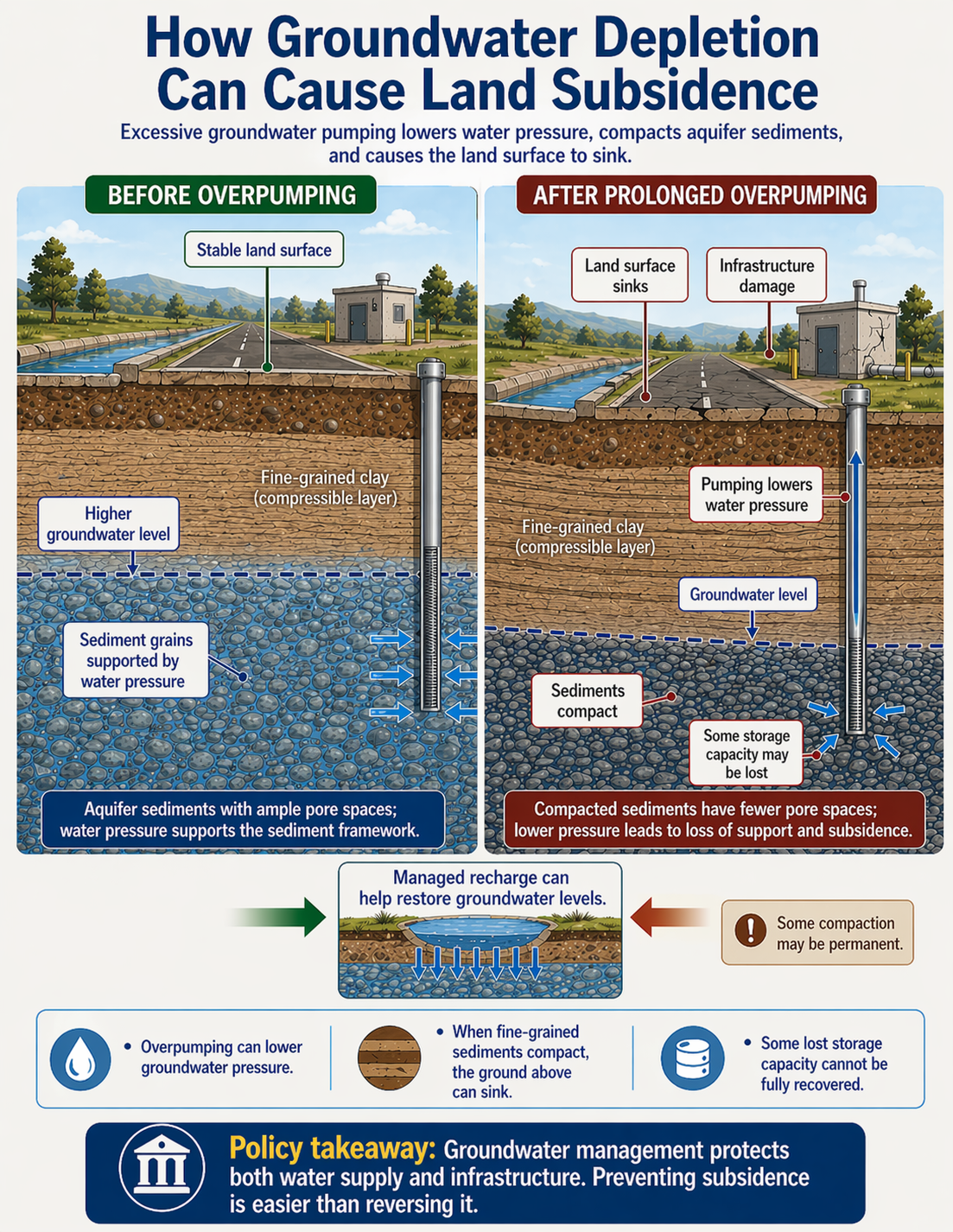
What the visual shows
The visual compares conditions before and after prolonged groundwater overpumping.
In the first panel, groundwater levels are higher. Water pressure helps support the sediment framework underground, especially in aquifer systems that include fine-grained layers such as clay and silt. The land surface remains stable.
In the second panel, prolonged pumping has lowered the groundwater level. Lower groundwater pressure reduces support within the aquifer system. Fine-grained sediments compact, the land surface sinks, and infrastructure at the surface can be damaged.
The visual also notes that managed recharge can help restore groundwater levels where conditions are suitable, but some compaction may be permanent.
How pumping can cause subsidence
Aquifers are made of geologic materials such as sand, gravel, silt, clay, and rock. Groundwater is stored in the spaces between grains and in cracks or fractures.
When groundwater is pumped, the groundwater level or pressure can decline. In some aquifer systems, especially those with compressible fine-grained layers, lower groundwater pressure allows sediments to compact.
As sediments compact underground, the land surface above them can sink. This sinking may occur gradually over years, but the effects can be long lasting.
Not all aquifers respond the same way. The risk of subsidence depends on the local geology, the amount and rate of pumping, the thickness of compressible layers, groundwater-level history, and whether groundwater levels recover.
Why subsidence matters
Land subsidence can create costly and long-term problems.
It can damage roads, bridges, canals, pipelines, building foundations, wells, and other infrastructure. Even small changes in land elevation can affect drainage systems and water-delivery canals.
Subsidence can also reduce flood-control capacity. If land sinks, levees, canals, stormwater systems, and low-lying areas may no longer function as originally designed.
In some aquifer systems, compaction can permanently reduce the amount of water the aquifer can store. This means subsidence can damage both surface infrastructure and the underground water-storage system.
For policy staff, groundwater levels can be warning indicators. Declining groundwater levels may signal not only water-supply stress, but also increasing risk to infrastructure and long-term aquifer capacity.
How recharge and groundwater management can help
Managed aquifer recharge can help maintain or restore groundwater levels where suitable water, aquifer conditions, land, infrastructure, and governance are available.
Recharge may reduce the risk of future subsidence by helping keep groundwater levels above thresholds where damaging compaction becomes more likely. However, recharge cannot always reverse subsidence that has already occurred.
Prevention is usually easier than repair. Once fine-grained sediments compact, some lost storage capacity may be permanent.
Groundwater management can also include pumping limits, monitoring wells, groundwater-level triggers, water conservation, water-use efficiency, imported water, recycled water, stormwater capture, and long-term accounting of groundwater storage.
Santa Clara Valley in California provides an example. Groundwater depletion caused land sinking in the early 1900s. The local water district was founded in the 1920s to recharge groundwater and prevent further subsidence. Later, managed recharge combined with imported water helped restore groundwater levels, and subsidence largely stopped.
Questions policy staff can ask
- Are groundwater levels declining in the area?
- Are there fine-grained clay or silt layers that could compact if groundwater pressure falls?
- Has land subsidence already been measured?
- What infrastructure could be affected by subsidence?
- Could subsidence reduce flood-control capacity or drainage performance?
- Could compaction reduce future aquifer storage?
- What groundwater-level thresholds should trigger management action?
- Is managed aquifer recharge feasible in this aquifer system?
- What water source would be available for recharge?
- How will groundwater levels, land elevation, and infrastructure impacts be monitored?
- Are pumping rules, recharge plans, and drought plans coordinated?
- Who is responsible for long-term groundwater management?
Policy takeaway
Groundwater levels are infrastructure protection indicators, not only water-supply indicators.
Main concept: Excessive groundwater pumping can lower water pressure underground, compact aquifer sediments, and cause the land surface to sink.
Core message: The visual explains that groundwater depletion can damage both water supply and infrastructure. Preventing subsidence is easier than reversing it.
Before overpumping: The first panel shows conditions before prolonged groundwater pumping.
Stable land surface: The land surface remains stable when groundwater levels are higher and underground sediments are supported.
Higher groundwater level: The guide shows a higher groundwater level before overpumping.
Sediments supported by water pressure: Water pressure helps support the sediment framework in the aquifer.
Fine-grained clay layer: A fine-grained clay layer is shown as a compressible layer that can compact if water pressure drops.
Before-overpumping explanatory note: Aquifer sediments have ample pore spaces, and water pressure supports the sediment framework.
After prolonged overpumping: The second panel shows what can happen after groundwater is pumped for a long period.
Pumping lowers water pressure: Groundwater pumping lowers the water level and reduces pressure within the aquifer system.
Sediments compact: Fine-grained sediments compact as pore spaces shrink and support is lost.
Land surface sinks: As sediments compact underground, the ground above can sink.
Infrastructure damage: The visual shows that subsidence can damage surface infrastructure.
Storage capacity loss: Some aquifer storage capacity may be lost when compacted sediments have fewer pore spaces.
After-overpumping explanatory note: Compacted sediments have fewer pore spaces. Lower pressure leads to loss of support and subsidence.
Managed recharge note: Managed recharge can help restore groundwater levels where conditions are suitable.
Caution: Some compaction may be permanent, and some lost storage capacity cannot be fully recovered.
Key points: Overpumping can lower groundwater pressure. When fine-grained sediments compact, the ground above can sink. Some lost storage capacity cannot be fully recovered.
Policy takeaway: Groundwater management protects both water supply and infrastructure. Preventing subsidence is easier than reversing it.