
Surface Recharge vs. Injection Wells
Compares surface recharge and injection wells as two managed aquifer recharge approaches.
Managed aquifer recharge can move water underground in different ways. Two common approaches are surface recharge, where water soaks downward from the land surface, and injection wells, where treated water is placed directly into an aquifer.The best method depends on the local geology, the available land, the quality of the water being recharged, project costs, and the long-term monitoring needed to protect groundwater.
This matters for water policy because surface recharge and injection wells are not interchangeable. They solve similar water-storage problems in different geologic and policy settings.
Download or reuse this guide in briefings and meeting materials.
What the visual shows
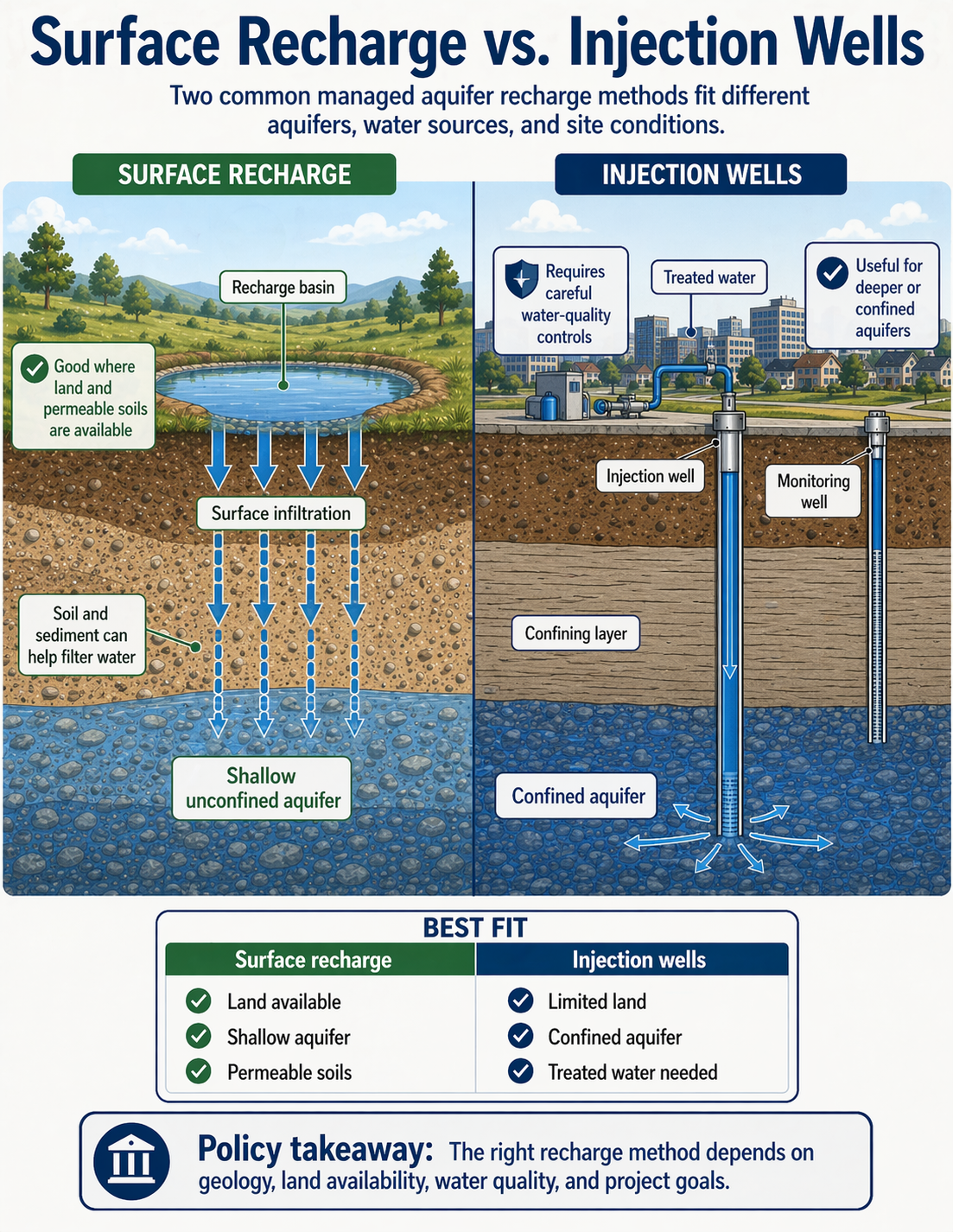
The visual compares two managed aquifer recharge approaches in a split-screen cross-section.
The left side shows surface recharge. Water enters a recharge basin, pond, or other surface feature, then infiltrates downward through soil and sediment. As the water moves downward, soil and geologic materials can help filter some contaminants before the water reaches a shallow unconfined aquifer.
The right side shows injection wells. Treated water is delivered directly into a deeper aquifer through a well. A confining layer sits above the aquifer, limiting natural downward movement from the surface. A monitoring well is shown nearby to track groundwater levels and water quality.
Surface recharge
Surface recharge includes methods such as spreading basins, artificial ponds, local catchments, and naturally infiltrating river channels.
This approach is especially useful where suitable land is available and the aquifer is close enough to the surface for water to move downward through permeable soil and sediment. It is commonly associated with shallow water-table aquifers, also called unconfined aquifers.
Surface recharge can provide some natural filtration as water passes through soil, sand, gravel, and other geologic materials. This can improve water quality in some settings.
However, natural filtration has limits. Not all pollutants are removed by soil and sediment, and some contaminants can move through the subsurface. Surface recharge still requires source-water review, site assessment, monitoring, and long-term management.
Injection wells
Injection wells place water directly into an aquifer through a constructed well.
This approach may be appropriate where the target aquifer is deeper, where the aquifer is confined beneath low-permeability layers, or where there is not enough land available for recharge basins.
Injection wells can be useful in urban or coastal areas where open land is limited. They can also be used where recharge needs to reach a specific aquifer layer rather than relying on water to move downward from the surface.
Because injection wells bypass much of the natural filtration that occurs in soil and shallow sediment, they usually require more careful attention to water quality. The water may need treatment before injection, and the project needs monitoring to make sure the injected water does not create groundwater-quality problems.
How to compare options
Surface recharge and injection wells are not interchangeable. They solve similar water-storage problems in different geologic and policy settings.
Surface recharge may be a better fit where land is available, soils are permeable, the aquifer is shallow, and the source water can safely infiltrate through the subsurface.
Injection wells may be a better fit where land is limited, the aquifer is confined or deeper, or water needs to be placed directly into a specific aquifer. Injection may also be more appropriate where recharge basins are not feasible because of urban development, surface constraints, or unsuitable soils.
Cost and maintenance also matter. Surface recharge may require land acquisition, basin construction, sediment management, and periodic maintenance to keep infiltration working. Injection wells may require more engineered infrastructure, treatment systems, permitting, pressure management, and monitoring.
The right choice depends on the problem the project is trying to solve and the conditions at the site.
Questions policy staff can ask
- What aquifer is the project trying to recharge?
- Is the aquifer shallow and unconfined, or deeper and confined?
- Is there enough suitable land for surface recharge?
- Are the soils and sediments permeable enough for infiltration?
- Would recharge water naturally reach the intended aquifer?
- What source water will be used?
- What treatment is needed before recharge or injection?
- What contaminants could be present, and can they be removed or managed?
- How will groundwater levels and water quality be monitored?
- What are the long-term maintenance needs?
- What permitting, water rights, and operating agreements are required?
- How will the project measure whether recharge is actually reaching and benefiting the aquifer?
Policy takeaway
Recharge method selection is a site-specific decision involving geology, land, water quality, cost, and long-term monitoring.
Main concept: Two common managed aquifer recharge methods fit different aquifers, water sources, and site conditions.
Core comparison: The visual compares surface recharge with injection wells. Surface recharge lets water soak downward from the land surface, while injection wells deliver treated water directly into an aquifer.
Surface recharge: The surface recharge side shows a recharge basin where water spreads across the land surface and infiltrates downward.
Surface infiltration: Water moves down through soil and sediment before reaching a shallow unconfined aquifer.
Natural filtration: The guide notes that soil and sediment can help filter water during surface recharge, although project conditions and water quality still matter.
Surface recharge best fit: Surface recharge is a better fit where land is available, the aquifer is shallow, and soils are permeable.
Injection wells: The injection-well side shows treated water being delivered directly into a deeper or confined aquifer through an injection well.
Water-quality controls: The guide notes that injection wells require careful water-quality controls because water is placed directly into the aquifer.
Monitoring well: A monitoring well is included to show that groundwater conditions and water quality need to be tracked.
Confining layer and confined aquifer: The visual shows a confining layer above a confined aquifer. Injection wells can be useful where the target aquifer is deeper or separated from the surface by low-permeability layers.
Injection wells best fit: Injection wells are a better fit where land is limited, the aquifer is confined, and treated water is needed.
Policy relevance: The visual shows that recharge methods are not interchangeable. The best method depends on local geology, available land, water quality, and the goals of the project.
Policy takeaway: The right recharge method depends on geology, land availability, water quality, and project goals.