
Recharge and Saltwater Intrusion
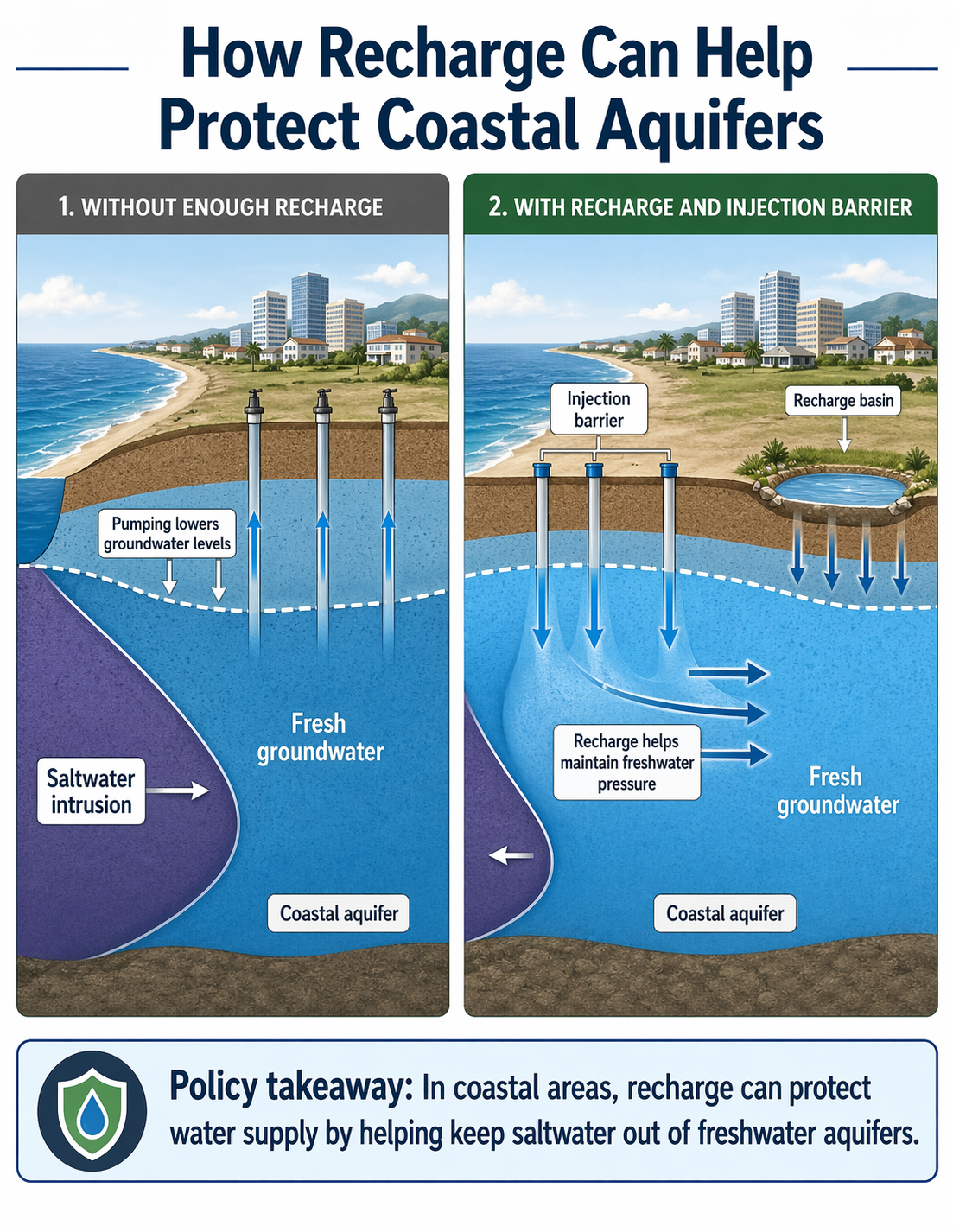
Shows how groundwater pumping near the coast can allow saltwater to enter freshwater aquifers, and how recharge can help protect coastal groundwater supplies.
Fresh groundwater and seawater meet beneath coastal areas. When groundwater levels are high enough, freshwater pressure helps hold salty ocean water back.
This matters for water policy because when coastal aquifers are depleted by pumping, saltwater can move inland and threaten freshwater supplies. Recharge, injection wells, pumping rules, and monitoring can help reduce that risk.
Download or reuse this guide in briefings and meeting materials.
What the visual shows
The visual shows a coastal aquifer beneath a community near the ocean.
In the first panel, groundwater pumping lowers freshwater levels near the coast. As freshwater pressure declines, saltwater from the ocean can move inland into the aquifer. This is called saltwater intrusion.
In the second panel, recharge and injection wells add freshwater to the groundwater system. This helps maintain freshwater pressure and can create or support an injection barrier that reduces inland movement of saltwater.
The visual shows that recharge can be both a water-supply strategy and a coastal aquifer protection strategy.
How saltwater intrusion happens
Fresh groundwater naturally flows toward the coast in many coastal aquifers. Seawater is denser than freshwater, so salty water can extend inland beneath the freshwater as a wedge-shaped zone.
When groundwater pumping lowers freshwater levels, the pressure pushing freshwater toward the ocean is reduced. If pumping is heavy enough, salty water can move farther inland or upward toward wells.
Once saltwater enters a freshwater aquifer, it can be difficult and expensive to remove. Wells that once produced usable freshwater may become too salty for drinking water, irrigation, or other uses.
Saltwater intrusion risk depends on local geology, groundwater levels, pumping patterns, well locations, sea level, recharge, and how the aquifer connects to the ocean.
How recharge can help
Recharge can help by increasing groundwater levels and maintaining freshwater pressure in the aquifer.
Inland recharge, such as recharge basins or spreading grounds, can add water to the aquifer system and support groundwater flow toward the coast.
Injection wells can place freshwater or highly treated water directly into strategic locations. In some coastal areas, lines of injection wells are used to create a freshwater pressure barrier between the ocean and inland groundwater supplies.
Recharge must be paired with pumping management. If groundwater is withdrawn faster than it is replenished, recharge alone may not be enough to stop saltwater intrusion.
Water quality is also central. Water used for recharge or injection must meet project requirements, and monitoring is needed to track both salinity and other groundwater-quality indicators.
Why this matters for coastal communities
Coastal communities often rely on groundwater for drinking water, agriculture, industry, and emergency supply.
Saltwater intrusion can reduce usable freshwater supplies, increase treatment costs, and limit future water options. It can also create long-term management problems because saline groundwater may persist underground even after pumping is reduced.
Recharge projects can help protect coastal aquifers, but they require planning, infrastructure, reliable source water, water-quality controls, and long-term monitoring.
Orange County and the Water Replenishment District of Southern California provide examples of coastal recharge and injection-barrier systems used to protect groundwater. These projects combine recharge, injection wells, water recycling, stormwater capture, groundwater monitoring, and pumping management.
Questions policy staff can ask
- Is the aquifer hydraulically connected to the ocean?
- Are groundwater levels declining near the coast?
- Has saltwater intrusion already been detected?
- Which wells, communities, or water users are at risk?
- How much pumping can occur without increasing intrusion risk?
- Where would recharge or injection wells be most effective?
- What source water would be used for recharge or injection?
- What treatment and monitoring would be required?
- How will salinity be measured over time?
- Are pumping rules coordinated with recharge operations?
- Who is responsible for long-term monitoring and maintenance?
- How will the project define success: groundwater levels, salinity reduction, protected wells, or avoided treatment costs?
Policy takeaway
Coastal groundwater protection requires managing both pumping and recharge.
Main concept: Recharge can help protect coastal aquifers by maintaining freshwater pressure and reducing the inland movement of saltwater.
Core message: The visual explains that in coastal areas, recharge can protect water supply by helping keep saltwater out of freshwater aquifers.
Coastal aquifer setting: The guide shows a coastal aquifer where fresh groundwater is stored beneath land near the ocean.
Without enough recharge: The first panel shows what can happen when there is not enough recharge or when groundwater pumping lowers groundwater levels.
Pumping lowers groundwater levels: Pumping reduces freshwater levels in the coastal aquifer.
Saltwater intrusion: When freshwater levels decline, saltwater can move inland into the aquifer.
Fresh groundwater: The visual distinguishes fresh groundwater from the saltwater intrusion zone.
Coastal aquifer: The aquifer beneath the coastal area is identified as the groundwater system at risk.
With recharge and injection barrier: The second panel shows how recharge can help protect the coastal aquifer.
Recharge basin: A recharge basin adds freshwater to the groundwater system.
Injection barrier: An injection barrier adds water in a strategic location to help keep saltwater from moving inland.
Freshwater pressure: Recharge helps maintain freshwater pressure in the aquifer.
Protected coastal aquifer: The guide shows fresh groundwater in the coastal aquifer being protected by recharge and injection.
Policy takeaway: In coastal areas, recharge can protect water supply by helping keep saltwater out of freshwater aquifers.