
How Geology Determines Whether MAR Will Work
Walks through why managed aquifer recharge depends on aquifer suitability, permeability, confinement, faults, and recovery potential.
Managed aquifer recharge requires more than a source of water. It also requires a suitable aquifer system that can accept water, store it underground, and allow it to be recovered or managed later.
This matters for water policy because local geology determines whether recharge is likely to work as intended. The most important question is not only whether water can enter the ground, but whether it can remain useful and recoverable.
Download or reuse this guide in briefings and meeting materials.
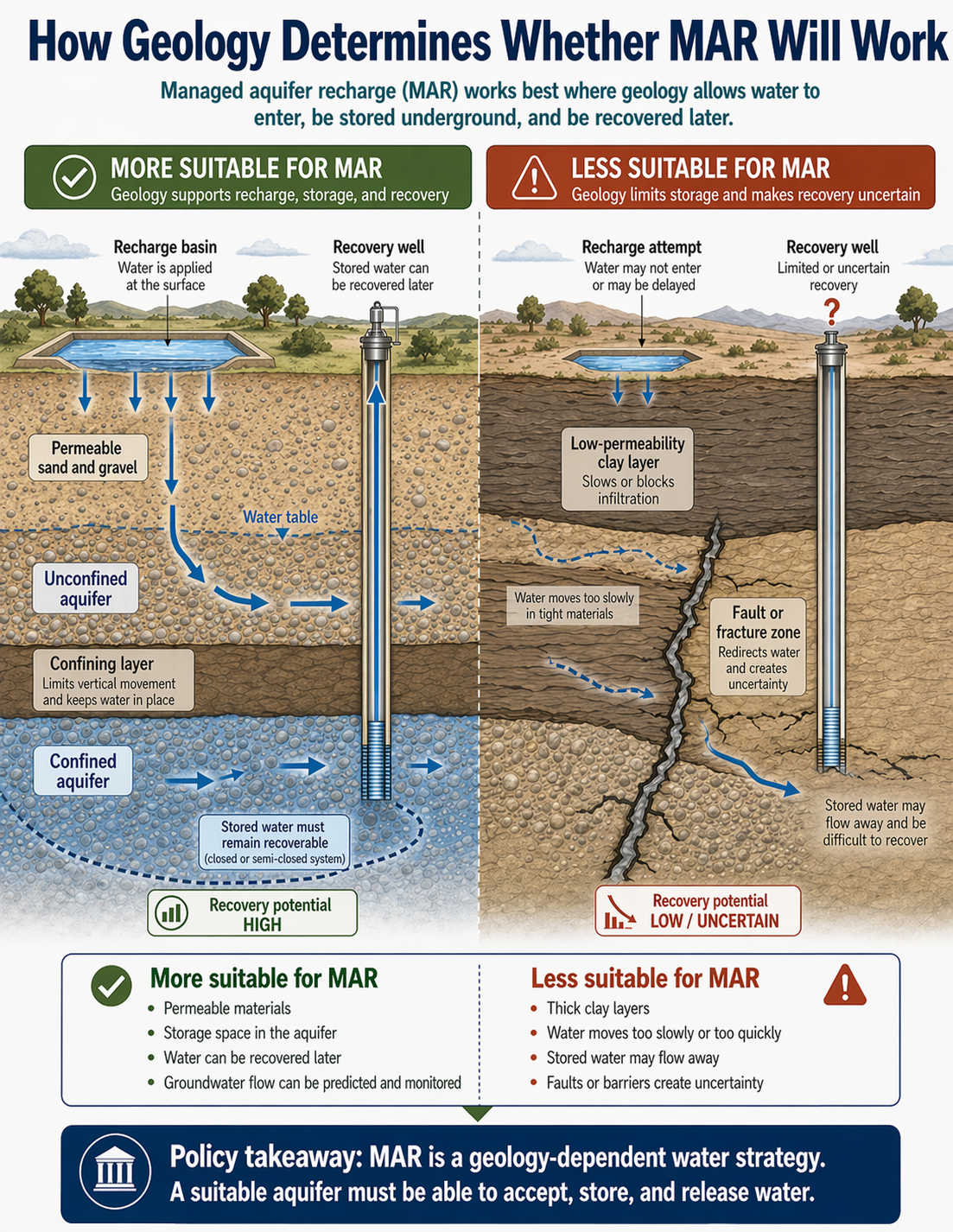
What the visual shows
The visual compares two simplified geologic settings.
The more suitable setting shows a recharge basin over permeable sand and gravel. Water can move downward into an unconfined aquifer, then through the aquifer toward a recovery well. A deeper confined aquifer is shown beneath a confining layer. The visual emphasizes that stored water must remain recoverable.
The less suitable setting shows a recharge attempt over low-permeability clay-rich layers. Water may enter very slowly, be delayed, or not reach the intended aquifer. A fault or fracture zone may redirect groundwater flow and create uncertainty. A recovery well is shown, but recovery is limited or uncertain.
The comparison highlights that MAR works best where geology supports recharge, storage, predictable groundwater movement, and later recovery.
Why aquifer suitability matters
A recharge project needs a suitable aquifer, not just a place to put water.
A suitable aquifer must have enough connected pore spaces, fractures, or permeable materials to receive water. It must also have enough storage space to hold water without causing unacceptable impacts, and the stored water must be able to remain accessible for later recovery or management goals.
Water storage is most useful where the water does not simply flow away into inaccessible areas. Closed or semi-closed aquifer systems can help keep stored water within a usable part of the groundwater system. Open systems may still be useful, but they require a clearer understanding of groundwater flow direction, travel time, and where the water may go.
Aquifer suitability also affects cost, design, permitting, monitoring, and public expectations. A site that looks promising at the surface may not work if the subsurface geology does not support recharge and recovery.
Geologic factors that affect MAR
Permeability
Permeability describes how easily water can move through sediment or rock. Sand and gravel are often more permeable. Clay and silt are usually less permeable. MAR works best where water can move into and through the aquifer at a useful rate.
Storage space
Aquifers need enough open pore space or connected fractures to store water. If the aquifer has limited storage capacity, the project may not be able to store much water or may raise groundwater levels in ways that cause problems.
Unconfined aquifers
Unconfined aquifers are closer to the surface and have a water table. They may be well suited to surface recharge where soils and sediments are permeable and where water can safely move downward.
Confined aquifers
Confined aquifers are located beneath low-permeability layers. Surface water may not easily reach them, so injection wells may be needed to place water directly into the aquifer.
Clay layers and confining layers
Clay layers can protect aquifers by slowing the movement of contaminants from the surface. However, they can also limit recharge by slowing or blocking downward water movement. Whether a clay layer is helpful or limiting depends on the project goal and recharge method.
Faults and fractures
Faults and fractures can sometimes provide pathways for groundwater movement. They can also create uncertainty by redirecting water away from the intended storage zone or creating barriers to flow. Projects in faulted or fractured settings need careful geologic and groundwater analysis.
Recovery potential
Recovery potential describes whether stored water can be pumped or otherwise used later. A project may successfully move water underground but still fail to meet its goals if that water cannot be recovered, accounted for, or shown to benefit the intended aquifer.
Policy benefits and limits
Geology can create opportunities for underground storage. A suitable aquifer can help support drought resilience, water-supply reliability, stormwater capture, land-subsidence prevention, or saltwater-intrusion protection.
However, geology also creates limits. Some aquifers accept water too slowly. Some allow water to move away too quickly. Some have clay layers that block recharge. Others have faults, fractures, or groundwater-flow patterns that make recovery uncertain.
Policy staff should be cautious about treating MAR as a universal solution. A recharge method that works in one basin may not work in another because the aquifer system is different.
Good project planning usually requires site-specific geologic information, groundwater modeling, pilot testing, monitoring wells, water-quality review, and clear performance measures.
Questions policy staff can ask
- What aquifer is the project trying to recharge?
- Is the aquifer unconfined, confined, or part of a more complex system?
- What geologic materials control recharge at the site?
- Are the soils and sediments permeable enough for surface infiltration?
- Are clay layers present, and do they help protect the aquifer or limit recharge?
- Would injection wells be needed to reach the target aquifer?
- Is the aquifer closed or semi-closed enough for stored water to remain recoverable?
- Which direction does groundwater flow?
- Could faults or fractures redirect water away from the intended storage zone?
- How long will stored water remain in the aquifer?
- Can the stored water be recovered when needed?
- How will recovery, groundwater levels, and water quality be monitored?
- What evidence shows that this site is suitable for MAR?
- What would count as project success or failure?
Policy takeaway
A recharge project is only as strong as the aquifer system it depends on.
Main concept: Managed aquifer recharge, or MAR, works best where geology allows water to enter the ground, be stored underground, and be recovered later.
Core message: The visual explains that MAR is a geology-dependent water strategy. A suitable aquifer must be able to accept, store, and release water.
Overall comparison: The guide compares a more suitable geologic setting for MAR with a less suitable setting where recharge and recovery are uncertain.
More suitable for MAR: The more-suitable setting shows geology that supports recharge, storage, and recovery.
Recharge basin: Water is applied at the surface through a recharge basin.
Permeable sand and gravel: Permeable sand and gravel allow water to move into and through the aquifer.
Water table: The water table marks the upper surface of groundwater in the unconfined aquifer.
Unconfined aquifer: Water can enter the unconfined aquifer where surface conditions and subsurface materials allow infiltration.
Recovery well: A recovery well shows that stored water can be pumped later.
Confining layer: A confining layer limits vertical movement and helps keep water in place.
Confined aquifer: A deeper confined aquifer is shown below the confining layer.
Recoverable stored water: The visual emphasizes that stored water must remain recoverable.
Closed or semi-closed system: A closed or semi-closed system helps keep stored water from flowing away into areas where it cannot be recovered.
Recovery potential: The more-suitable setting has high recovery potential.
Less suitable for MAR: The less-suitable setting shows geology that limits storage and makes recovery uncertain.
Recharge attempt: Water is applied at the surface, but it may not enter the ground effectively or may be delayed.
Low-permeability clay layer: A low-permeability clay layer slows or blocks infiltration.
Slow movement in tight materials: Water may move too slowly through tight, low-permeability materials to support useful recharge.
Fault or fracture zone: A fault or fracture zone may redirect water and create uncertainty in groundwater movement.
Stored water may flow away: The visual notes that stored water may flow away and become difficult to recover.
Recovery well: A recovery well is shown, but recovery is limited or uncertain.
Recovery potential: The less-suitable setting has low or uncertain recovery potential.
Comparison summary: The guide lists conditions that make a site more or less suitable for MAR.
More suitable conditions: Permeable materials, storage space in the aquifer, recoverable water, and groundwater flow that can be predicted and monitored all support MAR.
Less suitable conditions: Thick clay layers, water that moves too slowly or too quickly, stored water that may flow away, and faults or barriers that create uncertainty can limit MAR.
Policy takeaway: MAR is a geology-dependent water strategy. A suitable aquifer must be able to accept, store, and release water.