
Why Water Quality Monitoring Is Central to Recharge Projects
Explains why managed aquifer recharge projects need source-water assessment, treatment where needed, groundwater monitoring, and public communication.
Managed aquifer recharge can help store water underground, but the water being recharged must be safe for the aquifer. Water-quality monitoring helps project managers understand the water before, during, and after recharge.
This matters for water policy because recharge water can come from different sources, and each source has different water-quality concerns. Protecting groundwater quality is central to project design, public trust, and long-term success.
Download or reuse this guide in briefings and meeting materials.
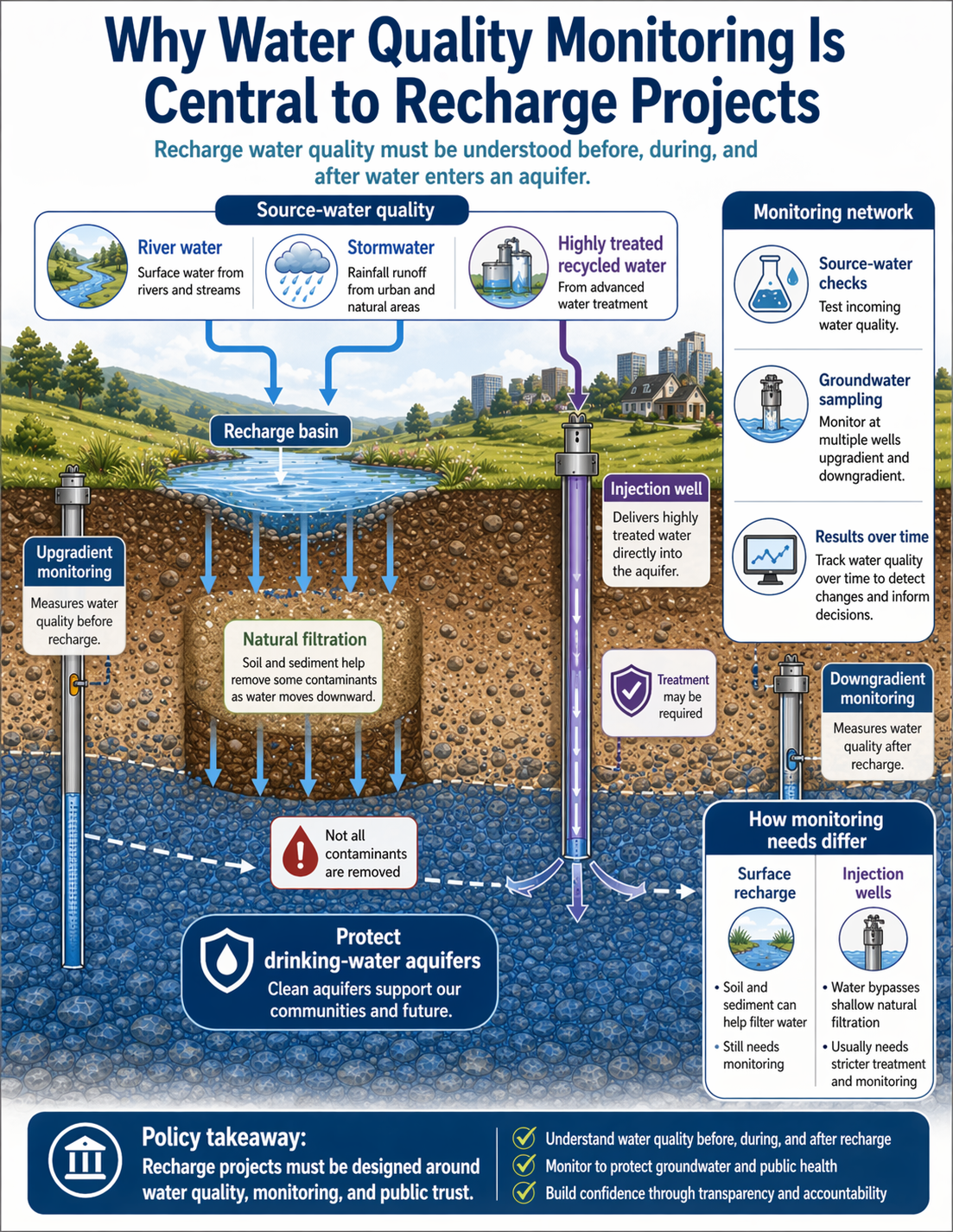
What the visual shows
The visual shows several sources of recharge water, including river water, stormwater, and highly treated recycled water. These sources can enter a managed aquifer recharge system through surface recharge, injection wells, or a combination of methods.
The recharge basin shows water moving downward through soil and sediment. This zone can provide some natural filtration as water moves toward the aquifer.
The injection well shows treated water being placed directly into the aquifer. Because this water bypasses much of the shallow soil and sediment, injection wells usually require stricter water-quality controls and monitoring.
The visual also shows monitoring wells placed before and after the recharge area. These wells help track groundwater quality over time and detect whether recharge is affecting the aquifer.
Why source-water quality matters
Recharge water may come from river water, stormwater, treated wastewater, or combinations of these sources.
Each source has different water-quality characteristics. River water quality may vary with season, upstream land use, sediment, and runoff. Stormwater can carry pollutants from roads, rooftops, parking lots, industrial areas, lawns, and other surfaces. Treated wastewater or recycled water can provide a more reliable supply, but it requires treatment, monitoring, regulatory review, and clear public communication.
Source-water quality affects the entire project. It influences whether treatment is needed, whether surface recharge or injection is appropriate, what permits may be required, and how the project should be monitored.
A recharge project should not assume that all water sources are interchangeable. The source water and the recharge method need to fit the aquifer setting and the project goals.
Natural filtration and its limits
Surface recharge can allow water to move through soil, sediment, and rock before it reaches the aquifer. In some settings, these materials can help filter water by trapping particles, breaking down some contaminants, or allowing chemical reactions that improve water quality.
Natural filtration can be useful, but it has limits. Not all contaminants are removed underground. Some pollutants can move through the soil and reach groundwater. Others may react with aquifer materials in ways that need to be understood before a project begins.
The effectiveness of natural filtration depends on soil type, sediment texture, travel time, groundwater chemistry, contaminant type, and the distance between the recharge area and wells or other groundwater users.
Injection wells require special attention because they place water directly into the aquifer. Since the water bypasses shallow natural filtration, injection projects often need more advanced treatment, tighter operating controls, and more intensive monitoring.
Monitoring networks
A monitoring network is the set of wells, sampling points, tests, and reporting systems used to track water quality and groundwater conditions.
Monitoring should occur before recharge to establish baseline conditions. This helps project managers understand existing groundwater quality before the project begins.
Monitoring should occur during recharge to confirm that operations are working as expected and that the recharge water is not creating water-quality problems.
Monitoring should continue after recharge to track how water moves through the aquifer and whether water quality changes over time.
Monitoring wells can be placed upgradient and downgradient of a recharge site. Upgradient wells help characterize groundwater before it reaches the recharge area. Downgradient wells help detect changes after recharge water has moved through the system.
Groundwater models can also help project managers predict where recharge water may move, how long it may take to reach wells, and where monitoring should be focused. Modeling does not replace monitoring, but the two together can reduce uncertainty.
Why this matters for policy
Water-quality monitoring protects public health, groundwater resources, and public confidence.
For policy staff, monitoring is not simply a technical detail. It affects permitting, project design, operating rules, budgets, public communication, and long-term accountability.
Monitoring can also help identify problems early. If water quality changes, managers may need to adjust treatment, pause recharge, change source water, modify operations, or expand the monitoring network.
Public communication is especially important when treated wastewater or recycled water is used. Communities need clear information about treatment standards, monitoring results, oversight, and how groundwater will be protected.
A recharge project should include monitoring costs and responsibilities from the beginning. If monitoring is underfunded or unclear, the project may be harder to permit, harder to operate, and harder for the public to trust.
Questions policy staff can ask
- What source water will be used for recharge?
- How does water quality vary by source, season, and storm conditions?
- What contaminants are known or possible in the source water?
- What treatment or pretreatment is required before recharge?
- Will the project use surface recharge, injection wells, or both?
- Does the recharge method match the source-water quality?
- What natural filtration is expected, and what are its limits?
- Which contaminants may not be removed by soil or sediment?
- What baseline groundwater-quality data are available?
- Where will monitoring wells be located?
- Will monitoring occur before, during, and after recharge?
- How often will water-quality testing occur?
- Who will review the monitoring results?
- What happens if monitoring detects a water-quality problem?
- How will results be reported to the public?
- How will modeling and monitoring be used together to reduce risk?
Policy takeaway
Water-quality monitoring is not an add-on to recharge projects; it is part of the infrastructure.
Main concept: Water quality must be understood before, during, and after recharge water enters an aquifer.
Core message: The visual explains that recharge projects must be designed around water quality, monitoring, and public trust.
Source-water quality: The guide identifies three source-water types that may be used in recharge projects.
River water: River water is surface water from rivers and streams.
Stormwater: Stormwater is rainfall runoff from urban and natural areas.
Highly treated recycled water: Highly treated recycled water comes from advanced water treatment.
Main recharge system: The visual shows a recharge basin, an injection well, natural filtration, and monitoring wells.
Recharge basin: The recharge basin is where water enters the ground through surface recharge.
Natural filtration: Soil and sediment can help remove some contaminants as water moves downward.
Natural filtration limits: The guide notes that not all contaminants are removed by soil and sediment.
Injection well: The injection well delivers highly treated water directly into the aquifer.
Treatment: The guide notes that treatment may be required before water is recharged.
Upgradient monitoring: Upgradient monitoring measures water quality before recharge.
Downgradient monitoring: Downgradient monitoring measures water quality after recharge.
Monitoring network: The visual shows a monitoring network that tracks water quality over time.
Source-water checks: Incoming water quality is tested before recharge.
Groundwater sampling: Groundwater is monitored at multiple wells, including upgradient and downgradient locations.
Results over time: Water-quality results are tracked over time to detect changes and inform decisions.
Drinking-water protection: The guide emphasizes that clean aquifers support communities and the future.
Surface recharge monitoring: Surface recharge can use soil and sediment to help filter water, but it still needs monitoring.
Injection-well monitoring: Injection wells bypass shallow natural filtration and usually need stricter treatment and monitoring.
Public trust: The guide notes that monitoring helps protect groundwater and public health and builds confidence through transparency and accountability.
Policy takeaway: Recharge projects must be designed around water quality, monitoring, and public trust.