
Where Recharge Water Comes From
Breaks down common water sources for managed aquifer recharge and the tradeoffs associated with river water, stormwater, and treated wastewater.
Managed aquifer recharge needs both a suitable aquifer and a source of water to store. Existing MAR projects commonly use river water, stormwater, treated wastewater, or combinations of these sources.
This matters for water policy because each source has different advantages, limits, water-quality considerations, infrastructure needs, and public-policy tradeoffs.
Download or reuse this guide in briefings and meeting materials.
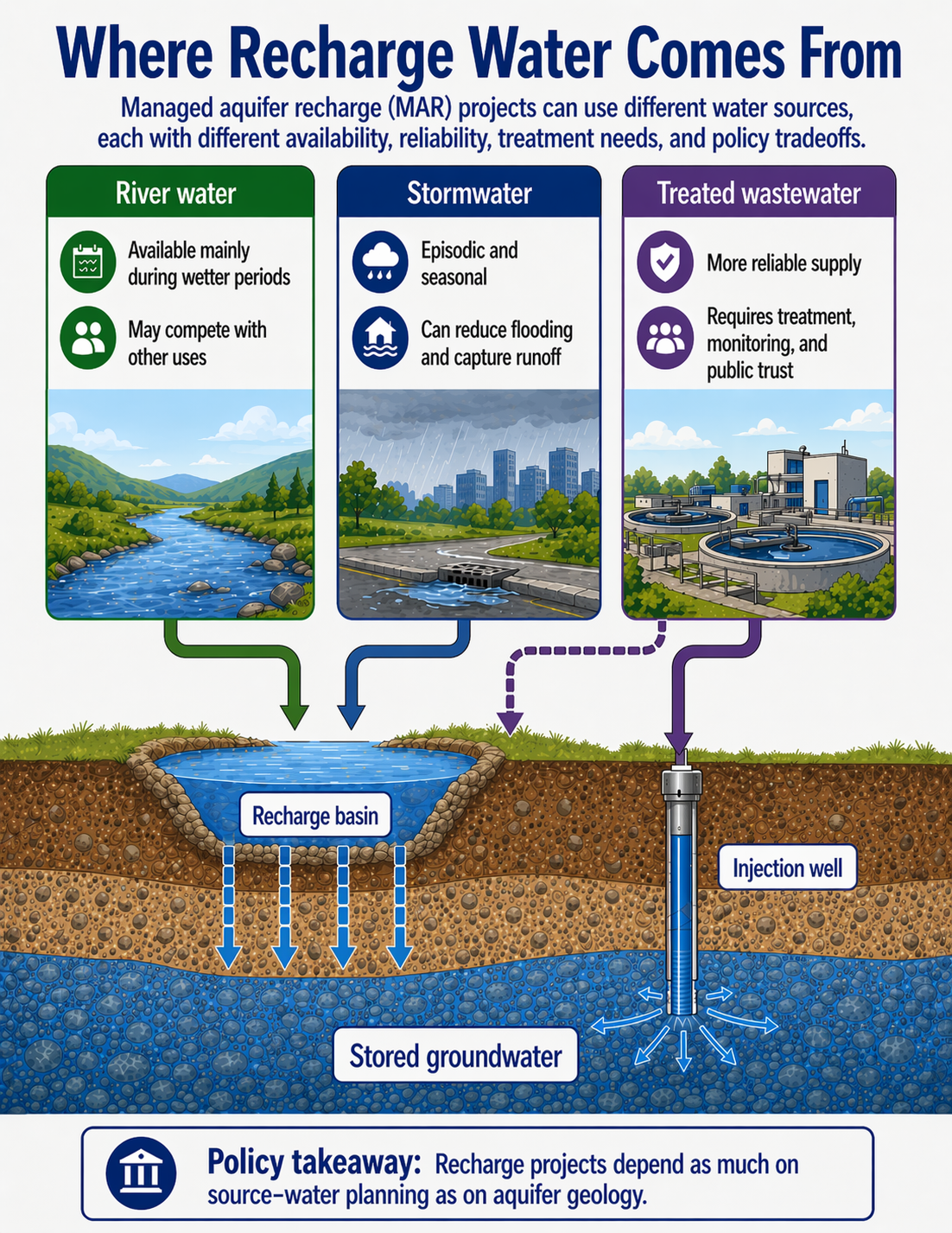
What the visual shows
The visual shows three common water sources that can support managed aquifer recharge: river water, stormwater, and treated wastewater.
River water and stormwater are shown as pathways that can feed a recharge basin, where water can infiltrate downward into the aquifer.
Treated wastewater is shown as a pathway that can feed an injection well, where treated water is delivered below the surface into the aquifer. In some projects, highly treated recycled water may also be used in surface recharge, but the project must meet applicable treatment, monitoring, and regulatory requirements.
The bottom of the visual shows stored groundwater in the aquifer. This emphasizes that source-water planning is part of the recharge system, not a separate issue.
River water
River water can be an important source for managed aquifer recharge, especially during wetter periods when flows are higher.
In some places, river water may be available only seasonally or during wet years. It may also have competing uses, including drinking water, irrigation, ecosystems, hydropower, recreation, downstream water rights, and legal flow requirements.
River water can be relatively high quality in many settings, but quality can vary with upstream land use, storm events, sediment, pollutants, and seasonal conditions.
Policy staff should treat river water as a potentially useful but often variable source. The key questions are when the water is available, who has the legal right to use it, how it will be diverted, and whether diversion will affect downstream users or ecosystems.
Stormwater
Stormwater is water from rain or snowmelt that runs off streets, roofs, parking lots, fields, and other surfaces.
Stormwater is usually episodic and seasonal. It may arrive in short, intense events rather than as a steady supply. This means stormwater recharge projects often need capture, conveyance, sediment control, pretreatment, and space to hold or spread water during storms.
Stormwater recharge can provide multiple benefits. It can reduce flooding, capture water that might otherwise be lost as runoff, and help replenish groundwater where soils and aquifers are suitable.
However, stormwater quality can vary, especially in urban areas. It may carry sediment, metals, oils, nutrients, trash, bacteria, pesticides, or other pollutants. Monitoring, pretreatment, and site design are important for reducing risks.
Treated wastewater
Treated wastewater, also called recycled water in many water-management contexts, can provide a steadier source of water for recharge than river water or stormwater.
Because treated wastewater is produced continuously by communities, it may be less dependent on wet years. It may also face fewer direct competing uses than river water, although recycled water can still have multiple possible uses.
Treated wastewater requires appropriate treatment, monitoring, regulatory approval, and public communication. The level of treatment needed depends on the recharge method, aquifer conditions, intended use, and applicable water-quality standards.
Deep injection often requires stricter water-quality controls than surface infiltration because injected water bypasses much of the natural filtration that can occur as water moves through soil and sediment. Surface recharge can provide some natural filtration, but it does not remove every contaminant.
Public trust is also important. Communities need clear information about treatment standards, monitoring, groundwater protection, and how the recharged water will be used.
Why source water affects project design
The source of recharge water affects nearly every part of a MAR project.
A project using river water may need diversion structures, seasonal operations, water-rights agreements, and ecological safeguards.
A project using stormwater may need drainage connections, sediment basins, pretreatment, flood-management coordination, and enough land or storage capacity to handle short storm events.
A project using treated wastewater may need advanced treatment, pipelines, injection wells or recharge basins, groundwater monitoring, public communication, and clear regulatory approvals.
Water quality varies by source. Monitoring and modeling help project managers understand how recharge water will move underground, how it may interact with aquifer materials, and whether it could affect nearby wells or groundwater users.
Source-water planning also affects reliability. A recharge project that depends only on wet-year river flows may operate differently from one that uses a steadier supply of treated wastewater or a stormwater system designed to capture episodic runoff.
Questions policy staff can ask
- What water source or combination of sources will the project use?
- How reliable is each source across wet years, dry years, and drought?
- Who has the legal right to use the source water?
- Are there competing uses or downstream impacts?
- What treatment is required before recharge?
- How does water quality vary by source and season?
- Will the project use surface infiltration, injection wells, or both?
- Does the recharge method match the source-water quality?
- What monitoring will be used to protect groundwater quality?
- What modeling has been done to predict where the water will go?
- How will the project account for stored water and recovered water?
- How will the public be informed about treatment, safety, and monitoring?
- What happens if the source water is not available in a dry year?
Policy takeaway
A recharge project needs both a place to store water and a reliable, acceptable source of water to store.
Main concept: Managed aquifer recharge projects can use different water sources, each with different availability, reliability, treatment needs, and policy tradeoffs.
Core message: The visual explains that recharge projects depend as much on source-water planning as on aquifer geology.
River water: The guide identifies river water as one possible recharge source.
River water availability: River water is available mainly during wetter periods.
River water tradeoff: River water may compete with other uses.
Stormwater: The guide identifies stormwater as another possible recharge source.
Stormwater availability: Stormwater is episodic and seasonal.
Stormwater benefit: Stormwater recharge can reduce flooding and capture runoff.
Treated wastewater: The guide identifies treated wastewater as a possible recharge source.
Treated wastewater reliability: Treated wastewater can provide a more reliable supply than some seasonal sources.
Treated wastewater requirements: Treated wastewater requires treatment, monitoring, and public trust.
Recharge pathways: The visual shows two main pathways for moving source water into an aquifer.
Recharge basin: Water from sources such as river water and stormwater can be directed to a recharge basin, where it infiltrates downward into the aquifer.
Injection well: Treated wastewater can be directed to an injection well, where it is delivered into the aquifer.
Stored groundwater: Water that enters the aquifer becomes stored groundwater.
Policy takeaway: Recharge projects depend as much on source-water planning as on aquifer geology.