
What Managed Aquifer Recharge Means
Explores how managed aquifer recharge depends on suitable geology, source water, infrastructure, monitoring, and governance.
Managed aquifer recharge is a water-management method that intentionally moves water into a suitable aquifer. The stored groundwater may later be recovered for use during dry periods or managed to support other public benefits.
This matters for water policy because a project may be limited by geology if the aquifer cannot accept, store, transmit, or release water effectively.
Download or reuse this guide in briefings and meeting materials.
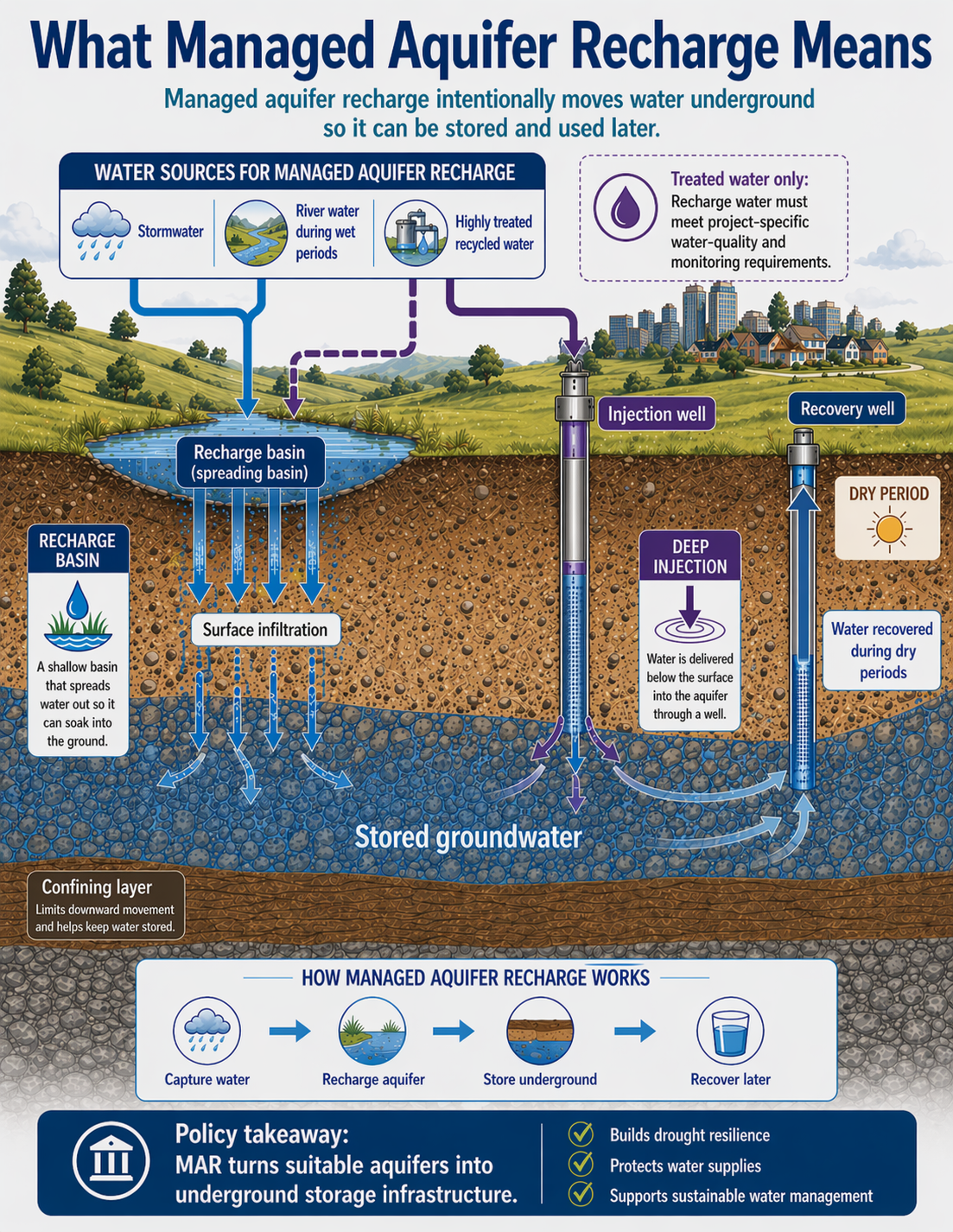
What the visual shows
The visual shows water from several possible sources being directed into an aquifer.
On one side, water enters a recharge basin, also called a spreading basin. This is a shallow basin that spreads water out so it can soak into the ground. The process of water moving downward from the surface is called surface infiltration.
The visual also shows an injection well, where treated water is delivered below the surface into an aquifer. Injection wells can be useful where land is limited or where the target aquifer is deeper.
Underground, the visual shows stored groundwater. During a dry period, a recovery well can pump some of that stored water for use when surface water supplies are limited.
How managed aquifer recharge works
MAR begins with a source of water. Common sources can include stormwater, river water during wet periods, and highly treated recycled water.
The water is then moved into the aquifer using one or more recharge methods. In surface infiltration, water is spread across a basin, pond, or channel and allowed to soak downward through soil and sediment. In deep injection, water is placed directly into an aquifer through a well.
Once underground, the water becomes part of the groundwater system. It may be stored for later recovery, used to help maintain groundwater levels, or managed to support other goals such as reducing saltwater intrusion or preventing land subsidence.
Successful MAR requires more than simply adding water to the ground. Projects need suitable geology, an available water source, infrastructure, water-quality protections, monitoring, and long-term management.
Why communities use MAR
Communities use managed aquifer recharge for several reasons.
MAR can help strengthen water supplies by storing water during wet periods for use during dry periods. This can support drought resilience, especially where surface water supplies vary from year to year.
MAR can also help manage groundwater levels. In areas where groundwater pumping has lowered water levels, recharge can help reduce the risk of land subsidence if the aquifer system and water supply are suitable.
In coastal areas, recharge and injection wells can help maintain freshwater pressure in aquifers, reducing the risk that saltwater will move inland and contaminate freshwater supplies.
MAR can also be connected to stormwater management. Capturing stormwater for recharge can reduce runoff, make use of water that might otherwise be lost, and support local groundwater supplies.
In some settings, surface recharge can also improve water quality as water moves through soil and sediment. However, this natural filtering has limits and does not remove every contaminant.
Policy benefits and limits
MAR can provide important benefits, but it is not appropriate everywhere.
A project may be limited by geology if the aquifer cannot accept, store, transmit, or release water effectively. A project may also be limited by water availability if there is not enough source water during wet periods or if that water has competing uses.
Water quality is another central issue. Recharge water must be suitable for the recharge method and aquifer setting. Injection projects often require especially careful treatment and monitoring because water is placed directly into the aquifer.
Land availability also matters. Surface recharge can require open land with soils that allow infiltration. Injection wells may require less surface land but can involve higher treatment, permitting, engineering, and monitoring needs.
Governance is equally important. MAR projects require clear rules about water rights, accounting, operations, monitoring, recovery, and responsibility for long-term management.
Questions policy staff can ask
- What problem is the MAR project intended to solve?
- Is the goal water supply, drought resilience, subsidence prevention, saltwater-intrusion protection, stormwater management, water-quality improvement, or a combination of these?
- What aquifer will receive the water?
- Is the aquifer suitable for storing and later recovering water?
- What source water will be used?
- Is the source water reliable, seasonal, or dependent on wet years?
- What treatment or water-quality protections are required?
- Will the project use surface infiltration, injection wells, or both?
- What land, infrastructure, permits, and operating agreements are needed?
- How will groundwater levels, water quality, storage, and recovery be monitored?
- Who will manage the project over the long term?
- How will success be measured?
Policy takeaway
Managed aquifer recharge is underground storage infrastructure that requires both suitable geology and sustained management.
Main definition: Managed aquifer recharge intentionally moves water underground so it can be stored and used later.
Core concept: The visual explains that managed aquifer recharge, or MAR, uses suitable aquifers as underground storage infrastructure. Water is captured, moved into an aquifer, stored underground, and recovered later when needed.
Water sources: The guide identifies three water sources for managed aquifer recharge: stormwater, river water during wet periods, and highly treated recycled water.
Treated water note: The visual states that recharge water must meet project-specific water-quality and monitoring requirements.
Main recharge methods: The visual shows two main ways water can be moved underground.
First, recharge basin: A recharge basin, also called a spreading basin, is a shallow basin that spreads water out so it can soak into the ground.
Second, deep injection: Deep injection delivers water below the surface into the aquifer through a well.
Surface infiltration: The guide shows water moving from the recharge basin downward through the ground into the aquifer.
Injection well: The guide shows water being delivered into the aquifer through an injection well.
Stored groundwater: The underground aquifer is shown as the storage zone where recharged water is held for later use.
Recovery well: A recovery well shows how stored groundwater can be pumped back out during dry periods.
Dry period: The visual shows water being recovered during dry periods when stored water may be needed.
Confining layer: A confining layer is shown below the stored groundwater zone. It limits downward movement and helps keep water stored.
Process sequence: The guide summarizes managed aquifer recharge in four steps: capture water, recharge aquifer, store underground, and recover later.
Additional benefits: The visual notes that MAR can build drought resilience, protect water supplies, and support sustainable water management.
Policy takeaway: MAR turns suitable aquifers into underground storage infrastructure.