
What Water Banking Means
Discusses water banking as storing water underground and managing deposits, withdrawals, ownership, recovery rights, and operating limits.
Water banking is a way of storing water underground when water is available and managing its recovery later when water is needed. In practice, it usually relies on managed aquifer recharge, groundwater storage, and a system for tracking who stored water, how much was stored, and under what conditions it can be recovered.
This matters for water policy because water banking is not just a physical storage project. It is also a legal, administrative, and operational system that depends on accounting, rules, monitoring, and long-term management.
Download or reuse this guide in briefings and meeting materials.
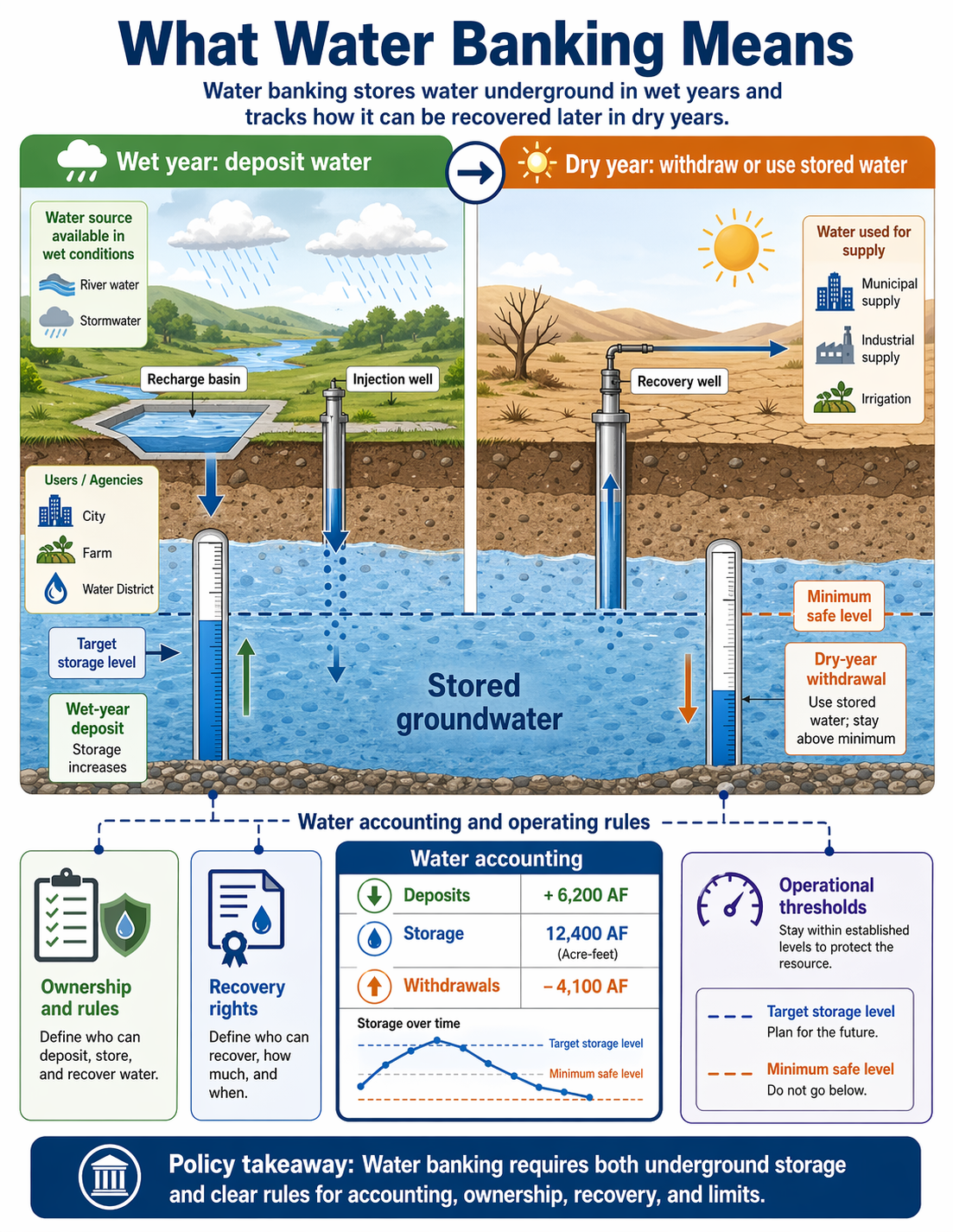
What the visual shows
The visual shows a simple wet-year and dry-year timeline. In the wet-year panel, water from available sources is placed into the ground through a recharge basin or an injection well. This increases stored groundwater in the aquifer.
In the dry-year panel, a recovery well pumps stored water for later use. The visual also includes a ledger or dashboard that tracks deposits, storage, and withdrawals. This emphasizes that water banking depends on accounting as well as underground storage.
The visual also shows operational thresholds such as a target storage level and a minimum safe level. These help show that groundwater storage is finite and that water cannot be withdrawn without limits.
Wet-year deposits
Water banking begins when water is available for storage. This often happens in wet years, high-flow periods, or other times when water supplies exceed immediate demand.
That available water may come from river flows, stormwater, imported water, or other approved sources. It is then directed into a recharge basin, spreading ground, or injection well so it can enter the aquifer.
The goal of a wet-year deposit is to move water underground while conditions allow it. In some places, this creates a reserve that can support water supply during later dry periods. In other cases, it may help stabilize groundwater levels or improve overall system reliability.
A wet-year deposit only becomes useful water banking if the stored water can later be tracked, protected, and recovered under clear rules.
Dry-year withdrawals
In dry years, some of the stored water may be recovered through pumping wells and used for municipal supply, irrigation, industrial use, or other approved purposes.
Dry-year withdrawals are one of the main reasons water banking is attractive. Instead of relying entirely on surface reservoirs or current-year water supplies, communities can store water in advance and use it later when drought or shortages occur.
However, stored water is not automatically available without limits. Recovery depends on groundwater conditions, pumping rules, water rights, infrastructure, and operational thresholds. It also depends on whether the stored water remains recoverable in the aquifer and whether water quality remains acceptable.
Water banking can support drought resilience, but it is not unlimited storage. Aquifer capacity, groundwater levels, and legal rules all place limits on what can be withdrawn.
Why accounting and governance matter
Water banking requires physical recharge, but it also requires legal and administrative accounting.
Someone must track how much water was deposited, how much remains in storage, who has storage credits, who has the right to recover water, and how withdrawals are reported. These systems are often described through terms such as water rights, ownership, storage credits, recovery rules, and accounting agreements.
Governance matters because multiple agencies, landowners, irrigation districts, cities, or water users may be involved. Without clear rules, disputes can arise over who owns stored water, how long it can remain underground, and when it can be pumped.
Accounting also helps distinguish between native groundwater already in the aquifer and water that has been intentionally stored through banking operations. This distinction can be important for regulation, reporting, contracts, and recovery decisions.
In short, water banking works only when physical storage and institutional rules are aligned.
Operational thresholds
Operational thresholds are the limits or targets that help manage the water bank safely and predictably.
A target storage level may represent the desired amount of water to keep in storage for future use. A minimum safe level may represent a groundwater level below which pumping should be limited to protect the aquifer, prevent overdraft, reduce subsidence risk, or protect nearby users.
Operational thresholds can also help define:
- when water can be stored,
- when water can be recovered,
- how much can be pumped in a given period,
- and when operations need to slow down or stop.
These thresholds are important because groundwater levels and storage capacity are finite. A water bank cannot be managed as if the aquifer has unlimited capacity or no competing demands.
Monitoring is needed to track groundwater levels, water quality, and whether stored water remains recoverable over time.
Questions policy staff can ask
- What source water will be used for the water bank?
- Under what conditions can water be deposited?
- What aquifer is being used for storage, and is it suitable for long-term recovery?
- How much water can realistically be stored?
- How much of the stored water is expected to be recoverable later?
- Who owns the stored water?
- How are storage credits tracked and reported?
- What rules define who can withdraw water and when?
- What operational thresholds are in place?
- What is the target storage level?
- What is the minimum safe groundwater level?
- What monitoring is used to track groundwater levels, water quality, and recovery?
- How are conflicts among water users handled?
- What happens during drought if demand exceeds the recoverable stored supply?
- How will the public and decision-makers receive information about deposits, withdrawals, and current storage?
Policy takeaway
Water banking is both a groundwater-storage system and a governance system.
Main concept: Water banking stores water underground in wet years and tracks how it can be recovered later in dry years.
Core message: The visual explains that water banking requires both underground storage and clear rules for accounting, ownership, recovery, and limits.
Timeline: The guide shows a two-part timeline that compares wet-year deposits with dry-year withdrawals.
Wet year deposit: In wet conditions, water is available to be stored underground.
Wet-year water sources: The visual identifies river water and stormwater as possible sources of water during wet conditions.
Recharge infrastructure: The wet-year panel shows a recharge basin and an injection well as ways to move water underground.
Users and agencies: The guide shows multiple users or agencies involved in water banking, including a city, a farm, and a water district.
Storage labels: The wet-year panel includes a target storage level, a wet-year deposit, and an indication that storage increases.
Dry year withdrawal: In dry years, stored water can be withdrawn or used.
Recovery well: The dry-year panel shows a recovery well pumping stored groundwater.
Water uses: Recovered water may be used for municipal supply, industrial supply, or irrigation.
Operating labels: The dry-year panel includes a minimum safe level, a dry-year withdrawal, and a note to use stored water while staying above the minimum level.
Stored groundwater: The main aquifer label identifies the underground storage zone as stored groundwater.
Water accounting and operating rules: The visual explains that water banking includes governance and accounting, not just physical recharge.
Ownership and rules: Ownership and rules define who can deposit, store, and recover water.
Recovery rights: Recovery rights define who can recover stored water, how much can be recovered, and when recovery can occur.
Water accounting: The guide shows a water-accounting example with deposits of plus 6,200 acre-feet, storage of 12,400 acre-feet, and withdrawals of minus 4,100 acre-feet.
Storage over time: The visual tracks storage over time between a target storage level and a minimum safe level.
Operational thresholds: Operational thresholds keep water banking within established levels to protect the resource.
Target storage level: The target storage level helps plan for the future.
Minimum safe level: The minimum safe level is a threshold that should not be crossed.
Policy takeaway: Water banking requires both underground storage and clear rules for accounting, ownership, recovery, and limits.