
Why Recharge Is Also Stormwater Policy
Describes how stormwater management and managed aquifer recharge can overlap when runoff is captured, treated, and directed into suitable aquifers.
Stormwater is often treated as a drainage problem, but in some places it can also be part of a water-supply strategy. When runoff is captured, treated, and directed into a suitable aquifer, stormwater management and managed aquifer recharge can overlap.
This matters for policy because the same rainstorm can produce very different outcomes. Depending on land cover, infrastructure, and site conditions, stormwater can contribute to flooding and pollution, or it can be managed as a local water resource.
Download or reuse this guide in briefings and meeting materials.
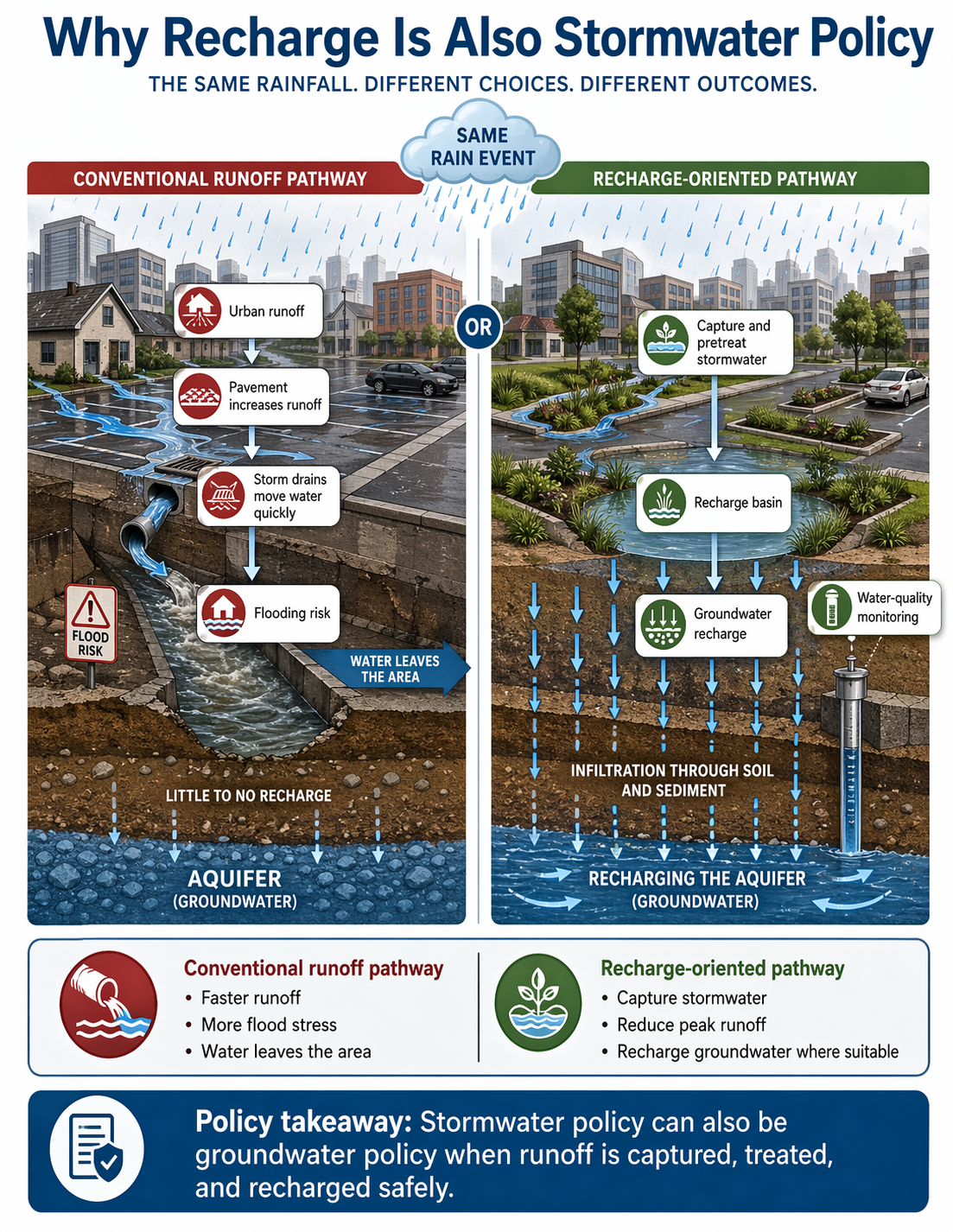
What the visual shows
The visual compares two pathways for the same urban rainfall.
On one side, rainfall lands on rooftops, streets, and other paved surfaces. Because pavement and compacted ground limit infiltration, more water runs off quickly into storm drains and channels. This pathway increases runoff, raises flood stress, and sends water out of the area with little groundwater recharge.
On the other side, rainfall is captured and routed into a recharge-oriented pathway. This side shows stormwater capture, pretreatment, a recharge basin, infiltration through soil and sediment, and water-quality monitoring. Instead of quickly leaving the area, some stormwater is slowed down, treated, and allowed to move into the ground where local geology and water quality make recharge appropriate.
The comparison shows that stormwater can be managed either mainly as something to move away quickly or, in suitable settings, as a resource that can support groundwater recharge.
Stormwater as a problem
Urban runoff can increase flooding, erosion, and water-quality problems.
In developed areas, pavement, rooftops, parking lots, and compacted soils reduce infiltration. That means more rainfall becomes runoff rather than soaking into the ground. Storm drains then move water quickly into channels, streams, or downstream systems. This can create sharp runoff peaks, more localized flooding, streambank erosion, and greater stress on drainage infrastructure.
Stormwater can also carry pollutants. Depending on the area, runoff may contain sediment, trash, oil and grease, metals, nutrients, bacteria, and other contaminants washed off streets, yards, industrial sites, or other surfaces.
Stormwater is also episodic and seasonal. It often arrives in bursts during storms rather than as a steady supply. That makes it harder to manage and means storage, treatment, and conveyance capacity all matter.
Stormwater as a recharge source
Stormwater can also be a recharge source when it is captured and directed into suitable aquifers.
Instead of letting all runoff move quickly offsite, communities may design systems that slow water down, collect it, remove sediment or other pollutants, and route it into recharge basins or other infiltration areas. In places with suitable soils and aquifer conditions, this can allow stormwater to enter the ground and replenish groundwater.
Stormwater managed aquifer recharge can have multiple benefits. It can reduce peak runoff, lower some flood risks, capture water that might otherwise be lost as runoff, and support local groundwater supplies.
However, not every place is suitable. Recharge is appropriate only where aquifer geology, soil conditions, and water quality allow it. Some sites infiltrate too slowly. Some aquifers may be poorly suited for recharge. In other locations, water-quality concerns may require more treatment, more monitoring, or may limit recharge altogether.
Design and water-quality considerations
Stormwater recharge depends on both engineering design and site conditions.
Pretreatment matters. Stormwater often needs some level of pretreatment before recharge. This may include sediment basins, screens, forebays, vegetated systems, or other measures that reduce solids and improve water quality before infiltration.
Sediment control matters. If fine sediments clog a recharge basin, infiltration rates can fall. Projects often need maintenance plans to remove accumulated sediment and keep recharge systems functioning.
Monitoring matters. Water-quality monitoring helps managers understand incoming stormwater, aquifer conditions, and how recharge is affecting groundwater over time. Monitoring can support regulatory compliance and public confidence.
Site selection matters. A site needs suitable soils, enough infiltration capacity, and an aquifer that can accept water safely. It also needs room for infrastructure and operations.
Recharge is not automatic. Even where stormwater capture is possible, recharge should be used only where geology, water quality, and operational capacity support it.
Why this matters for policy
Stormwater recharge links land-use planning, flood management, water supply, and groundwater protection.
Land-use decisions affect how much runoff is produced, where it goes, and whether areas remain available for infiltration or recharge. Flood-management policy affects how quickly water is conveyed and whether floodwater can be captured. Water-supply policy affects whether communities invest in recharge infrastructure as part of a broader resilience strategy. Groundwater policy affects how recharge is permitted, monitored, and integrated with basin management.
For policy staff, this means stormwater decisions can have consequences beyond drainage. A decision about pavement, development patterns, green infrastructure, basin land use, or maintenance can influence flood risk, groundwater recharge, water quality, and long-term supply reliability.
Stormwater can be a nuisance, a flood driver, a pollutant source, or a water resource. Policy choices help determine which of those roles dominates.
Questions policy staff can ask
- How much stormwater currently leaves the area as runoff?
- Which surfaces or land uses are driving the most runoff?
- Are there sites where stormwater could be captured and infiltrated safely?
- Are the soils and subsurface materials suitable for recharge?
- Is the target aquifer appropriate for managed aquifer recharge?
- What pretreatment will be used before recharge?
- What pollutants are likely to be present in the stormwater?
- How will sediment buildup be managed?
- What monitoring will be done before, during, and after recharge?
- How will stormwater recharge affect flood management and drainage operations?
- What agencies are responsible for land use, stormwater, groundwater, and maintenance?
- Is there land available for recharge basins or related infrastructure?
- How will the project balance flood protection, water supply, and groundwater protection goals?
- What would count as successful performance for the project?
Policy takeaway
Stormwater can be a disposal problem or a recharge resource, depending on how it is planned and managed.
Main concept: Recharge is also stormwater policy because the same rainfall can lead to different outcomes depending on how runoff is managed.
Core message: The visual explains that the same rainfall can produce different choices and different outcomes. Stormwater can either leave the area quickly as runoff or be captured, treated, and used to recharge groundwater where conditions are suitable.
Main comparison: The guide compares a conventional runoff pathway with a recharge-oriented pathway.
Conventional runoff pathway: The conventional pathway shows urban runoff moving quickly across paved surfaces and through storm drains.
Pavement increases runoff: Pavement prevents much of the rainfall from soaking into the ground, so more water becomes runoff.
Storm drains move water quickly: Storm drains carry runoff away from the area quickly.
Flooding risk: Faster runoff can increase flood stress and contribute to flooding risk.
Water leaves the area: In the conventional pathway, stormwater is moved away rather than stored locally.
Little to no recharge: Because water runs off quickly, little to no water reaches the aquifer as groundwater recharge.
Aquifer: The aquifer is shown below ground as the groundwater system that receives little recharge in the conventional pathway.
Recharge-oriented pathway: The recharge-oriented pathway shows stormwater being captured and pretreated before it enters a recharge system.
Capture and pretreat stormwater: Stormwater is collected and treated to reduce sediment or pollutants before recharge.
Recharge basin: A recharge basin spreads stormwater so it can soak into the ground.
Infiltration through soil and sediment: Water moves downward through soil and sediment toward the aquifer.
Groundwater recharge: Captured stormwater recharges the aquifer where conditions are suitable.
Water-quality monitoring: Monitoring is included to track water quality and help ensure recharge is done safely.
Comparison summary: The conventional runoff pathway leads to faster runoff, more flood stress, and water leaving the area. The recharge-oriented pathway captures stormwater, reduces peak runoff, and recharges groundwater where suitable.
Policy takeaway: Stormwater policy can also be groundwater policy when runoff is captured, treated, and recharged safely.