
Why Pavement Changes Runoff
Breaks down how pavement and other impervious surfaces reduce infiltration, speed runoff, and can increase flood peaks downstream.
Pavement does not create more rainfall, but it changes what rainfall does after it hits the ground. When land is covered by roads, parking lots, roofs, and other impervious surfaces, less water can soak into the soil and more of it becomes fast-moving runoff.
This matters because flood behavior is shaped not only by how much rain falls, but also by how quickly water moves across the landscape. A clearer understanding of runoff helps policy staff connect development patterns, stormwater systems, and flood outcomes.
Download or reuse this guide in briefings and meeting materials.
What the visual shows
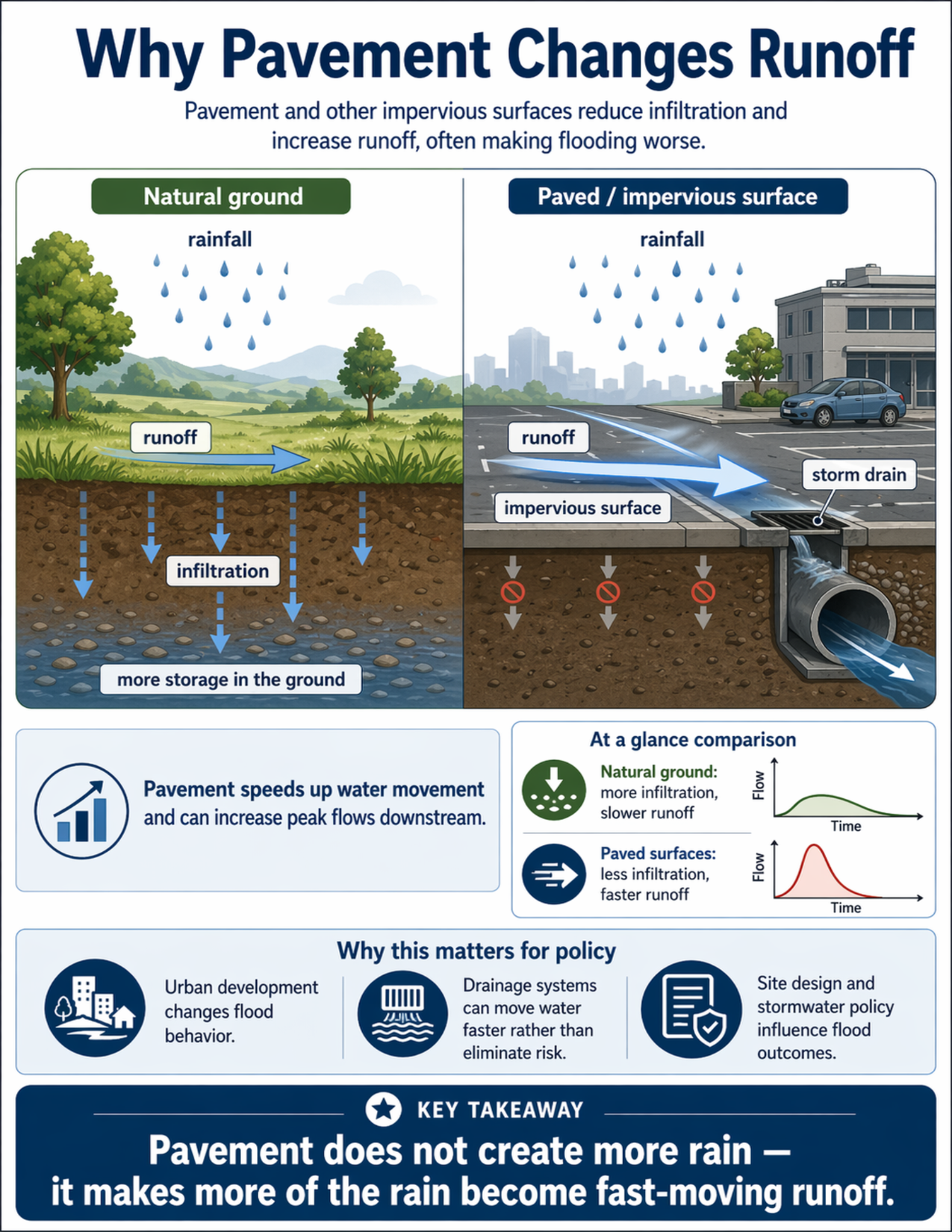
The visual compares two surfaces under the same rainfall: natural ground and paved or impervious surface.
On the natural ground side, rainfall falls onto soil and vegetation. Some water moves across the surface as runoff, but much of it infiltrates into the ground. The guide shows downward arrows into the soil and notes that this increases storage in the ground.
On the paved side, rainfall falls onto an impervious surface. Because the surface prevents infiltration, water moves quickly across it as runoff. The runoff is directed into a storm drain and then into a pipe, moving water rapidly away from the site.
A comparison box summarizes the difference. Natural ground has more infiltration and slower runoff. Paved surfaces have less infiltration and faster runoff. The guide also emphasizes that pavement speeds up water movement and can increase peak flows downstream.
Why this matters for policy
Urban development changes how water moves. When natural land is replaced with impervious surfaces, less water is absorbed into the ground and more water reaches drainage systems and channels quickly.
This affects how flood risk is managed. Storm drains and pipes can move water away from one location, but they do not eliminate the water itself. In many cases, they move it faster and can contribute to sharper flood peaks downstream.
This concept matters for site design, stormwater policy, drainage standards, floodplain planning, and resilience discussions. Policy staff often need to look not only at rainfall totals, but also at how land cover and drainage design affect runoff timing and concentration.
Key terms
Runoff
Water that flows over land rather than soaking into the ground.
Infiltration
The process of water soaking into soil or other geologic materials.
Impervious surface
A surface, such as pavement or rooftops, that prevents or greatly reduces infiltration.
Storm drain
A structure that collects surface runoff and routes it into pipes or drainage systems.
Peak flow
The highest flow reached during a runoff or flood event.
Stormwater policy
Rules, standards, or planning approaches that govern how runoff is managed in developed areas.
Questions policy staff can ask
- How much surface area in this project or neighborhood is impervious?
- How much rainfall is soaking into the ground versus becoming runoff?
- Are drainage systems reducing harm at one site while increasing it elsewhere?
- How quickly is water being routed into streams or channels?
- Are there opportunities to increase infiltration through design changes?
- How do pavement, parking, roads, and rooftops affect local flood behavior?
- Do stormwater standards address runoff timing as well as runoff volume?
- How might site design influence downstream flood peaks?
Policy takeaway
Pavement does not create more rain—it makes more of the rain become fast-moving runoff.
Main concept: Pavement and other impervious surfaces reduce infiltration and increase runoff, often making flooding worse.
Main comparison: The visual shows a side-by-side comparison between natural ground and paved or impervious surface.
Natural ground: Rainfall falls onto soil and vegetation. Some water runs off slowly across the surface. Much of the water infiltrates downward into the ground. The visual labels rainfall, runoff, infiltration, and more storage in the ground.
Paved or impervious surface: Rainfall falls onto pavement. Water moves quickly across the surface as runoff. Little or no water infiltrates into the ground. The runoff is directed into a storm drain and pipe. The visual labels rainfall, runoff, impervious surface, and storm drain.
Comparison: A section compares natural ground and paved surfaces at a glance. Natural ground has more infiltration and slower runoff. Paved surfaces have less infiltration and faster runoff.
Downstream effect: The guide states that pavement speeds up water movement and can increase peak flows downstream.
Policy relevance: The guide notes that urban development changes flood behavior, drainage systems can move water faster rather than eliminate risk, and site design and stormwater policy influence flood outcomes.
Key takeaway: Pavement does not create more rain; it makes more of the rain become fast-moving runoff.