
What Is Liquefaction?
Explains how liquefaction occurs when loose, water-saturated sandy or silty soils temporarily lose strength during earthquake shaking.
Liquefaction is a type of earthquake-related ground failure. It happens when loose, water-saturated sandy or silty soils temporarily lose strength during shaking and behave more like a liquid than a stable solid.
This matters for policy because liquefaction can damage buildings, roads, bridges, pipelines, utilities, port facilities, and other infrastructure, especially in low-lying areas with young sediments, near rivers, coastlines, deltas, or filled land.
Download or reuse this guide in briefings and meeting materials.
What Is Liquefaction?
Liquefaction is a type of earthquake-related ground failure. It happens when loose, water-saturated sandy or silty soils temporarily lose strength during strong shaking and behave more like a liquid than a stable solid.
This can cause the ground to settle, tilt, crack, or move sideways. Even in flat areas, liquefaction can damage buildings, roads, bridges, utilities, pipelines, and other infrastructure.
What the visual shows
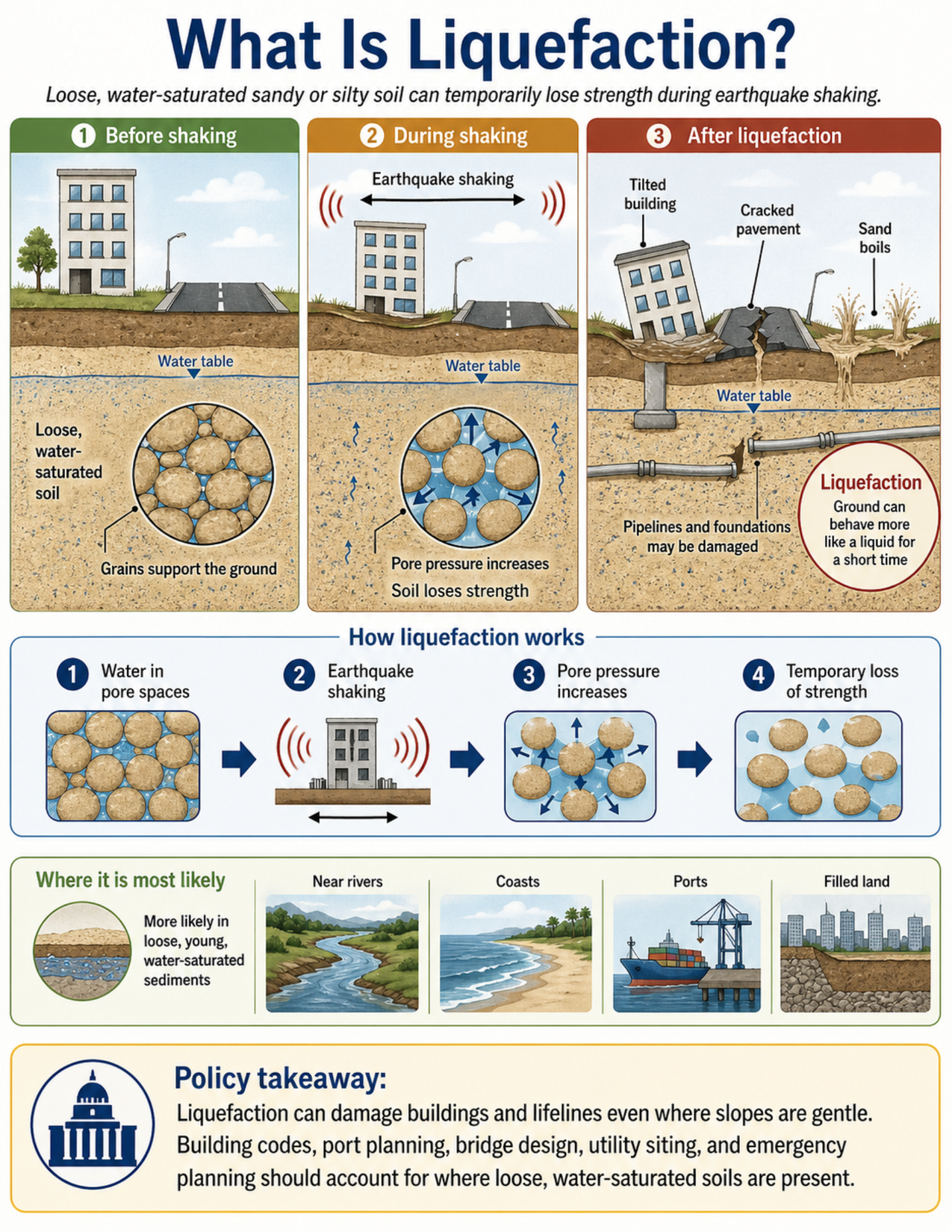
The visual explains liquefaction in a simple before-during-after sequence. It shows how the same ground can behave differently before shaking, during shaking, and after liquefaction has occurred.
In the before shaking panel, the soil is loose and water-saturated, but the grains are still in contact with one another. A water table is shown below the ground surface. The grain contact helps the soil support the ground, buildings, and roads above.
In the during shaking panel, earthquake shaking disturbs the loose sandy or silty soil. The grains jostle, and water pressure in the spaces between them increases. As the pressure increases, the grains can lose firm contact with one another. This reduces the soil’s ability to support weight.
In the after liquefaction panel, the visual shows the results: ground settlement, a tilted building, cracked pavement, sand boils, and damaged pipelines or foundations. These effects show how liquefaction can disrupt both structures and buried infrastructure.
The visual also includes a simplified process strip showing water in pore spaces, earthquake shaking, increased pore pressure, and temporary loss of strength. A lower section highlights where liquefaction is most likely, including near rivers, coastlines, ports, and filled land.
Why this matters for policy
Liquefaction is important because earthquake risk is not only about how much buildings shake. It is also about whether the ground beneath them stays strong and stable during the earthquake.
Liquefaction happens most often in loose, water-saturated sandy or silty soils. These conditions are common in low-lying areas with young sediments, near rivers, deltas, coastlines, ports, and filled land. These are often places where communities also have roads, utilities, housing, commercial buildings, and critical infrastructure.
Liquefaction is different from a landslide. A landslide is downslope movement of soil or rock. Liquefaction is a loss of strength in loose saturated soil during shaking. Liquefaction can still lead to movement, including settlement, tilting, cracking, and sometimes lateral spreading, where the ground moves sideways toward a riverbank, shoreline, or other open edge.
Signs of liquefaction can include sand boils, settlement, tilted structures, cracked pavement, and lateral spreading. Damage may affect buildings, roads, bridge approaches, port facilities, pipelines, buried utilities, and emergency access routes.
Policy responses may include hazard maps, building codes, geotechnical site investigations, infrastructure design standards, utility planning, retrofits, and emergency planning. These help communities identify susceptible ground and reduce damage before an earthquake occurs.
Key terms
Liquefaction
A type of earthquake-related ground failure in which loose, water-saturated sandy or silty soil temporarily loses strength during shaking.
Saturated soil
Soil in which the spaces between grains are filled with water.
Shaking
Ground motion caused by an earthquake. Shaking can change how soil behaves.
Pore pressure
The pressure of water in the spaces between soil grains. During shaking, pore pressure can increase.
Loss of strength
A reduction in the soil’s ability to support weight or resist movement.
Settlement
Downward sinking of the ground surface. Liquefaction can cause buildings, roads, and utilities to settle unevenly.
Lateral spreading
Sideways movement of ground, often toward a riverbank, shoreline, or other open edge. Liquefaction can contribute to this kind of movement.
Sand boils
Small eruptions of water and sand at the ground surface caused by pressure pushing sediment upward during liquefaction.
Water table
The underground level below which soil or sediment is saturated with groundwater.
Site investigation
A study of local ground conditions, including soil, sediment, and groundwater, to help assess hazard and design needs.
Questions policy staff can ask
- Is the site in an area mapped for liquefaction susceptibility?
- Are loose sandy or silty soils present beneath the site?
- Is shallow groundwater present, or is the site in a low-lying area where soils may be saturated?
- Is the area near a river, delta, coastline, port, waterfront, or filled land?
- Could liquefaction affect buildings, bridge approaches, roads, utilities, pipelines, or emergency routes?
- Could liquefaction contribute to settlement, tilted structures, cracked pavement, or lateral spreading?
- Are site investigations required before development or infrastructure investment?
- Do building codes and engineering standards address liquefaction risk?
- Are buried utilities and lifelines designed to tolerate ground deformation?
- Do emergency plans account for ground failure in flat areas as well as on steep slopes?
Policy takeaway
Liquefaction shows that earthquake risk is not just about shaking intensity. It also depends on what kind of ground is beneath people, buildings, and infrastructure.
Main concept: Liquefaction is a type of earthquake-related ground failure.
Core message: The visual explains that liquefaction happens when loose, water-saturated sandy or silty soils temporarily lose strength during earthquake shaking and behave more like a liquid than a stable solid.
Before shaking: The first panel shows stable ground above a layer of loose, water-saturated soil below the water table. Soil grains are in firm contact and are able to support the ground above.
During shaking: The second panel shows earthquake shaking disturbing the soil. Water pressure in the soil increases, grain-to-grain contact is reduced, and the soil loses strength.
After liquefaction: The third panel shows ground settlement, a tilted building, cracked pavement, sand boils, and damaged pipelines or foundations. These effects illustrate how infrastructure can be damaged when the ground loses strength.
Process explanation: The visual includes a simple sequence showing water in pore spaces, earthquake shaking, increased pore pressure, and temporary loss of strength.
Likely settings: The visual highlights that liquefaction is more likely in loose, young, water-saturated sediments, especially near rivers, coasts, ports, and filled land.
Policy takeaway: Liquefaction shows that earthquake risk is not just about shaking intensity. It also depends on what kind of ground is beneath people, buildings, and infrastructure.