
What Makes a Slope Stable or Unstable?
Explains how slope stability depends on the balance between driving forces that pull material downslope and resisting forces that hold soil and rock in place.
A slope can look stable at the surface, but its stability depends on the balance between forces pulling material downhill and forces holding it in place. Changes in water, grading, vegetation, added weight, or ground strength can shift that balance toward failure.
This matters for land-use and infrastructure policy because drainage, grading, vegetation, setbacks, road cuts, and geotechnical review all affect whether land can safely support buildings, roads, utilities, and other infrastructure.
Download or reuse this guide in briefings and meeting materials.
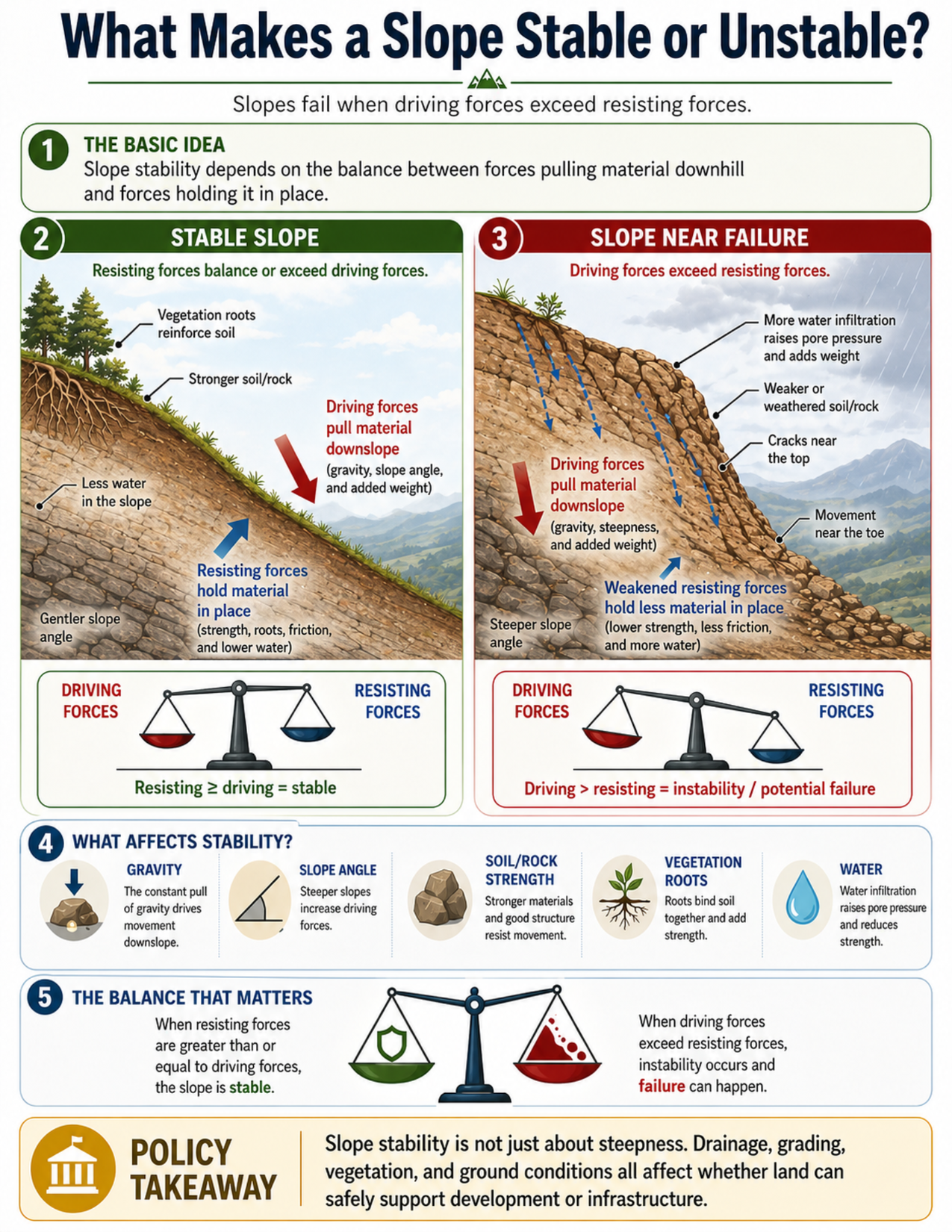
What Makes a Slope Stable or Unstable?
Slopes fail when the forces pulling material downslope become stronger than the forces holding it in place. A hillside can look stable at the surface, but changes in water, grading, vegetation, added weight, or ground strength can shift that balance toward failure.
What the visual shows
The visual compares a stable slope with a slope near failure.
On the stable slope, resisting forces are strong enough to balance or exceed the forces pulling material downhill. These resisting forces include soil and rock strength, friction between particles and surfaces, vegetation roots, and lower water content in the slope.
On the slope near failure, driving forces are stronger. Steeper slope angle, gravity, added weight near the top of the slope, and water entering the ground can increase the chance that material will move downslope. Cracks near the top of the slope, bulging near the toe, or movement along a possible failure surface can be signs that the slope is losing stability.
The balance-scale diagrams show the central idea: when resisting forces are greater than or equal to driving forces, the slope is more stable. When driving forces exceed resisting forces, instability or failure can occur.
Why this matters for policy
Slope stability is directly relevant to land-use planning, infrastructure design, emergency management, and public safety. Decisions about where to allow development, how roads are cut into hillsides, how stormwater is routed, and how much setback is required from steep slopes can all affect whether land remains stable.
Policy staff do not need to calculate slope stability themselves, but they do need to understand what kinds of decisions can increase or reduce risk. Grading, road cuts, vegetation removal, poor drainage, leaking pipes, irrigation, and added structures can all change the balance of forces on a slope.
This is why slope setbacks, drainage controls, grading standards, geotechnical review, and maintenance requirements are important. These tools help identify where slopes may need additional investigation, design standards, monitoring, or limits on development.
Key terms
Driving forces
Forces that pull material downslope. These include gravity, slope angle, added weight from buildings or fill, and water that adds weight or pressure inside the slope.
Resisting forces
Forces that help hold slope material in place. These include soil strength, rock strength, friction, vegetation roots, and engineered support such as retaining structures.
Failure surface
The surface or zone along which soil, rock, or debris may slide or move.
Pore pressure
Water pressure in the spaces between soil grains or within cracks in rock. Higher pore pressure can reduce the strength of a slope.
Slope setback
A required distance between development and a slope, bluff, or unstable area. Setbacks help reduce exposure to slope movement or collapse.
Geotechnical review
A technical evaluation of soil, rock, groundwater, and slope conditions, usually conducted by qualified professionals, to assess whether a site can safely support development or infrastructure.
Questions policy staff can ask
- Is the site on or near a steep slope, bluff, road cut, or previously mapped landslide area?
- Has the slope been modified by grading, excavation, fill, road construction, or retaining walls?
- How is stormwater routed across or into the slope?
- Are there signs of instability, such as cracks, bulging, leaning trees, tilted walls, or repeated pavement damage?
- Has vegetation been removed, burned, or significantly altered?
- Could buildings, roads, utilities, or fill add weight near the top of the slope?
- Is a geotechnical review needed before permitting, construction, or repair?
- Are setback, drainage, inspection, or maintenance requirements appropriate for the site?
Policy takeaway
Slope stability is a balance of forces, not just a question of whether a hillside looks steep or safe.
Main concept: Slopes fail when driving forces pulling material downslope exceed resisting forces holding material in place.
Core message: The visual explains that slope stability depends on a balance of forces, not simply on whether a hillside looks steep or safe.
Basic idea: Slope stability depends on the balance between forces pulling material downhill and forces holding it in place.
Stable slope panel: The left side of the visual shows a stable slope where resisting forces balance or exceed driving forces.
Stable slope conditions: The stable slope includes vegetation roots that reinforce soil, stronger soil and rock, less water in the slope, and a gentler slope angle.
Driving forces on the stable slope: A red arrow shows that driving forces pull material downslope. These forces are influenced by gravity, slope angle, and added weight.
Resisting forces on the stable slope: A blue arrow shows that resisting forces hold material in place. These forces are influenced by soil and rock strength, vegetation roots, friction, and lower water content.
Stable slope balance: The balance scale under the stable slope shows that resisting forces are greater than or equal to driving forces, which means the slope is stable.
Slope near failure panel: The right side of the visual shows a slope near failure where driving forces exceed resisting forces.
Near-failure slope conditions: The slope near failure includes more water infiltration, weaker or weathered soil and rock, cracks near the top, movement near the toe, and a steeper slope angle.
Water effects: More water infiltration can raise pore pressure, add weight, reduce friction, and weaken the slope.
Weakened resisting forces: The visual shows that resisting forces may become weaker when material strength is lower, friction is reduced, and more water is present in the slope.
Near-failure balance: The balance scale under the slope near failure shows that driving forces are greater than resisting forces, which can lead to instability or potential failure.
What affects stability: The guide identifies gravity, slope angle, soil and rock strength, vegetation roots, and water as major factors affecting slope stability.
Balance that matters: When resisting forces are greater than or equal to driving forces, the slope is stable. When driving forces exceed resisting forces, instability and failure can happen.
Policy takeaway: Slope stability is not just about steepness. Drainage, grading, vegetation, and ground conditions all affect whether land can safely support development or infrastructure.