
The Role of Gravity, Slope Angle, and Material Strength
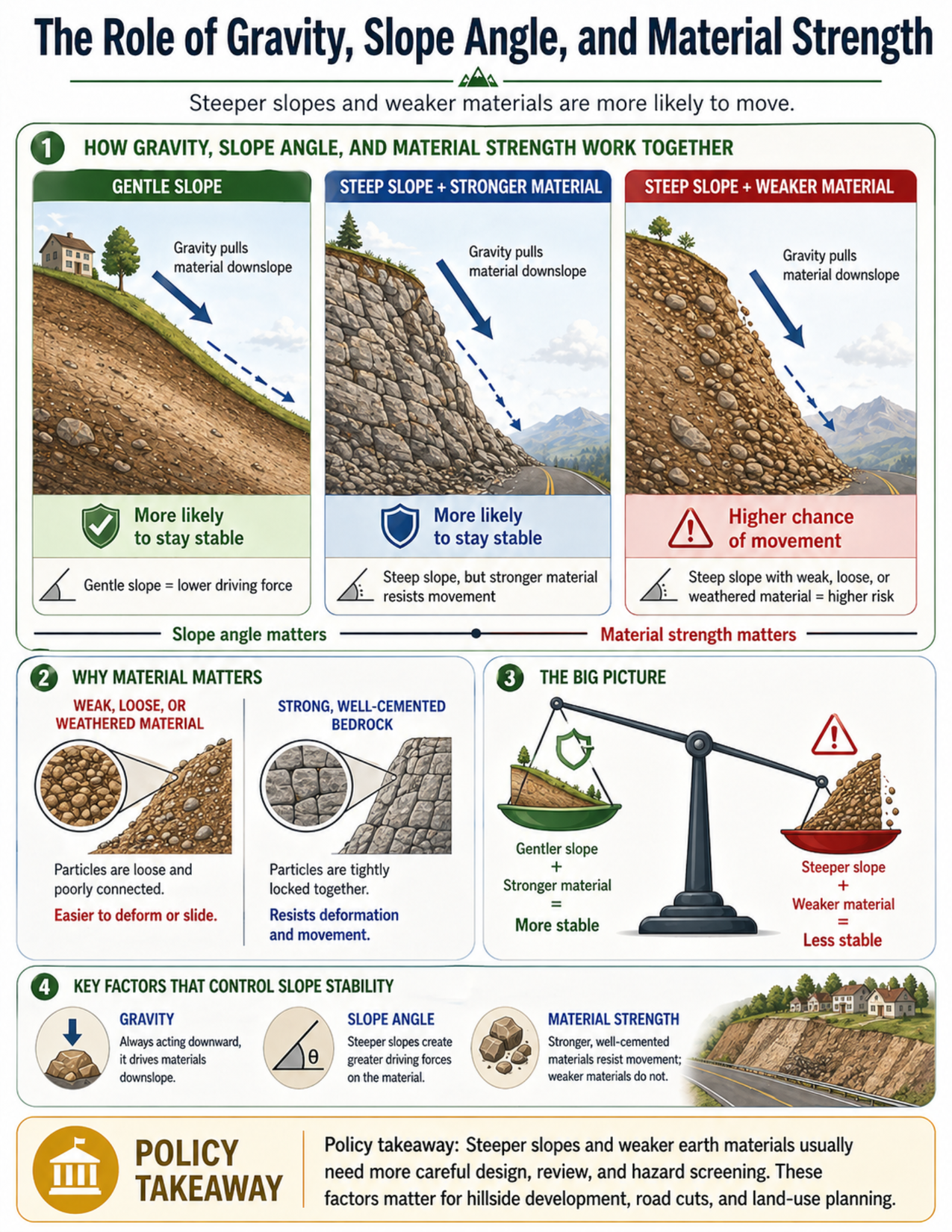
Describes how gravity, slope angle, and material strength work together to influence whether slopes are more likely to remain stable or move.
Gravity acts on every slope, but slope angle and material strength affect how likely earth materials are to move. Steeper slopes and weaker materials generally create greater land-instability concerns than gentler slopes and stronger materials.
This matters for land-use and infrastructure policy because hillside development, road cuts, excavation, grading, and setbacks all depend on both the steepness of a slope and the strength of the soil or rock present.
Download or reuse this guide in briefings and meeting materials.
The Role of Gravity, Slope Angle, and Material Strength
Gravity pulls material downslope on every hillside. Whether that material actually moves depends partly on the steepness of the slope and partly on the strength of the soil, rock, or fill that makes up the slope.
Steeper slopes and weaker materials are generally more likely to move than gentler slopes and stronger materials. A steep slope made of strong bedrock may be more stable than a gentler slope made of very weak material, depending on local conditions.
What the visual shows
The visual compares three slope settings.
The first panel shows a gentle slope. Gravity still pulls material downslope, but the lower slope angle means the downslope driving force is smaller. This setting is shown as more likely to stay stable.
The second panel shows a steep slope made of stronger material. The slope is steep, so gravity creates a stronger downslope pull. However, strong bedrock or well-cemented material can resist movement better than loose or weak material.
The third panel shows a steep slope made of weaker material. The slope is steep and the material is loose, weak, or weathered. This combination is shown as having a higher chance of movement.
The visual also compares weak, loose, or weathered material with strong, well-cemented bedrock. Loose particles are easier to deform or slide because they are poorly connected. Stronger material is more tightly locked together and better able to resist movement.
Why this matters for policy
Slope angle and material strength are basic factors in hillside development, infrastructure siting, road-cut design, and hazard mapping. A parcel, road corridor, trail, utility line, or public facility may face different stability concerns depending on both how steep the land is and what kind of material is present.
Road cuts, excavation, and hillside grading can make slopes steeper than they were before. Added fill can also create instability if the fill is poorly compacted, placed on weak material, or built on a slope without adequate drainage or design. In some places, engineered fill may behave differently from natural soil or bedrock and may require special review.
Hazard maps and geotechnical reviews often consider slope angle, geology, soil type, weathering, fractures, clay-rich layers, groundwater, and previous movement. These factors help agencies decide when setbacks, drainage controls, slope design standards, monitoring, or additional investigation are needed.
Key terms
Gravity
The force that pulls material downward. On a slope, gravity also contributes to downslope movement.
Slope angle
How steep a slope is. Steeper slopes generally create greater downslope driving forces.
Material strength
The ability of soil, rock, sediment, or fill to resist deformation or movement.
Weathered rock
Rock that has been weakened or broken down by exposure to water, air, temperature changes, roots, or chemical processes.
Loose soil or sediment
Material such as sand, gravel, or uncompacted soil that may be poorly connected and easier to move.
Clay-rich material
Soil or sediment containing significant clay. Some clay-rich layers can weaken when wet, expand or shrink with moisture changes, or form weak surfaces where movement can occur.
Fractured bedrock
Rock that contains cracks or breaks. Fractures can reduce strength, allow water movement, and create surfaces where blocks may loosen or slide.
Engineered fill
Soil, rock, or other material placed during construction. Properly designed and compacted fill can support development, but poorly placed or poorly drained fill can increase instability.
Questions policy staff can ask
- Is the site on a gentle slope, moderate slope, steep slope, road cut, bluff, or fill slope?
- What materials make up the slope: strong bedrock, fractured rock, weathered rock, loose soil, clay-rich layers, or engineered fill?
- Has the slope been steepened by grading, excavation, road construction, or previous development?
- Is the slope made of natural material, placed fill, or a combination of both?
- Are there weak layers, fractures, seepage zones, or signs of previous slope movement?
- Could development, roads, retaining walls, or utilities add load to a steep or weak slope?
- Does a hazard map identify this area as susceptible to landslides or other ground movement?
- Is geotechnical review needed before approving development, repairs, or infrastructure work?
- Are setbacks, drainage controls, slope-design standards, or monitoring requirements appropriate?
Policy takeaway
Gravity affects every slope, but steeper slopes and weaker materials are more likely to create land-instability problems that require planning, design, and review.
Main concept: Gravity pulls earth materials downslope, and steeper slopes with weaker materials are generally more likely to move.
Core message: The visual explains that slope stability depends on both slope angle and material strength, not on steepness alone.
Gravity: Gravity acts on all slopes. It constantly pulls soil, rock, sediment, and debris downward and downslope.
Slope angle: Slope angle affects how strongly gravity contributes to downslope movement. Gentler slopes usually have lower driving forces, while steeper slopes usually have greater driving forces.
Material strength: Material strength affects how well soil and rock resist movement. Strong, well-cemented, or intact materials tend to resist movement better than weak, loose, weathered, or poorly connected materials.
Gentle slope panel: The first panel shows a gentle slope with a lower downslope driving force. It is labeled as more likely to stay stable.
Steep slope with stronger material panel: The second panel shows a steep slope made of stronger material. Although gravity still pulls material downslope, strong material can resist movement.
Steep slope with weaker material panel: The third panel shows a steep slope made of weak, loose, or weathered material. It is labeled as having a higher chance of movement.
Material comparison: The guide compares weak, loose, or weathered material with strong, well-cemented bedrock. Loose particles are poorly connected and easier to deform or slide, while strong bedrock is more tightly locked together and resists deformation and movement.
Big picture: The visual summarizes the main pattern: gentler slope plus stronger material is generally more stable, while steeper slope plus weaker material is generally less stable.
Key factors: The guide identifies gravity, slope angle, and material strength as key controls on slope stability.
Policy connection: Road cuts, excavation, hillside grading, engineered fill, and development can change slope angle or place infrastructure on materials with different strengths.
Policy takeaway: Gravity affects every slope, but steeper slopes and weaker materials are more likely to create land-instability problems that require planning, design, and review.