
Why Coastal Bluffs Collapse
Explains how coastal bluffs can collapse when waves erode the base while rainfall, groundwater, fractures, and gravity weaken the upper bluff.
Coastal bluffs are shaped by both shoreline erosion and slope processes. Waves can remove support at the base while rainfall, groundwater, cracks, and gravity weaken the bluff from above.
This matters for coastal policy because bluff retreat can happen gradually over time, but individual collapses can occur suddenly. Setbacks, drainage management, infrastructure siting, shoreline planning, and managed retreat all affect risk where development is close to the bluff edge.
Download or reuse this guide in briefings and meeting materials.
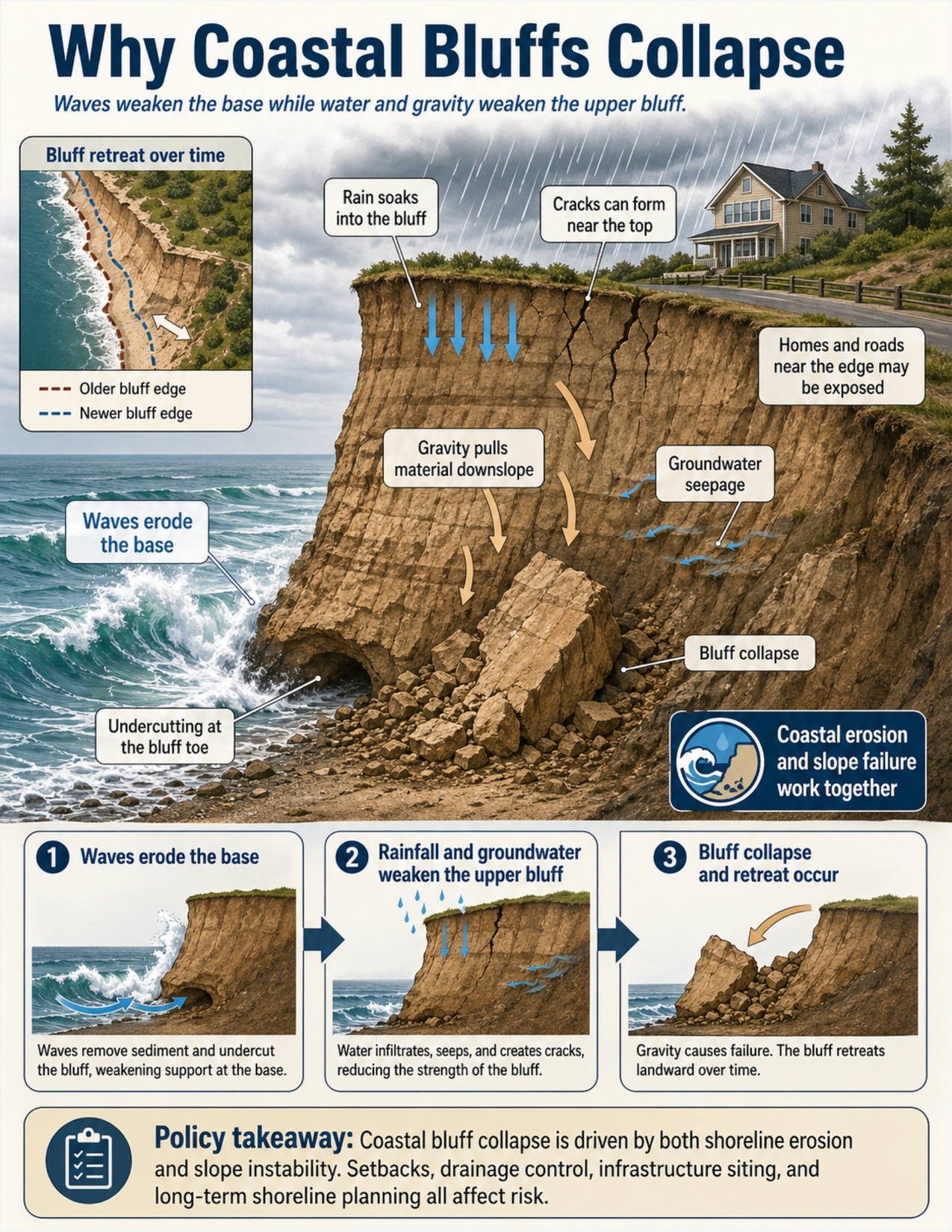
Why Coastal Bluffs Collapse
Coastal bluffs are shaped by both marine erosion and slope processes. Waves can erode the base of the bluff, while rainfall, groundwater, cracks, and gravity weaken the upper bluff.
Bluff retreat may happen gradually over many years, but a single collapse can happen suddenly. This makes coastal bluff hazards important for land-use planning, infrastructure siting, public access, and long-term shoreline policy.
What the visual shows
The visual shows a coastal bluff cross-section next to the ocean. Waves are striking the base of the bluff and removing material from the bluff toe. This creates an undercut area where the base has been eroded and the upper bluff has less support.
At the top of the bluff, rain falls on the land surface and soaks into bluff materials. Blue arrows show water moving downward into the bluff. Groundwater seepage emerges from the bluff face, and cracks form near the top. These features show that the upper bluff can weaken from water and internal deformation.
Gravity pulls weakened bluff material downslope. The visual shows a block of bluff material collapsing toward the beach, with rock and sediment accumulating at the base.
An inset shows bluff retreat over time. The older bluff edge is farther seaward, and the newer bluff edge is farther inland. This illustrates that coastal bluff failure is part of a longer-term process of shoreline change.
A three-step sequence summarizes the process: waves erode the base, rainfall and groundwater weaken the upper bluff, and bluff collapse and retreat occur.
Why this matters for policy
Coastal bluff collapse is not caused by one process alone. It often reflects the interaction of wave erosion, rainfall, groundwater, bluff materials, cracks, gravity, and development choices near the edge.
Waves can remove support at the base of the bluff. Once the base is undercut, the upper bluff may be more likely to slump, slide, or collapse. Rainfall and groundwater can further reduce stability by adding water, increasing seepage, and weakening the materials that make up the bluff.
Bluff retreat may look gradual on maps or aerial images, but individual failures can happen suddenly. A home, road, trail, utility, or public access area near the edge may be exposed even if the bluff appeared stable before the collapse.
Sea-level rise can increase the frequency or extent of wave attack at the bluff base by allowing waves to reach higher or farther inland. Shoreline armoring, such as seawalls or revetments, may reduce erosion in some locations, but it can also change erosion patterns, beach width, sediment movement, and public access. These tradeoffs are important in long-term shoreline planning.
Policy responses may include bluff setbacks, drainage controls, infrastructure siting decisions, monitoring, risk disclosure, public-access planning, shoreline management, and managed retreat where long-term exposure is difficult to reduce.
Key terms
Coastal bluff
A steep slope or cliff along the coast, often made of soil, sediment, rock, or a combination of materials.
Marine erosion
Erosion caused by ocean waves, tides, currents, and storm surge.
Bluff toe
The base of the bluff where the slope meets the beach or shoreline.
Undercutting
Removal of material from the base of a slope or bluff. Undercutting can reduce support for the upper bluff.
Groundwater seepage
Water moving through the ground and emerging from the bluff face. Seepage can weaken materials and contribute to erosion.
Bluff retreat
The landward movement of the bluff edge over time as erosion and collapse remove material.
Setback
A required distance between development and a hazard area, such as a bluff edge. Setbacks help reduce exposure to collapse and long-term retreat.
Shoreline armoring
Structures such as seawalls, revetments, or riprap intended to reduce erosion or protect development. Armoring can have tradeoffs for beaches, sediment movement, and nearby shorelines.
Managed retreat
A planning approach that moves development, infrastructure, or land uses away from areas where long-term hazard exposure is increasing.
Questions policy staff can ask
- Are homes, roads, utilities, trails, public access points, or other assets located close to the bluff edge?
- Is there evidence of wave erosion, undercutting, or notching at the bluff toe?
- Are cracks, scarps, leaning fences, tilted walls, or other signs of instability visible near the bluff top?
- Where does stormwater from roofs, roads, parking areas, or landscaping drain?
- Could irrigation, leaking pipes, septic systems, or poor drainage add water to the bluff?
- Is groundwater seepage visible on the bluff face?
- Has bluff retreat been measured over time using maps, surveys, aerial images, or monitoring?
- How might sea-level rise or more frequent wave attack affect the base of the bluff?
- Would shoreline armoring reduce risk, shift erosion, narrow the beach, or affect public access?
- Are setbacks, drainage controls, monitoring, risk disclosure, infrastructure relocation, or managed retreat needed?
Policy takeaway
Coastal bluff collapse is not caused by one process alone. It reflects the combined effects of wave erosion, water in the bluff, gravity, and development choices near an actively changing shoreline.
Main concept: Coastal bluffs can collapse when waves erode and undercut the base while rainfall, groundwater, fractures, and gravity weaken the upper bluff.
Core message: The visual explains that coastal bluff collapse is a combined process involving shoreline erosion below and slope instability above.
Coastal erosion: Waves strike the base of the bluff and can remove sediment or rock, weakening support at the bluff toe.
Undercutting: Undercutting at the bluff toe occurs when wave erosion removes material from the base, leaving the upper bluff less supported.
Rainfall: Rain can soak into bluff materials and reduce their strength, especially where soils, sediments, or fractured rock absorb water.
Groundwater seepage: Groundwater can emerge from the bluff face and contribute to weakening, erosion, and local instability.
Cracks: Cracks near the bluff top may be warning signs that the bluff is deforming or beginning to separate from more stable ground behind it.
Gravity: Gravity pulls weakened bluff material downslope, causing blocks, slabs, or masses of material to slump, slide, or collapse.
Bluff retreat: Bluff retreat may happen gradually over time as the edge moves landward, but individual collapse events can occur suddenly.
Sea-level rise: Sea-level rise can increase the frequency or extent of wave attack at the bluff base by allowing waves to reach higher or farther inland.
Shoreline armoring: Shoreline armoring may reduce erosion in some places, but it can also change beach width, sediment movement, access, and erosion patterns nearby.
Development exposure: Homes, roads, utilities, public access areas, and other infrastructure near the bluff edge may be exposed to sudden collapse and long-term retreat.
Policy connection: Setbacks, drainage management, infrastructure siting, shoreline planning, public access planning, and managed retreat are all relevant policy responses.
Policy takeaway: Coastal bluff collapse is not caused by one process alone. It reflects the combined effects of wave erosion, water in the bluff, gravity, and development choices near an actively changing shoreline.