
How Rockfalls Happen
Explains how rockfalls occur when fractured rock blocks detach from steep slopes, cliffs, bluffs, or road cuts and fall, bounce, or roll downslope.
Rockfalls happen when blocks or fragments of rock detach from a steep slope, cliff, bluff, or road cut. Once released, rocks can fall, bounce, or roll downslope and may reach roads, trails, buildings, or other infrastructure below.
This matters for transportation, land-use, parks, coastal, and infrastructure policy because rockfalls are often sudden and localized, but they can have serious consequences where people or assets are located below steep fractured rock.
Download or reuse this guide in briefings and meeting materials.
How Rockfalls Happen
Rockfalls occur when blocks or fragments of rock detach from a steep slope, cliff, bluff, or road cut. Once released, rocks can fall, bounce, and roll downslope, sometimes traveling beyond the base of the cliff or slope.
Most rockfalls begin where fractures or cracks already exist in the rock. Weathering, freeze-thaw, root growth, earthquake shaking, erosion, excavation, and road cuts can all help loosen blocks until they detach.
What the visual shows
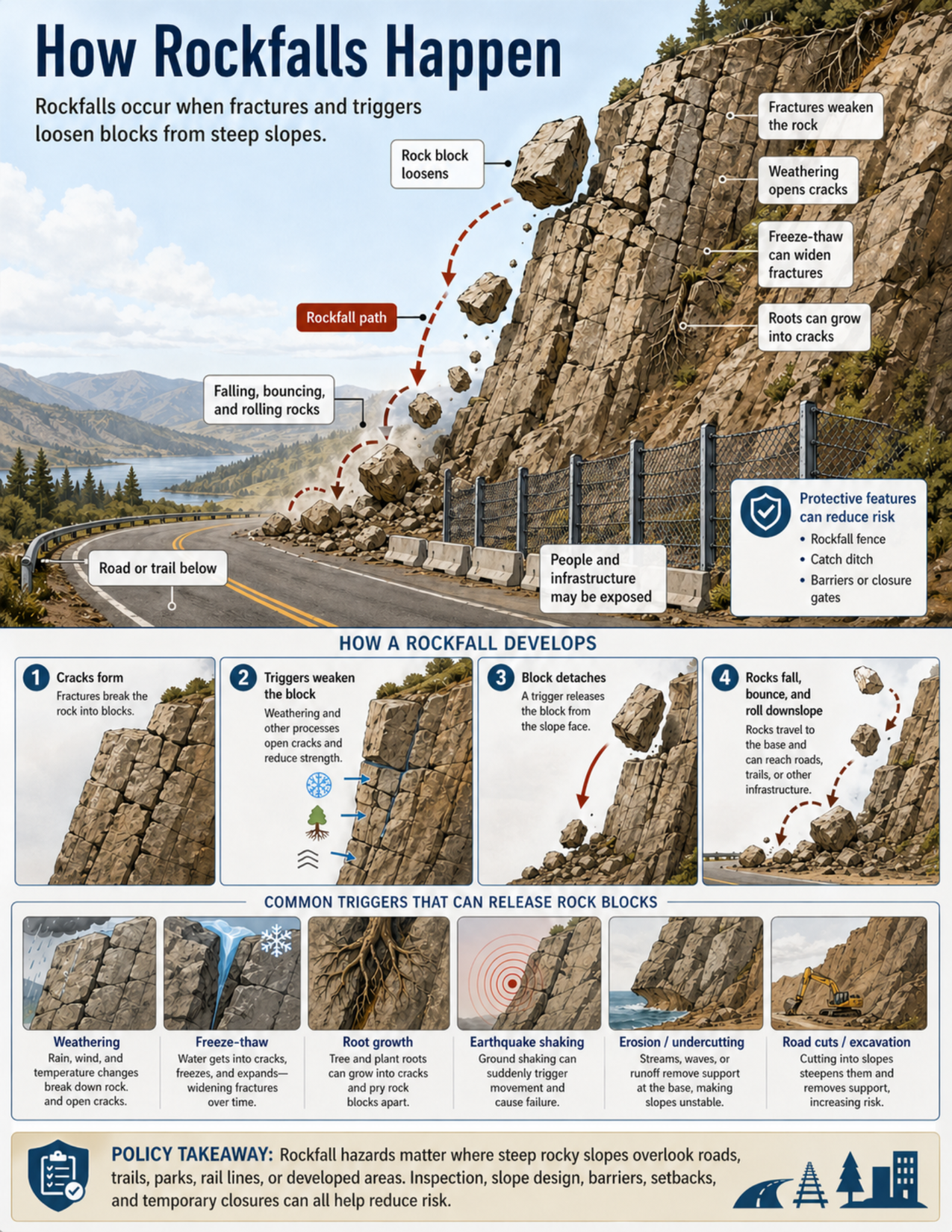
The visual shows a steep fractured rock slope above a road or trail. A loosened rock block has detached from the rock face and is falling downslope. Smaller rocks are shown bouncing and rolling along a marked rockfall path.
Labels identify several processes that can weaken or loosen rock blocks. Fractures divide the rock into blocks. Weathering opens cracks over time. Freeze-thaw can widen fractures when water enters cracks, freezes, and expands. Roots can grow into fractures and help pry rock apart. Earthquake shaking can trigger movement in blocks that are already weakened.
The visual also shows the area below the slope as part of the hazard zone. Rocks may not stop at the cliff base; they can bounce, roll, or scatter downslope toward roads, trails, rail lines, parks, developed areas, or other infrastructure.
A sequence panel explains how a rockfall develops: cracks form, triggers weaken the block, a block detaches, and rocks fall, bounce, and roll downslope. A trigger panel highlights weathering, freeze-thaw, root growth, earthquake shaking, erosion or undercutting, and road cuts or excavation.
Why this matters for policy
Rockfalls are often sudden. A rock face may look stable for long periods, then release blocks quickly when conditions change or a trigger occurs. This makes rockfalls important for transportation corridors, trails, parks, coastal bluffs, rail lines, steep road cuts, and developed areas below rocky slopes.
The hazard is not limited to the rock face itself. The area below the slope matters because falling rocks can bounce, roll, and travel outward. This is why road shoulders, trail segments, parking areas, rail corridors, and buildings at the base of steep slopes may require special attention.
Policy and management responses may include regular inspection, monitoring, slope scaling, rock bolting, rockfall fences, catch ditches, barriers, warning signs, setbacks, temporary closures, and maintenance of drainage or erosion controls. The appropriate response depends on the slope, rock condition, exposure below the slope, and likelihood of future rockfall.
Road cuts and construction can also change rockfall risk. Excavating into a slope can steepen the face, expose fractured rock, remove support, and increase the need for engineering review or protective design.
Key terms
Rockfall
A type of landslide in which rock blocks or fragments detach from a steep slope, cliff, bluff, or cut and fall, bounce, or roll downslope.
Fracture
A crack or break in rock. Fractures can divide rock into blocks that may later loosen and fall.
Weathering
The breakdown or weakening of rock by water, temperature changes, wind, chemical processes, roots, or other natural processes.
Freeze-thaw
A process where water enters cracks, freezes, expands, and helps widen fractures over time.
Undercutting
Removal of support at the base of a slope by waves, streams, runoff, erosion, or excavation.
Road cut
A slope or rock face created when a road is cut into hillside or bedrock. Road cuts can expose fractured rock and create steep faces.
Rockfall path
The area where falling rocks may travel as they fall, bounce, roll, or scatter downslope.
Catch ditch
A ditch or depression designed to catch falling rocks before they reach a road, trail, rail line, or other exposed area.
Rockfall fence
A protective barrier designed to intercept or slow falling rocks.
Slope scaling
The removal of loose or unstable rock from a slope, usually by trained crews, to reduce the chance of future rockfall.
Rock bolting
An engineering method that uses bolts or anchors to help secure unstable rock blocks to a slope face.
Questions policy staff can ask
- Are steep rocky slopes, cliffs, bluffs, or road cuts located above roads, trails, rail lines, parks, buildings, or public spaces?
- Are visible fractures, open cracks, overhangs, loosened blocks, or recent rockfall deposits present?
- Has the slope been affected by freeze-thaw, heavy rainfall, root growth, erosion, wildfire, or earthquake shaking?
- Has erosion or excavation removed support from the base of the slope?
- Did road construction or other excavation create a steep rock face?
- Where could falling rocks bounce, roll, or scatter after detaching?
- Are people, vehicles, trails, rail lines, utilities, buildings, or recreation areas located within the likely rockfall path?
- Are inspections or monitoring needed after storms, earthquakes, freeze-thaw periods, or visible cracking?
- Are protective measures such as catch ditches, barriers, rockfall fences, rock bolting, or slope scaling appropriate?
- Are warning signs, setbacks, temporary closures, or maintenance plans needed to reduce exposure?
Policy takeaway
Rockfalls are often sudden, localized hazards, but they can have serious consequences where steep fractured rock sits above roads, trails, or public spaces.
Main concept: Rockfalls occur when rock blocks or fragments detach from steep slopes, cliffs, bluffs, or road cuts and fall, bounce, or roll downslope.
Core message: The visual explains that rockfalls often begin where fractures or cracks already exist in the rock. Natural processes or human activity can weaken those fractures until a block is released.
Main rockfall scene: The visual shows a steep fractured rock face above a road or trail. A rock block has loosened from the slope face and is falling downslope.
Rockfall path: A dashed path shows rocks falling, bouncing, and rolling toward the base of the slope and the road or trail below.
Fractures: Fractures weaken the rock by dividing it into blocks. Many rockfalls begin where these cracks or breaks already exist.
Weathering: Weathering opens cracks and weakens rock over time through rain, wind, temperature change, and other surface processes.
Freeze-thaw: Water can enter fractures, freeze, expand, and widen cracks over time.
Root growth: Tree and plant roots can grow into cracks and help pry rock blocks apart.
Earthquake shaking: Ground shaking can dislodge blocks that were already weakened or partly detached.
Erosion and undercutting: Streams, waves, runoff, or erosion at the base of a slope can remove support and make the rock face less stable.
Road cuts and excavation: Cutting into slopes can steepen rock faces and remove support, increasing rockfall risk.
Exposure below the slope: The visual shows that people, roads, trails, parks, rail lines, buildings, and infrastructure below steep slopes may be exposed to falling, bouncing, or rolling rocks.
Protective features: The visual identifies rockfall fences, catch ditches, barriers, closure gates, and other protective measures as ways to reduce risk.
Policy connection: Inspection, monitoring, slope scaling, rock bolting, barriers, ditches, setbacks, warning signs, temporary closures, and maintenance planning can help reduce rockfall risk.
Policy takeaway: Rockfalls are often sudden, localized hazards, but they can have serious consequences where steep fractured rock sits above roads, trails, or public spaces.