
Why Water Is Often the Trigger for Slope Failure
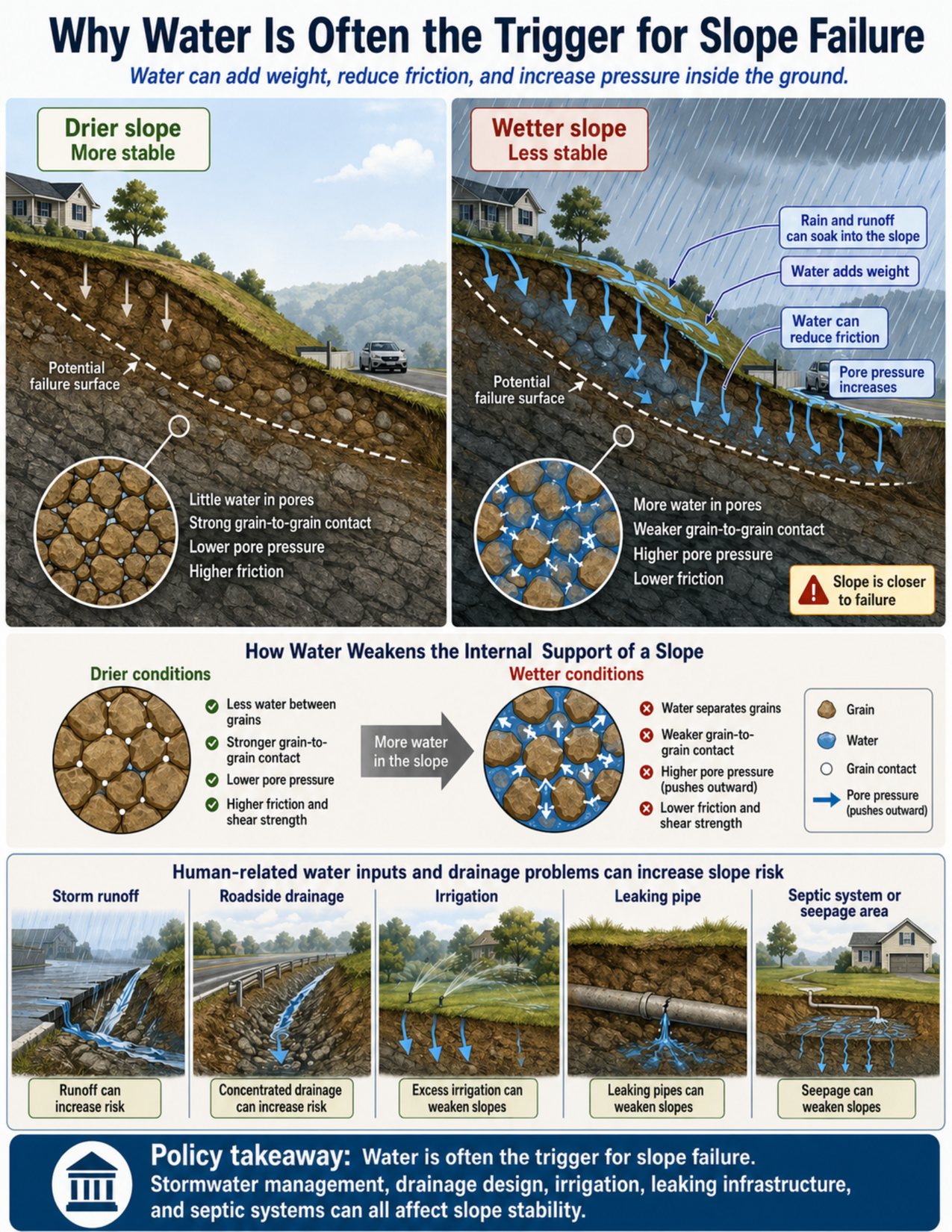
Shows how water can trigger slope failure by adding weight, reducing friction, and increasing pore pressure inside soil and rock.
Many slopes become unstable during or after heavy rainfall, but rain is not the only water source that matters. Storm runoff, poor drainage, irrigation, leaking pipes, and septic seepage can all add water to the ground and reduce slope stability.
This matters for land-use and infrastructure policy because drainage design, stormwater management, irrigation practices, utility maintenance, and septic systems can all affect whether a vulnerable slope remains stable or fails.
Download or reuse this guide in briefings and meeting materials.
Why Water Is Often the Trigger for Slope Failure
Many slopes become unstable during or after heavy rainfall because water changes how soil and rock behave. Water can add weight, reduce friction between particles, and increase pressure inside the spaces between grains or within cracks.
A slope may already be vulnerable because of its steepness, material strength, grading, or past movement. Water can be the trigger that shifts that slope from marginally stable to failing.
What the visual shows
The visual compares a drier slope with a wetter slope.
The drier slope is shown as more stable. It has little water in the pore spaces between grains, stronger grain-to-grain contact, lower pore pressure, and higher friction. These conditions help the slope resist movement.
The wetter slope is shown as less stable. Rain and runoff soak into the slope, and water moves downward through soil and rock. As more water enters the slope, it adds weight, reduces friction, and increases pore pressure. The wetter slope is shown as closer to failure.
The visual also includes magnified diagrams of the spaces between grains. Under drier conditions, grains are in stronger contact with one another. Under wetter conditions, water separates grains and pore pressure pushes outward, reducing the internal support of the slope.
The lower section shows human-related water sources that can also increase slope risk. These include storm runoff, roadside drainage, irrigation, leaking pipes, and septic systems or seepage areas.
Why this matters for policy
Water management is one of the most practical ways to reduce some slope-instability risks. Policy staff do not need to calculate pore pressure, but they do need to recognize that drainage, runoff, irrigation, and leaking infrastructure can affect slope safety.
Poor drainage can send water into places where it increases instability. Roadside drainage can concentrate flow onto a slope. Irrigation can add water gradually over time. Leaking pipes can saturate the ground below the surface before there are obvious signs at the ground surface. Septic systems and seepage areas can add water to slopes or shallow subsurface zones.
Stormwater policy, drainage design, grading standards, utility maintenance, septic-system review, and geotechnical review can all affect whether water is directed safely or allowed to weaken a vulnerable slope. These decisions matter for development permits, road maintenance, hillside infrastructure, emergency planning, and public communication.
Key terms
Pore pressure
The pressure of water in the spaces between soil grains or within cracks in rock. Higher pore pressure can push grains apart and reduce the strength of the slope.
Friction
Resistance to movement between particles or surfaces. Friction helps hold slope material in place, but water can reduce effective friction and make movement easier.
Grain-to-grain contact
The contact between soil or sediment particles. Stronger contact helps material resist movement. More water can weaken this contact.
Infiltration
The movement of water from the surface into soil, sediment, or rock.
Runoff
Water that flows over the land surface instead of soaking into the ground. Runoff can increase erosion or concentrate water in vulnerable areas.
Failure surface
The surface or zone along which soil, rock, or debris may slide or move.
Seepage
Slow movement of water through soil, sediment, rock, or infrastructure systems. Seepage can contribute to slope weakening if it adds water to vulnerable ground.
Questions policy staff can ask
- Where does stormwater go during heavy rainfall?
- Does drainage direct water onto, across, or into a slope?
- Are there road drains, culverts, ditches, or downspouts that discharge near a slope?
- Is irrigation adding water to a hillside or slope edge?
- Could leaking pipes, water lines, or stormwater infrastructure be adding water below the surface?
- Are septic systems or seepage areas located near slopes, bluffs, or unstable ground?
- Are there signs of wet ground, seepage, springs, cracks, bulging, or recent movement?
- Has the slope failed or moved before during wet periods?
- Is a geotechnical review needed to evaluate drainage, pore pressure, or slope stability?
- Are maintenance, monitoring, or drainage improvements needed before additional development or repair?
Policy takeaway
Water is often the trigger that turns a marginally stable slope into a landslide problem, which is why drainage and water management are central to land-instability policy.
Main concept: Water can trigger slope failure by adding weight, reducing friction, and increasing pore pressure inside the ground.
Core message: The visual explains that water is often the immediate trigger that turns an already vulnerable slope into a failing one.
Drier slope panel: The left side of the visual shows a drier slope that is more stable. It has little water in pores, stronger grain-to-grain contact, lower pore pressure, and higher friction.
Potential failure surface: Both slope panels show a dashed potential failure surface to indicate where slope material could move if conditions weaken enough.
Wetter slope panel: The right side of the visual shows a wetter slope that is less stable. Rain and runoff soak into the slope, water adds weight, friction is reduced, and pore pressure increases.
Water in pores: The magnified diagrams show how water fills spaces between grains. With less water, grains maintain stronger contact. With more water, contact weakens and pore pressure increases.
Pore pressure: Pore pressure is the pressure of water in spaces between grains or within cracks. Higher pore pressure can push grains apart and reduce the strength of the slope.
Friction: Friction helps resist movement between soil grains, rock surfaces, and possible failure surfaces. More water can reduce effective friction and make movement easier.
Slope closer to failure: The wetter slope panel shows that more water in the slope can bring it closer to failure, especially if the slope was already vulnerable.
Human-related water inputs: The guide identifies storm runoff, roadside drainage, irrigation, leaking pipes, and septic systems or seepage areas as water sources that can increase slope risk.
Drainage and infrastructure: Poorly routed runoff, concentrated drainage, leaking infrastructure, excess irrigation, and seepage can add water to slopes in ways that may not be obvious from the surface.
Policy connection: Stormwater management, drainage design, irrigation practices, utility maintenance, septic-system review, and development standards can all affect slope safety.
Policy takeaway: Water is often the trigger that turns a marginally stable slope into a landslide problem, which is why drainage and water management are central to land-instability policy.