
What Is Slope Creep?
Explains that slope creep is very slow downslope movement of soil and weathered rock that can cause long-term damage to roads, foundations, retaining walls, pipelines, and utilities.
Slope creep is a very slow form of ground movement. Soil and weathered rock can move downslope little by little over years or decades, often without a sudden collapse.
This matters for land-use and infrastructure policy because slow ground movement can create chronic maintenance costs, damage roads and utilities, and signal that a slope may not be fully stable even when it appears safe at first glance.
Download or reuse this guide in briefings and meeting materials.
What Is Slope Creep?
Slope creep is the very slow downslope movement of soil and weathered rock. It usually happens gradually over many years rather than as a sudden collapse.
Because slope creep is slow, it can be easy to overlook. But over time, small movements can bend trees, tilt fences, crack pavement, deform walls, damage utilities, and create repeated maintenance problems.
What the visual shows
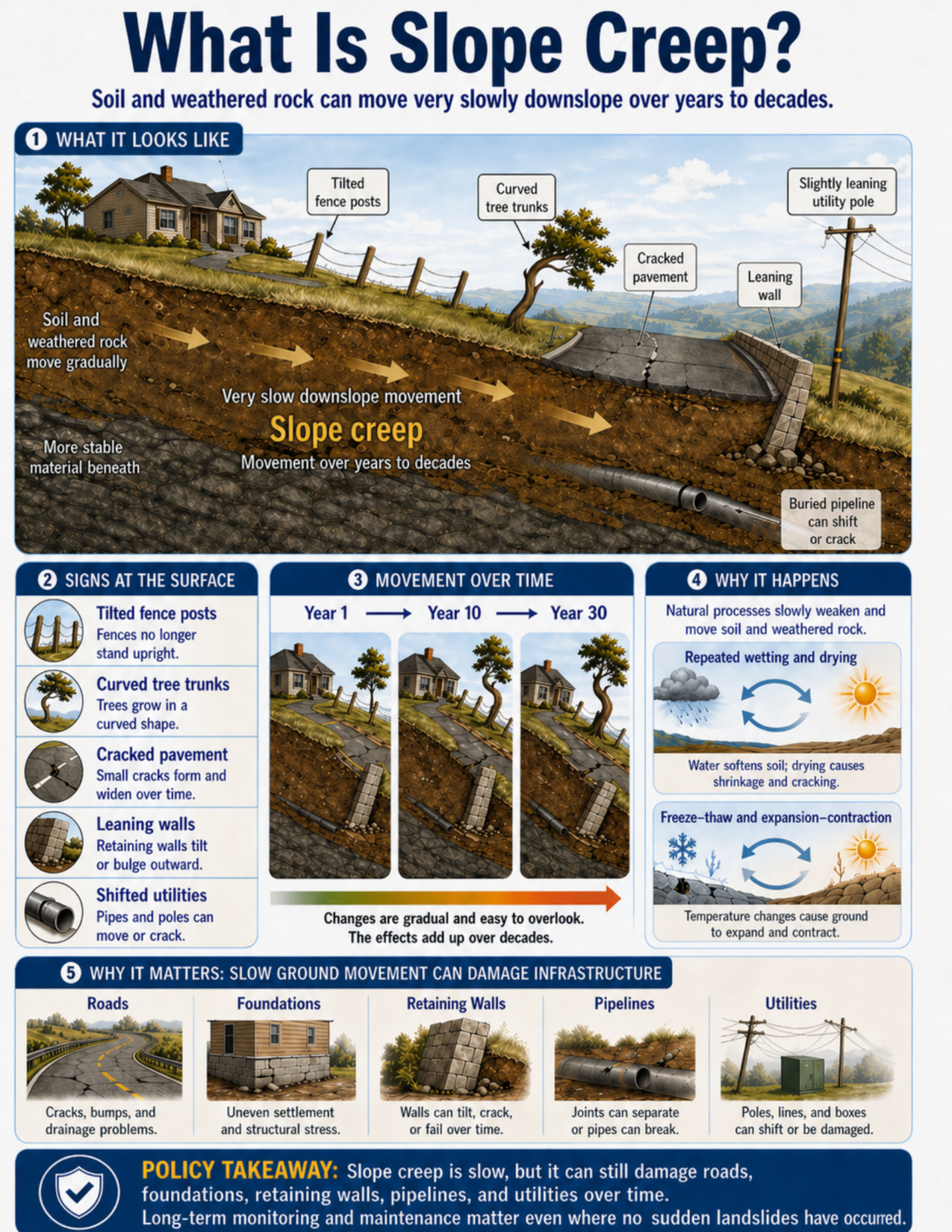
The visual shows a hillside cross-section where soil and weathered rock are moving slowly downslope above more stable material beneath. Arrows in the soil layer show the direction of gradual movement.
At the surface, the visual shows common signs of slope creep. Fence posts are tilted, tree trunks are curved, pavement is cracked, a retaining wall is leaning, a utility pole is slightly displaced, and a buried pipeline may shift or crack.
A timeline shows how slope creep can develop over time. In Year 1, the changes may be subtle. By Year 10, fence posts, walls, and pavement may show more visible deformation. By Year 30, the same slope can show greater bending, cracking, tilting, and displacement.
The visual also shows processes that can contribute to creep, including repeated wetting and drying, freeze-thaw, and expansion-contraction. These processes can slowly weaken and move soil and weathered rock.
Why this matters for policy
Slope creep is often not a sudden life-safety failure. Instead, it can be a slow, chronic hazard that creates long-term infrastructure and maintenance costs.
Roads may develop cracks, bumps, drainage problems, or repeated pavement failures. Foundations may experience uneven settlement or structural stress. Retaining walls may tilt, crack, bulge, or fail over time. Pipelines may separate at joints or break. Utility poles, lines, boxes, and buried infrastructure may shift or become damaged.
A site can appear stable while still undergoing slow movement. This makes slope creep important for maintenance planning, infrastructure budgeting, road design, utility management, and development review. Repeated repairs in the same location may be a clue that the underlying ground is moving rather than just a sign of normal wear.
Monitoring, drainage management, slope design, and geotechnical review can help agencies understand whether slow movement is occurring and how to reduce long-term damage.
Key terms
Slope creep
Very slow downslope movement of soil, weathered rock, or fill over years or decades.
Weathered rock
Rock that has been weakened or broken down by exposure to water, air, temperature changes, roots, or chemical processes.
Downslope movement
Movement in the direction of lower elevation, driven by gravity.
Freeze-thaw
A process where water freezes and expands, then thaws. Repeated freeze-thaw cycles can loosen soil and rock.
Wetting and drying
Repeated changes in soil moisture. Wetting can soften soil, and drying can cause shrinkage and cracking.
Expansion-contraction
Ground movement caused by materials expanding and shrinking as moisture or temperature changes.
Surface clues
Visible signs that may indicate slow ground movement, such as bent trees, tilted fence posts, cracked pavement, leaning retaining walls, or repeated damage.
Chronic maintenance problem
A recurring repair or infrastructure problem that continues over time because the underlying cause has not been addressed.
Geotechnical review
A technical evaluation of soil, rock, groundwater, slope conditions, and site stability, usually conducted by qualified professionals.
Questions policy staff can ask
- Are there surface clues such as tilted fence posts, bent or curved trees, cracked pavement, leaning walls, or shifted utilities?
- Has the same road, wall, pipe, foundation, or utility line required repeated repairs?
- Is the slope made of soil, weathered rock, fill, or other material that may slowly deform?
- Are drainage problems, seepage, wetting and drying, or seasonal moisture changes contributing to movement?
- Are freeze-thaw cycles, shrink-swell soils, or expansion-contraction likely at this site?
- Is the movement affecting roads, retaining walls, buildings, pipelines, utilities, or drainage systems?
- Is monitoring needed to determine whether movement is continuing?
- Would improved drainage, slope redesign, retaining-wall evaluation, or maintenance planning reduce damage?
- Is geotechnical review needed before additional development, repairs, or infrastructure investment?
- Are repeated maintenance costs a sign of slow ground movement rather than isolated infrastructure failure?
Policy takeaway
Slope creep is slow enough to be easy to overlook, but over time it can bend, crack, tilt, and damage infrastructure in ways that matter for planning, maintenance, and land use.
Main concept: Slope creep is the very slow downslope movement of soil and weathered rock over years or decades.
Core message: The visual explains that slope creep is gradual rather than sudden, but it can still damage infrastructure and create long-term land-management problems.
What it looks like: The main visual shows a hillside cross-section where soil and weathered rock move gradually downslope above more stable material beneath.
Slow movement: Subtle arrows show very slow downslope movement. The guide emphasizes that creep occurs over years to decades.
Surface signs: The visual identifies tilted fence posts, curved tree trunks, cracked pavement, a leaning wall, a slightly leaning utility pole, and a buried pipeline that can shift or crack.
Movement over time: The guide shows a sequence from Year 1 to Year 10 to Year 30, illustrating how small changes can accumulate and become more visible over decades.
Why it happens: Repeated wetting and drying can soften soil, shrink soil, and cause cracking. Freeze-thaw and expansion-contraction can also help move soil and weathered rock slowly downslope.
Infrastructure effects: The visual shows that slope creep can affect roads, foundations, retaining walls, pipelines, and utilities.
Roads: Slope creep can create pavement cracks, bumps, uneven surfaces, and drainage problems.
Foundations: Slow ground movement can contribute to uneven settlement and structural stress.
Retaining walls: Walls may tilt, crack, bulge, or fail over time.
Pipelines: Pipe joints can separate, and pipes can shift or break as the ground moves.
Utilities: Utility poles, lines, boxes, and buried systems can shift or become damaged.
Policy connection: Monitoring, drainage management, slope design, maintenance planning, and geotechnical review can help reduce long-term damage from slope creep.
Policy takeaway: Slope creep is slow enough to be easy to overlook, but over time it can bend, crack, tilt, and damage infrastructure in ways that matter for planning, maintenance, and land use.