
How Human Activity Can Destabilize Land
Explains how human activities such as grading, excavation, added fill, drainage changes, vegetation removal, mining, and groundwater pumping can increase land instability.
Land instability is not caused only by natural processes. Human activity can change slope angle, add weight, redirect water, reduce root support, or remove material that once helped support the ground.
This matters for policy because development, infrastructure, resource extraction, and water management decisions can unintentionally increase risk. Permitting, environmental review, construction standards, site inspections, maintenance, and enforcement all influence whether land is destabilized or protected.
Download or reuse this guide in briefings and meeting materials.
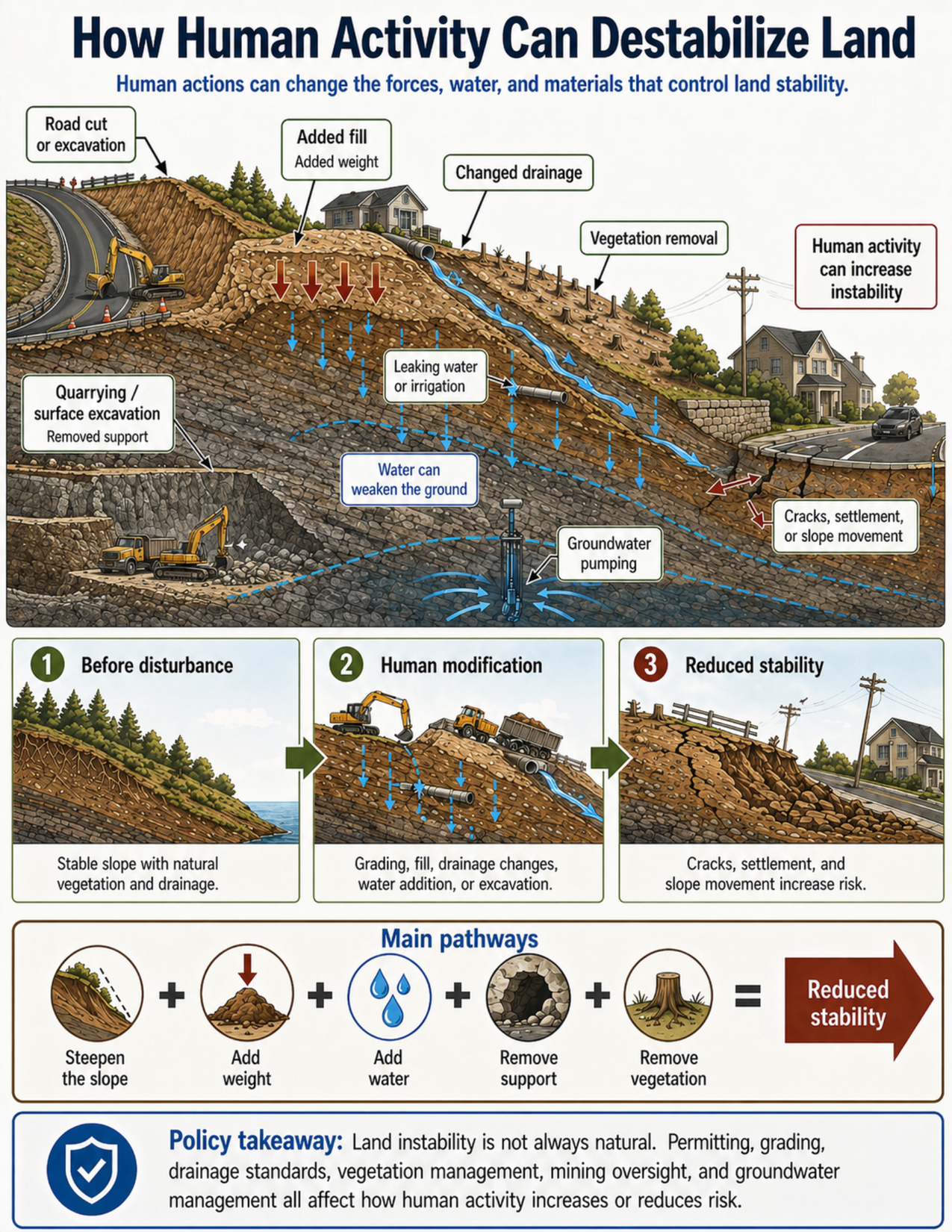
How Human Activity Can Destabilize Land
Land instability is not caused only by natural processes. Human activity can change slope angle, add weight, redirect water, reduce root support, or remove material that once helped support the ground.
Development and infrastructure decisions can make land more or less stable. Good policy can reduce avoidable risk by requiring site-specific review, drainage controls, appropriate slope design, maintenance, and monitoring.
What the visual shows
The visual shows a developed hillside and nearby residential area in cross-section. It highlights several ways human activity can reduce land stability.
A road cut or excavation has steepened part of the slope. Cutting into a slope for roads, building pads, utilities, or other construction can remove support and make the slope less stable.
Added fill has been placed near the top or middle of the slope. Fill can add weight to ground that may already be close to its stability limit.
Changed drainage sends water across and into the slope. Blue arrows show water moving through the ground. Drainage changes, irrigation, leaking pipes, septic systems, and concentrated stormwater can all increase water in the ground and reduce stability.
Vegetation has been removed from part of the slope. This can reduce root strength and increase runoff. Roots can help hold soil together, while vegetation can slow water moving across the ground surface.
The visual also shows quarrying or surface excavation removing support from the side of the slope. Mining, quarrying, and excavation can change slope shape and remove material that once helped hold the ground in place.
Groundwater pumping is shown in the lower part of the cross-section. In some settings, groundwater pumping can contribute to subsidence or other changes in land stability.
The right side of the visual shows cracks, settlement, and slope movement near a road, house, retaining wall, and utility lines. These features show how human-caused changes can affect infrastructure and communities.
Why this matters for policy
Land-instability problems may be described as natural hazards, but human decisions often affect whether the ground becomes more or less stable. Development, construction, road building, resource extraction, irrigation, stormwater management, and groundwater pumping can all change local conditions.
Some impacts appear quickly, such as a slope failing after excavation or a drainage change. Other problems may appear long after the original activity took place. A site may become vulnerable over years as fill settles, drainage systems fail, vegetation is removed, pipes leak, or groundwater levels change.
Permitting, environmental review, construction standards, site inspections, and enforcement all influence whether land is destabilized or protected. These tools can help identify slopes, soils, drainage conditions, and subsurface materials that need special attention.
Policy can reduce risk by requiring site-specific review where instability is possible. It can also require drainage controls, erosion control, slope design standards, vegetation management, inspection schedules, maintenance plans, and monitoring.
Human activity does not always increase risk. Well-designed projects can improve drainage, stabilize slopes, protect vegetation, manage groundwater, and reduce exposure. The key is to understand how each activity changes the forces, water, and materials that control land stability.
Key terms
Land instability
A general term for ground conditions that can lead to movement, settlement, cracking, slope failure, subsidence, or other ground problems.
Slope angle
The steepness of a slope. Steeper slopes are often more likely to move, especially when support is removed or water is added.
Road cut
A slope created by cutting into the ground to build a road. Road cuts can steepen slopes and expose weaker materials.
Excavation
Removal of soil, rock, or sediment for construction, utilities, mining, quarrying, or other purposes.
Added fill
Soil, rock, or other material placed on the ground to raise or reshape the land surface. Fill can add weight and may settle or move if not properly designed.
Drainage
The way water moves across or through the ground. Drainage changes can send more water into a slope or concentrate flow in one area.
Stormwater concentration
The focusing of runoff into a channel, pipe, ditch, or slope area. Concentrated stormwater can increase erosion and instability.
Root support
The strength that plant roots provide by helping hold soil together.
Removed support
Loss of material that once helped hold a slope or ground surface in place. This can happen through excavation, erosion, quarrying, or mining.
Groundwater pumping
Removal of water from underground aquifers or sediments. In some settings, pumping can contribute to subsidence or changes in ground stability.
Subsidence
Sinking or lowering of the land surface. Subsidence can occur when underground materials compact or support is reduced.
Site-specific review
Evaluation of the actual ground, slope, drainage, and infrastructure conditions at a location before construction, permitting, or major land-use decisions.
Questions policy staff can ask
- Could the proposed activity steepen a slope, remove support, or add weight?
- Will grading, excavation, road cuts, or building pads change slope forces?
- Is added fill planned, and has it been evaluated for stability and settlement?
- Could drainage changes send more water into or across a slope?
- Are irrigation, septic systems, leaking pipes, or stormwater systems adding water to unstable ground?
- Has vegetation been removed, and could that reduce root support or increase runoff?
- Are mining, quarrying, or excavation activities removing support from below or beside slopes?
- Is groundwater pumping occurring, and could it contribute to subsidence or other land-stability changes?
- Could instability appear years after construction or resource extraction?
- Are site inspections, maintenance, and monitoring required after construction?
- Do permitting, environmental review, construction standards, and enforcement address land-instability risk?
- Are drainage controls, slope design standards, vegetation management, and maintenance plans included in project approvals?
Policy takeaway
Human activity can unintentionally create land-instability problems, which is why permitting, design standards, review, and enforcement are important tools for reducing avoidable risk.
Main concept: Human activity can increase land instability by changing slope shape, ground loading, water movement, vegetation cover, and subsurface support.
Core message: The visual explains that instability is not always purely natural. Development, grading, excavation, drainage changes, vegetation removal, surface extraction, and groundwater pumping can all change the forces and materials that keep land stable.
Main landscape: The main panel shows a hillside and developed area in cross-section. Road cuts, added fill, changed drainage, vegetation removal, leaking water or irrigation, quarrying or surface excavation, and groundwater pumping are shown as examples of human activity that can reduce stability.
Road cuts and excavation: Cutting into a slope can steepen the slope and remove support.
Added fill: Fill can add weight to already marginal ground.
Water changes: Changed drainage, irrigation, leaking pipes, septic systems, and concentrated stormwater can add water to the ground and reduce stability.
Vegetation removal: Removing vegetation can reduce root strength and increase runoff.
Mining, quarrying, and excavation: Removing material from below or beside a slope can reduce support and increase instability.
Groundwater pumping: Pumping groundwater can contribute to subsidence or other changes in land stability in some settings.
Policy connection: Permitting, site-specific review, drainage controls, slope design, construction standards, inspections, enforcement, maintenance, and monitoring can help reduce avoidable risk.
Policy takeaway: Human activity can unintentionally create land-instability problems, which is why permitting, design standards, review, and enforcement are important tools for reducing avoidable risk.