
Landslides Are Not All the Same
Explores the several kinds of ground movement which fall under the term landslide, including falls, slides, flows, spreads, and creep.
A landslide is not one single process. Falls, slides, flows, spreads, and creep move in different ways, occur in different settings, and create different kinds of risk for people, infrastructure, and land use.
This matters for policy because monitoring, warning systems, engineering design, setbacks, emergency response, and public communication should match how the ground is likely to move.
Download or reuse this guide in briefings and meeting materials.
Landslides Are Not All the Same
“Landslide” is an umbrella term for several kinds of slope or ground movement. Falls, slides, flows, spreads, and creep can move at different speeds, involve different materials, leave different warning signs, and create different impacts.
For policy staff, identifying the general type of movement is important because the appropriate response may differ. A fast-moving debris flow, a rockfall along a road, a lateral spread near a riverbank, and slow creep beneath infrastructure do not require the same monitoring, design, warning, or land-use decisions.
What the visual shows
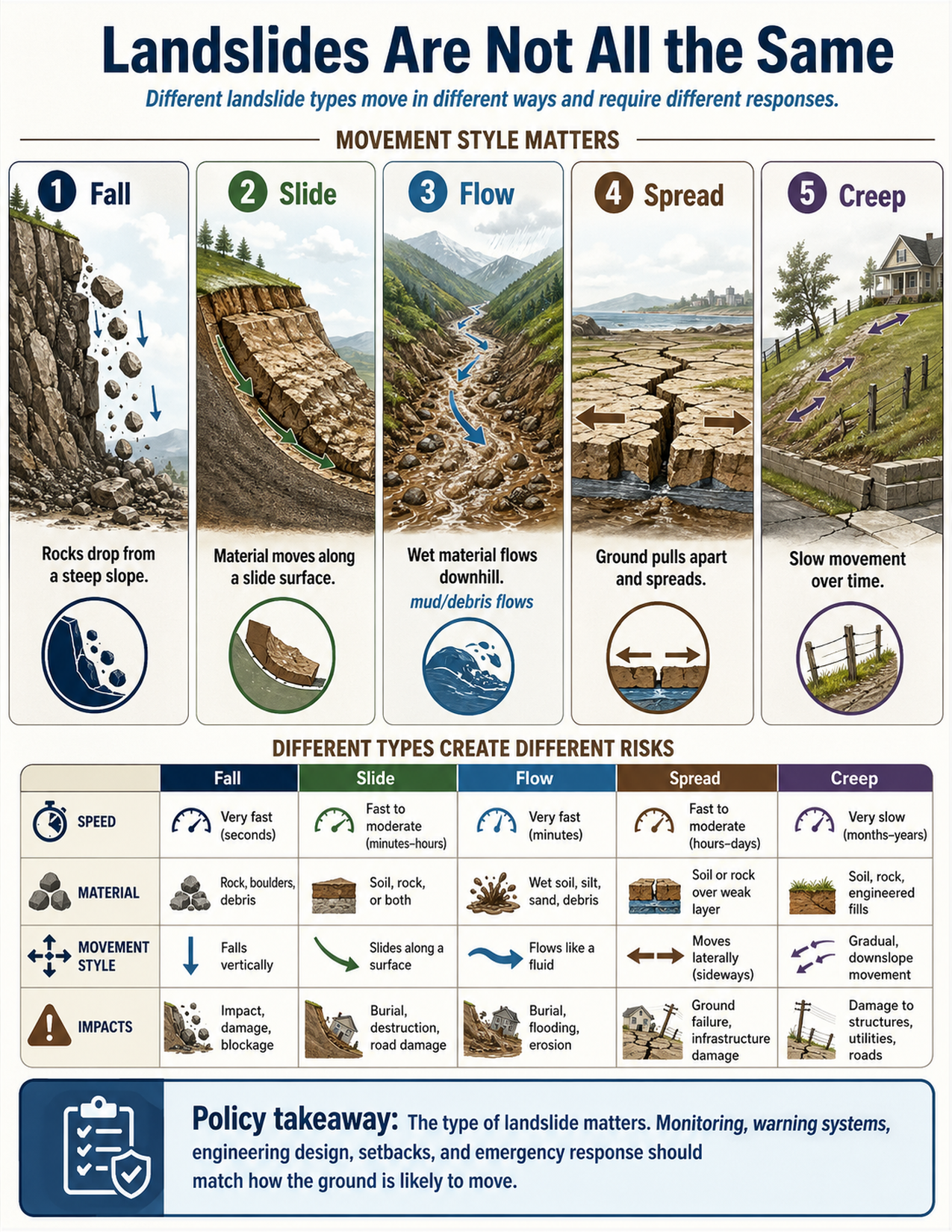
The visual compares five common types of landslide movement: fall, slide, flow, spread, and creep.
A fall occurs when rock or debris drops from a steep slope, cliff, bluff, or road cut. The material moves mostly downward through the air or by bouncing and rolling after detachment.
A slide occurs when a mass of soil, rock, or debris moves along a distinct failure surface. The moving material may remain partly intact as it travels downslope.
A flow occurs when water-rich soil, mud, sediment, or debris moves more like a thick fluid. Flows can move quickly, especially when they are concentrated in channels or gullies.
A spread occurs when ground pulls apart and moves sideways, often over a weak, soft, or liquefied layer. Spreads may occur on gentle slopes or near riverbanks, shorelines, canals, ports, or filled ground.
Creep is very slow downslope movement that can continue over years or decades. It may appear as tilted fence posts, bent trees, cracked pavement, leaning retaining walls, or repeated damage to roads and utilities.
The visual also summarizes how these types differ by speed, material, movement style, and impacts.
Why this matters for policy
Different landslide types create different management challenges. Some are sudden life-safety hazards, while others mainly create long-term maintenance and infrastructure problems.
Rockfalls can threaten transportation corridors, parks, trails, rail lines, and facilities below steep rock slopes. Responses may include inspection, slope scaling, barriers, ditches, warning signs, or temporary closures.
Slides can affect hillsides, road cuts, developed slopes, and areas with weak layers or poor drainage. Responses may include setbacks, slope-stability review, drainage control, retaining structures, or limits on grading and fill.
Flows, including mudflows and debris flows, can move quickly and travel through channels beyond the place where failure starts. Responses may include warning systems, evacuation planning, road closures, post-fire hazard assessment, culvert review, and public communication about flow paths.
Spreads can damage infrastructure even where land is not steep. They are especially important near riverbanks, shorelines, ports, levees, bridges, pipelines, and filled ground. Responses may include seismic and geotechnical review, setback decisions, ground-improvement measures, and lifeline-infrastructure planning.
Creep can be easy to overlook because it is slow. Over time, however, it can damage roads, foundations, retaining walls, pipelines, utilities, and other infrastructure. Responses may include monitoring, maintenance planning, drainage improvements, and geotechnical evaluation.
Understanding the type of movement helps agencies choose responses that match the actual hazard rather than treating all landslides as if they behave the same way.
Key terms
Landslide
A general term for the movement of rock, soil, sediment, debris, or fill downslope or outward under the influence of gravity.
Fall
A type of landslide in which rock or debris drops, bounces, or rolls from a steep slope, cliff, bluff, or cut.
Slide
A type of landslide in which a mass of soil, rock, or debris moves along a distinct surface or zone of weakness.
Flow
A type of landslide in which water-rich soil, mud, sediment, or debris moves like a thick fluid.
Spread
A type of ground movement in which material extends, cracks, and moves sideways, often over a weak, soft, or liquefied layer.
Creep
Very slow downslope movement of soil, rock, or fill over long periods of time.
Failure surface
The surface or zone along which soil, rock, or debris moves during a slide.
Runout
The distance landslide material travels from where it begins moving.
Warning signs
Observable features that may indicate movement or instability, such as cracks, tilted trees, bulging ground, leaning walls, seepage, or repeated pavement damage.
Questions policy staff can ask
- What type of ground movement is most likely at this site: fall, slide, flow, spread, creep, or a combination?
- Is the concern a sudden life-safety hazard, a long-term infrastructure problem, or both?
- How fast could the material move?
- How far could the material travel from the source area?
- What materials are involved: rock, soil, debris, water-rich sediment, weak layers, liquefied layers, or engineered fill?
- Are there warning signs such as cracks, bulging, tilted trees, leaning walls, seepage, or repeated road damage?
- Are people, roads, utilities, buildings, trails, bridges, or other assets located in the likely movement path?
- Do existing maps identify the area as susceptible to landslides, debris flows, rockfalls, liquefaction, or spreading?
- What monitoring, setbacks, drainage controls, engineering measures, closures, or warning systems are appropriate for this type of movement?
- Is geotechnical review needed before development, repair, road work, or infrastructure investment?
Policy takeaway
Calling something a “landslide” is only the first step. The type of movement affects how risk is assessed, communicated, and managed.
Main concept: Landslide is an umbrella term for several types of ground movement, including falls, slides, flows, spreads, and creep.
Core message: The visual explains that different landslide types move in different ways and require different policy, engineering, monitoring, and emergency-management responses.
Fall panel: The fall panel shows rock fragments dropping from a steep cliff or slope. Falls can happen very quickly and can affect roads, trails, buildings, and other infrastructure below steep rock faces.
Slide panel: The slide panel shows material moving along a distinct slide surface. Slides can involve soil, rock, debris, or a combination of materials.
Flow panel: The flow panel shows wet soil, mud, sediment, or debris moving downhill like a thick fluid. Flows can move rapidly through channels or across slopes.
Spread panel: The spread panel shows ground pulling apart and moving sideways, often over a weak or liquefied layer. Spreads can affect gentle slopes, riverbanks, shorelines, filled ground, and infrastructure corridors.
Creep panel: The creep panel shows slow movement over time. Creep can bend trees, tilt fence posts, crack pavement, damage retaining walls, and create long-term infrastructure problems.
Movement style: The guide emphasizes that movement style matters. A rockfall, slide, debris flow, spread, and creep do not create the same warning signs, speeds, runout patterns, or damage types.
Speed differences: Some landslides can happen very quickly, such as falls and debris flows. Others can happen more slowly, such as creep.
Material differences: Landslides may involve rock, boulders, soil, sediment, debris, water-rich material, weak layers, liquefied layers, or engineered fill.
Impact differences: Different landslide types can cause impact damage, burial, flooding, erosion, ground cracking, infrastructure displacement, or long-term deformation.
Policy connection: Monitoring, warning systems, engineering design, setbacks, evacuation planning, maintenance, and risk communication may need to differ depending on the type of landslide.
Policy takeaway: Calling something a landslide is only the first step. The type of movement affects how risk is assessed, communicated, and managed.