

Geoscience FAQ
What are rare earth elements, and why are they important?
Information preserved from U.S. Geological Survey.
U.S. Geological Survey Rare Earth Statistics and Information
The rare earth elements (REE) are a set of seventeen metallic elements. These include the fifteen lanthanides on the periodic table plus scandium and yttrium.
Rare earth elements are an essential part of many high-tech devices. The U.S. Geological Survey Professional Paper 1802-O Rare-earth elements explains:
"Because of their unusual physical and chemical properties, the REEs have diverse defense, energy, industrial, and military technology applications. The glass industry is the leading consumer of REE raw materials, which are used for glass polishing and as additives that provide color and special optical properties to the glass. Lanthanum-based catalysts are used in petroleum refining, and cerium-based catalysts are used in automotive catalytic converters. The use of REEs in magnets is a rapidly increasing application. Neodymium-iron-boron magnets, which are the strongest known type of magnets, are used when space and weight are restrictions. Nickel-metal hydride batteries use anodes made of a lanthanum-based alloys.
China, which has led the world production of REEs for decades, accounted for more than 90 percent of global production and supply, on average, during the past decade. Citing a need to retain its limited REE resources to meet domestic requirements as well as concerns about the environmental effects of mining, China began placing restrictions on the supply of REEs in 2010 through the imposition of quotas, licenses, and taxes. As a result, the global rare-earth industry has increased its stockpiling of REEs; explored for deposits outside of China; and promoted new efforts to conserve, recycle, and substitute for REEs. New mine production began at Mount Weld in Western Australia, and numerous other exploration and development projects noted in this chapter are ongoing throughout the world."
Learn More:
- REE Background (Webpage), Wyoming State Geological Survey
A precise definition of rare earth elements (REEs) and in-depth discussion of how common REEs are, worldwide REE production, and current REE production.
- Rare Earths Statistics and Information (Website), U.S. Geological Survey
Portal for information on annual production, price, and use of rare earth elements since 1997, plus links to further information.
- The Rare Earth Elements - Vital to Modern Technologies and Lifestyles (Factsheet), U.S. Geological Survey
Factsheet on the origin, distribution, abundance, supply and demand, and uses of rare earth elements
- The Principal Rare Earth Elements Deposits of the United States—A Summary of Domestic Deposits and a Global Perspective (Report), U.S. Geological Survey
Non-technical report providing an overview of the basic geology of rare earth elements including U.S. deposits, current sources and domestic reserves, and principal rare earth deposits of the United States.
- Tracking the Global Supply of Critical Materials (Webinar), American Geosciences Institute
2018 webinar detailing efforts from the U.S. and European Union to monitor the global production, trade, and usage of critical raw materials; identify and quantify vulnerabilities in supply; and support co-operation on production, recycling, and substitution of key mineral resources
Explore Related FAQs
Are rare earth elements the only critical mineral resources?
U.S. Geological Survey
Open FAQHow do we use rare earth elements?
U.S. Geological Survey
Open FAQWhat are critical minerals, and why are they important?
U.S. Geological Survey
Open FAQWhich mineral commodities used in the United States need to be imported?
American Geosciences Institute
Open FAQExplore Geoscience Intersections
Browse related geoscience intersections pages connected to the topics covered in this FAQ.

Critical Minerals
Critical minerals are those that are essential to the economy and whose supply may be disrupted. Critical minerals also tend to be those on which a country is heavily import-reliant, so the minerals that are deemed critical will vary from country to country. Demand for many of these minerals has skyrocketed in recent years with the spread of high-tech devices that use a wide variety of materials.
Learn more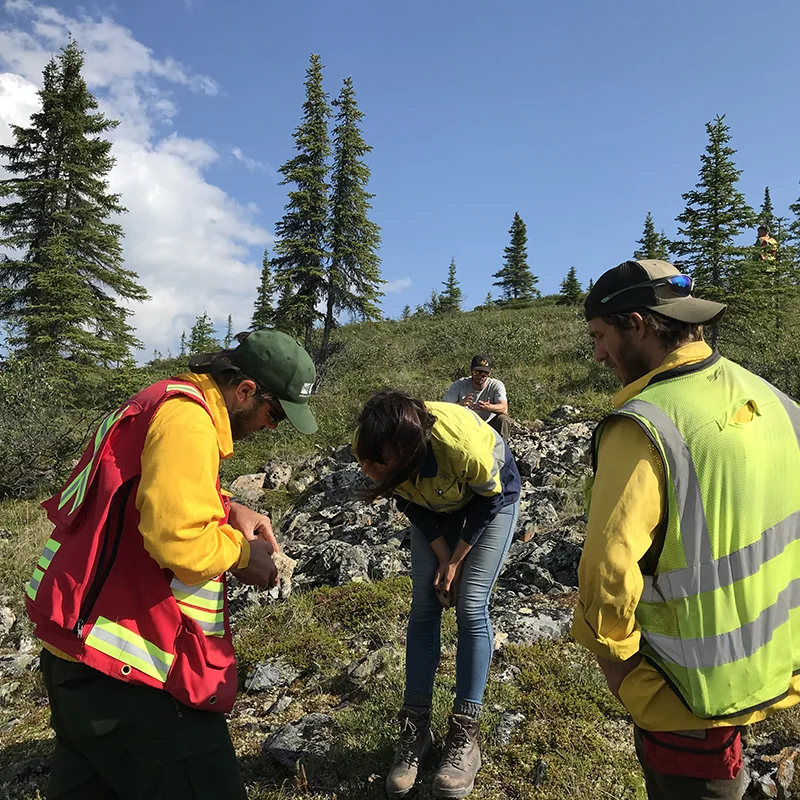
Mineral Resources
Global demand is rising for mineral resources of all kinds, including metals, industrial minerals, and solid fuels like coal. Mineral resources are unequally distributed around the globe, reflecting the vast differences in geology of different parts of the Earth. Geoscientists play an essential role in locating mineral resources and designing processes for their safe extraction.
Learn more